Image: Pexels, used under the Pexels License.
If you hire in Connecticut, the part of SB 5 that already applies to you is one sentence: since October 1, 2026, using an automated hiring tool is not a defense to a discrimination complaint. The notices most coverage talks about start a year later, on October 1, 2027. If you run a companion-style chatbot, your date is January 1, 2027. Everything else in the act lands on AI vendors, big image generators and frontier labs.
The bill passed the Senate 32-4 on April 21 and the House 131-17 on May 1, as CT Mirror reported. It became Public Act 26-15, titled "An Act Concerning Online Safety", and its signature line reads "Approved May 27, 2026". The other dates in law firm summaries come from the Governor's office: its bill notification of May 29 lists SB 5 among the bills signed "on May 27", and Governor Ned Lamont announced the signing at a June 2 event. So May 27 is the legal date; June 2 is the ceremony. Law firms also call it the CART Act (Connecticut Artificial Intelligence Responsibility and Transparency Act), a name that doesn't appear in the 74-page act.
Video: "Bill signing for legislation establishing youth online safety protections and AI regulations", Governor Ned Lamont's YouTube channel.What applies when
| Date | What starts | Who it's for | Sections |
|---|---|---|---|
| October 1, 2026 | Written key-terms notice before an AI subscription starts or renews | Subscription AI providers selling to Connecticut residents | Sec. 1 |
| October 1, 2026 | Whistleblower protections; anonymous internal reporting by January 1, 2027 for the largest labs | Frontier developers (over 10^26 operations); large ones over $500 million revenue | Sec. 2 |
| October 1, 2026 | Using an automated employment tool is not a defense to a discrimination complaint | Employers | Secs. 13, 14 |
| October 1, 2026 | Provenance data in generated audio, images and video | Generators with over 1 million monthly users, open to consumers | Sec. 15 |
| October 1, 2026 | Tell the Labor Department whether layoffs in a federal WARN notice relate to AI | Employers filing WARN notices | Sec. 26 |
| January 1, 2027 | Safety protocol, human-impersonation ban, AI notice, extra rules for minors | AI companion operators | Secs. 4-6 |
| October 1, 2027 | Disclosure and six-item pre-decision notice | Deployers of automated employment decision tools, and their developers | Secs. 8-10 |
Video: WTNH News8, "Connecticut Senate passes significantly amended AI regulation bill".
Hiring tools: one rule now, notices in 2027
The act defines an automated employment-related decision technology as anything that processes personal data and uses computation to produce an output that is "a substantial factor" in an employment decision, meaning it meaningfully alters the outcome. Word processors, spreadsheets and spam filters are out. So are decisions about scheduling, workplace safety and productivity monitoring, which the act carves out of "employment-related decision" by name. If an earlier guide told you your shift-scheduling tool is covered, it isn't.
What applies today is Sec. 13: "The use of an automated employment-related decision technology... shall not be a defense against a complaint alleging a discriminatory practice." The commission or a court may weigh your anti-bias testing, including its quality, recency, scope and results. That's not an audit mandate. It's a reason to have the file anyway.
From October 1, 2027, a deployer must disclose in plain language when an applicant or employee is interacting with such a tool, unless that's obvious, and must give a written notice before a decision with six items: that the tool is used, its purpose and the decision, its trade name, the categories of personal data and how they're assessed, the data sources, and contact details. Developers must hand deployers what they need for those notices if the tool was marketed or sold to influence employment decisions, and a developer can take the duties over by contract.
The act has no right to correct data, no appeal and no annual bias audit. Our Connecticut SB 5 employer checklist walks through the hiring sections step by step.
AI companion chatbots: January 1, 2027
Sections 4 to 6 cover "artificial intelligence companions": systems with a natural language interface that give human-like responses and can sustain a relationship across interactions. A customer-service or internal productivity bot that isn't marketed as a companion is excluded, as are narrow task tools, in-game bots and classroom tools.
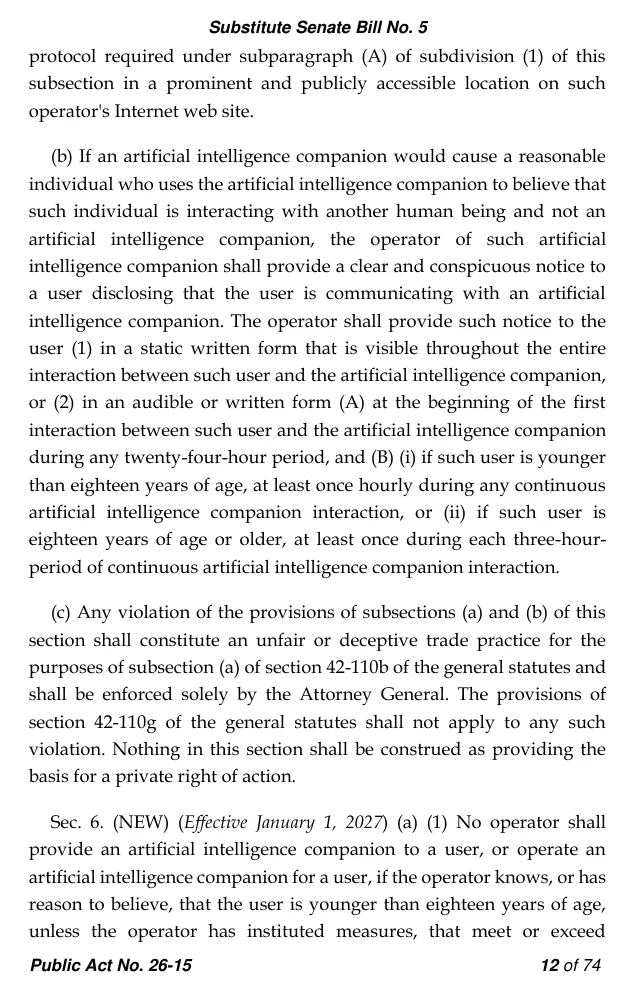 Screenshot: Public Act 26-15, page 12 (Secs. 5 and 6), Connecticut General Assembly.
If you operate one, you need:
- A protocol that detects expressions of suicide, self-harm or imminent violence, refers the user to resources including the 988 lifeline, and is posted on your website.
- Reasonable measures so the companion never claims to be human, even when asked.
- A clear notice that the user is talking to an AI, if a reasonable user could think otherwise. Either keep it visible for the whole session, or show it at the first interaction in any 24-hour period and then at least hourly for users under 18, or every three hours for adults.
- For users you know or have reason to believe are minors: measures that stop the companion encouraging self-harm, violence, disordered eating or drug and alcohol use, any romantic or sexual interaction, and eight listed manipulation tactics, plus screen-time and account tools for minors and parents.
Enforcement is by the Attorney General alone, as an unfair trade practice, and Sec. 5 states there's no private right of action. The earlier version of this guide said parents could sue directly for punitive damages. The enacted text doesn't say that.
Provenance data for big generators: October 1, 2026
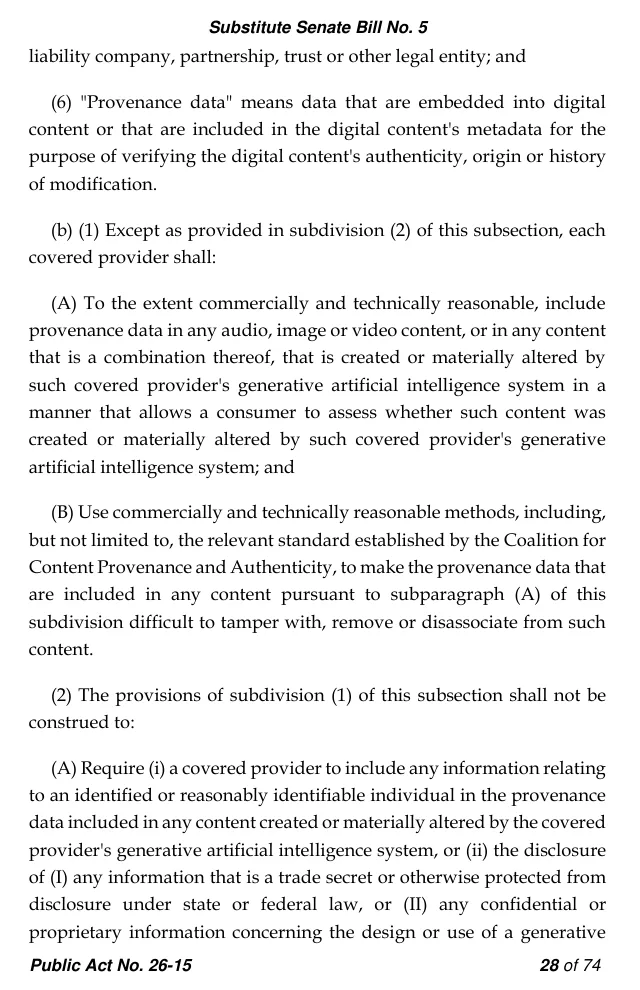 Screenshot: Public Act 26-15, page 28 (Sec. 15), Connecticut General Assembly.
Sec. 15 applies to "covered providers": whoever produces a generative system for images, audio or video that has more than one million users a month and is publicly accessible to consumers for personal use. To the extent commercially and technically reasonable, they must include provenance data that lets a consumer check whether content was created or materially altered by the system, and make it hard to strip, with the C2PA standard named as one method. Business-to-business use, video game experiences and pure upscaling or noise-reduction tools are excluded.
There is no second-stage watermarking rule for "all developers" in October 2027. That was in drafts we relied on earlier and isn't in the enacted act. If you only use these tools for marketing, the duty sits with your vendor.
Subscriptions, frontier labs and WARN notices
Subscription AI (Sec. 1). A provider can't start or renew a paid AI subscription with a Connecticut consumer unless it has given a written notice of key terms (usage limits, and whether it can cut or reduce functionality) and the consumer has accepted in writing.
Frontier developers (Sec. 2). A frontier developer trained a foundation model with more than 10^26 operations. It can't stop staff from reporting catastrophic-risk concerns and must post or send a notice of their rights. A large frontier developer (over $500 million in annual revenue) needs an anonymous internal reporting process by January 1, 2027. Penalties run up to $1,000 per violation, collected by the Attorney General.
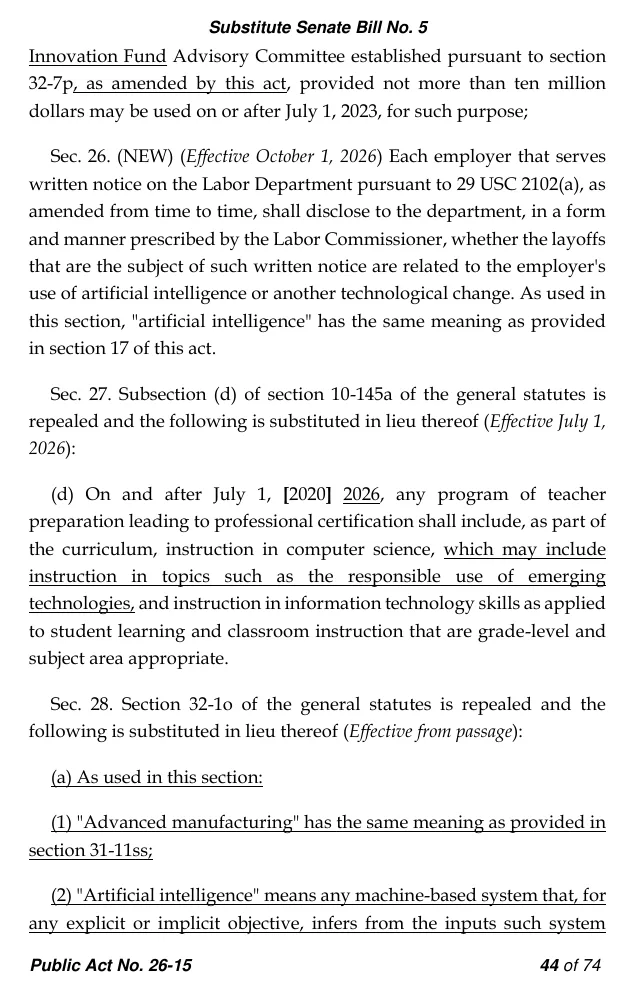 Screenshot: Public Act 26-15, page 44 (Sec. 26), Connecticut General Assembly.
WARN notices (Sec. 26). An employer that serves a notice on the Connecticut Labor Department under the federal WARN Act (29 USC 2102(a)) must say whether the layoffs relate to its use of AI or another technological change, in a form the Labor Commissioner sets. It rides on the federal threshold (employers with 100 or more employees). We found no separate penalty in Sec. 26.
Checklist by date
Now (in force since October 1, 2026):
- List every tool that scores, ranks or screens Connecticut applicants or staff, and keep its anti-bias testing results on file.
- Add an "AI or other technological change?" field to your WARN notice template.
- If you sell AI subscriptions to Connecticut consumers, put the key-terms notice and written acceptance into checkout and renewal.
- If you buy image, audio or video generation, ask the vendor whether it's a covered provider and how it embeds provenance data.
Before January 1, 2027:
- Decide whether your chatbot is a companion under Sec. 4 or falls in an exclusion, and write down why.
- If it's a companion: publish the safety protocol, block "I'm human" answers, and set the notice to always-on or hourly for minors and every three hours for adults.
Before October 1, 2027:
- Draft the plain-language disclosure and the six-item pre-decision notice.
- Get your hiring-tool vendor's information for those notices in writing, or a contract clause where the vendor takes the notices over.
Our take
We'd spend the first hour on the hiring-tool inventory and the bias file, because that's the one piece already live for ordinary employers and it's what the act tells the commission or a court it may weigh. The companion rules matter only if you sell something people talk to for company. For everyone else, SB 5 is mostly a set of questions to put to vendors.
How we checked this: on October 13, 2026 we read Public Act 26-15 from the Connecticut General Assembly PDF (Secs. 1, 2, 4 to 15 and 26) and took the three screenshots above, checked the vote dates on the legislature's bill status page, and compared the votes and signing date with CT Mirror and the Ropes & Gray and Ogletree summaries. On October 15, 2026 we matched the signing date against the Governor's bill notification and June 2 press release. Last reviewed: October 13, 2026.
Correction (October 13, 2026): Earlier versions of this guide said the employment notices, data correction rights and an all-developer watermarking rule apply from 2026 or 2027, that scheduling tools are covered, that parents can sue over companion chatbots with no cure period, that the AG can impose $5,000 per violation, and that the bill passed on May 11. None of that matches the enacted act. The dates and duties above follow Public Act 26-15; May 11 is the day it got its Public Act number.
Related Reading
- Connecticut SB 5 AI Employer Checklist: 10 Steps
- AI hiring tool compliance 2026, NYC, Illinois, Connecticut, Colorado matrix
- Colorado Chatbot Safety Act (HB 26-1263): Compliance Guide 2027
- Rhode Island Just Passed 3 AI Laws With a $15,000-a-Day Penalty
- AI employee monitoring disclosure laws 2026: state-by-state tracker
- Connecticut Data Privacy Law Expands July 1: CTDPA SB 4 Small Team Compliance
- AI vendor due diligence checklist 2026
- Texas TRAIGA compliance checklist 2026
- Colorado AI Act Compliance: What SB 26-189 Requires in 2027
- Washington AI Likeness Law (SSB 5886, effective June 11, 2026): Compliance Checklist
- Maryland Surveillance Pricing Law 2026
- EU AI Act compliance guide for small teams