Image: Unsplash.
If your team has cloned a spokesperson's voice or put a real face into an AI-made ad, Washington now lets that person sue unless they said yes. SSB 5886 isn't a stand-alone deepfake statute. It amends the state's personality rights law, RCW 63.60, so a "forged digital likeness" sits next to name, voice, signature, photograph and likeness in the list of things you can't use commercially without consent. We read the enacted text, both legislative bill reports and the exemptions section the bill left alone. Here's what it covers, what it doesn't, and a checklist plus a consent clause you can paste into talent and agency contracts.
What changed
The Senate passed the bill 47-0 on February 5, the House 85-9 on March 4, and Governor Bob Ferguson signed it on March 16, 2026 as Chapter 69, Laws of 2026. "As technology evolves, so do the risks of having someone's image or voice used without their permission," the prime sponsor, Senator Matt Boehnke, said in his signing release. It took effect in June. Four sections of RCW 63.60 changed:
| Item | Before SSB 5886 | After SSB 5886 |
|---|---|---|
| What is protected | Name, voice, signature, photograph, likeness | Adds "forged digital likeness" |
| Money owed for an infringement | The greater of $1,500 or actual damages, plus profits | A civil penalty of $3,000 and actual damages, plus profits not already counted |
| Extra damages for a forged digital likeness | None | Noneconomic damages, whether or not the infringement made a profit |
| Court orders | Injunctions; impounding during the case; destruction at judgment | Same, and injunctions now name forged digital likeness |
| Attorneys' fees | Prevailing party recovers | Unchanged (this cuts both ways: a defendant who wins recovers too) |
| Counting | One work is one act of infringement, however many copies | Unchanged |
Voice was already protected before this bill. What's new is the forged version: a fake that looks or sounds like the person, rather than a recording of them.
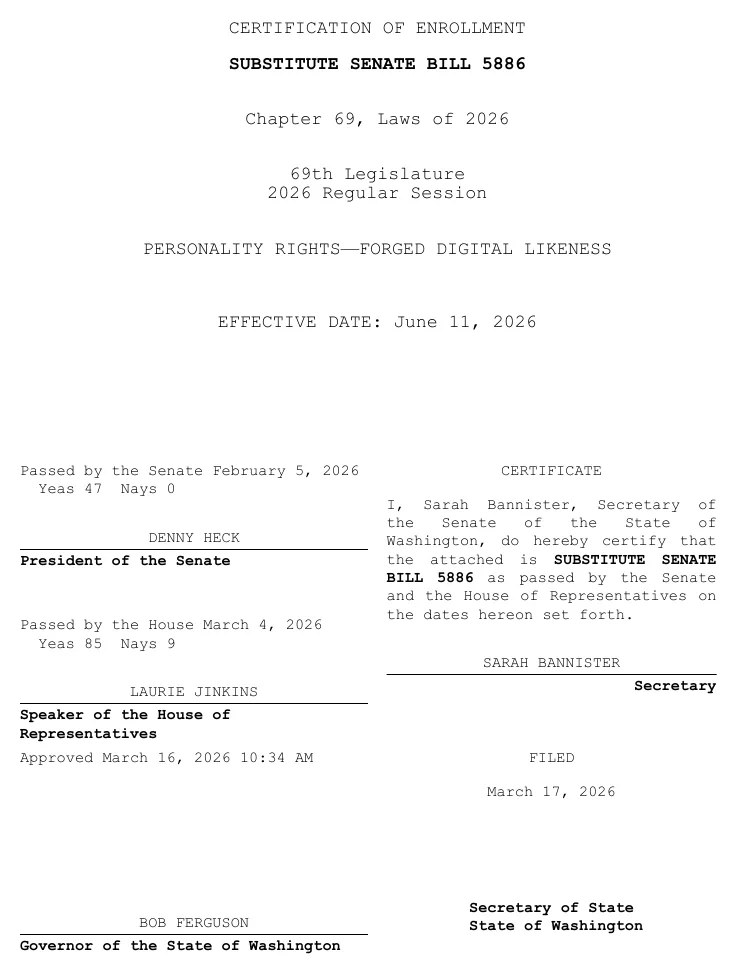
Screenshot: SSB 5886 session law, Chapter 69, Laws of 2026, Washington State Legislature.
What counts as a forged digital likeness
The definition, in full (RCW 63.60.020(3)):
"Forged digital likeness" means a visual representation which is either persistent or transmitted in real-time of an actual and identifiable individual, or an audio recording which is either persistent or transmitted in real-time of an actual and identifiable individual's voice, which: (a) Has been digitally created, adapted, altered, or modified to be indistinguishable from a genuine visual representation or audio recording of the individual; (b) Misrepresents the appearance, speech, or conduct of the individual; and (c) Is likely to deceive a reasonable person into believing that the visual representation or audio recording is genuine.
Three things stand out when you read it slowly:
- All three prongs must be met. A convincing clone that shows the person doing exactly what they did isn't "misrepresenting" anything. An obvious cartoon won't deceive a reasonable person. Both can still be a plain "likeness" or "voice", which the law protected long before 2026.
- Live counts. "Transmitted in real-time" pulls in avatars on sales calls and webinars. Supporters told the House committee that the real-time wording was added "because of the alarming rise in real-time cloning of likenesses in the commission of crimes using tools like Zoom."
- The tool doesn't matter. The words "artificial intelligence" don't appear anywhere in the enacted text. The test is the result ("digitally created, adapted, altered, or modified"), so a hand-edited composite counts the same as a generated one.
Who it applies to, and who it doesn't
The infringement section (RCW 63.60.050) reaches anyone who "uses or authorizes the use" of a protected attribute in one of three settings:
| Setting | Statutory wording |
|---|---|
| Products | "on or in goods, merchandise, or products entered into commerce in this state" |
| Advertising | "for purposes of advertising products, merchandise, goods, or services", or disseminating or publishing such ads in Washington |
| Fundraising | "for purposes of fund-raising or solicitation of donations" |
Two details matter for small teams. "Authorizes the use" means the brand that signs off on an agency's AI ad is in the frame, not only the agency. And the law applies "without regard to whether the use or activity is for profit or not for profit", so a nonprofit's donation video is covered.
Consent can be "written or oral, express or implied." The law doesn't demand paper. We'd still get it in writing, because an implied or oral yes is very hard to prove once the person says they never gave it.
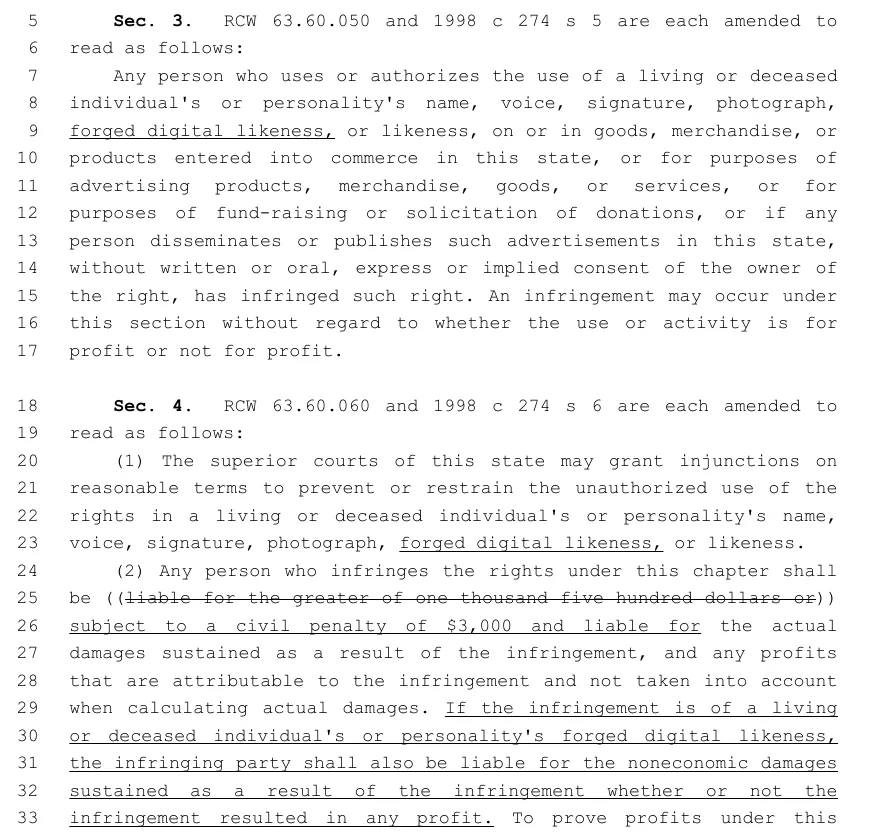
Screenshot: SSB 5886 session law, page 4, sections 3 and 4, Washington State Legislature.
What the law leaves out is just as useful to know. RCW 63.60.070, which SSB 5886 didn't amend, says:
- Public-interest uses need no consent: matters of "cultural, historical, political, religious, educational, newsworthy, or public interest", including "comment, criticism, satire, and parody". There's no labeling requirement in the text.
- Films, TV, news, sports and political campaigns are outside the chapter, unless a campaign falsely claims an endorsement.
- Media owners aren't liable for running the ad. The infringement section "does not apply to the owners or employees of any medium used for advertising", and the list includes "online service providers", unless the ad promotes the medium itself.
- Incidental or de minimis uses are exempt, and class actions are barred: each person sues for themselves.
One catch: the exemptions are written for "name, voice, signature, photograph, or likeness." None of them mentions a forged digital likeness, because the bill didn't touch that section. Cooley's April analysis lists how the law will interact with First Amendment protection for satire, parody and commentary as an open question. Don't build a parody campaign around a real person's cloned voice on the assumption the exemption covers you.
There's also no attorney general role, no labeling duty and no platform takedown duty anywhere in the four sections. Remedies come through a lawsuit brought over the infringed right.
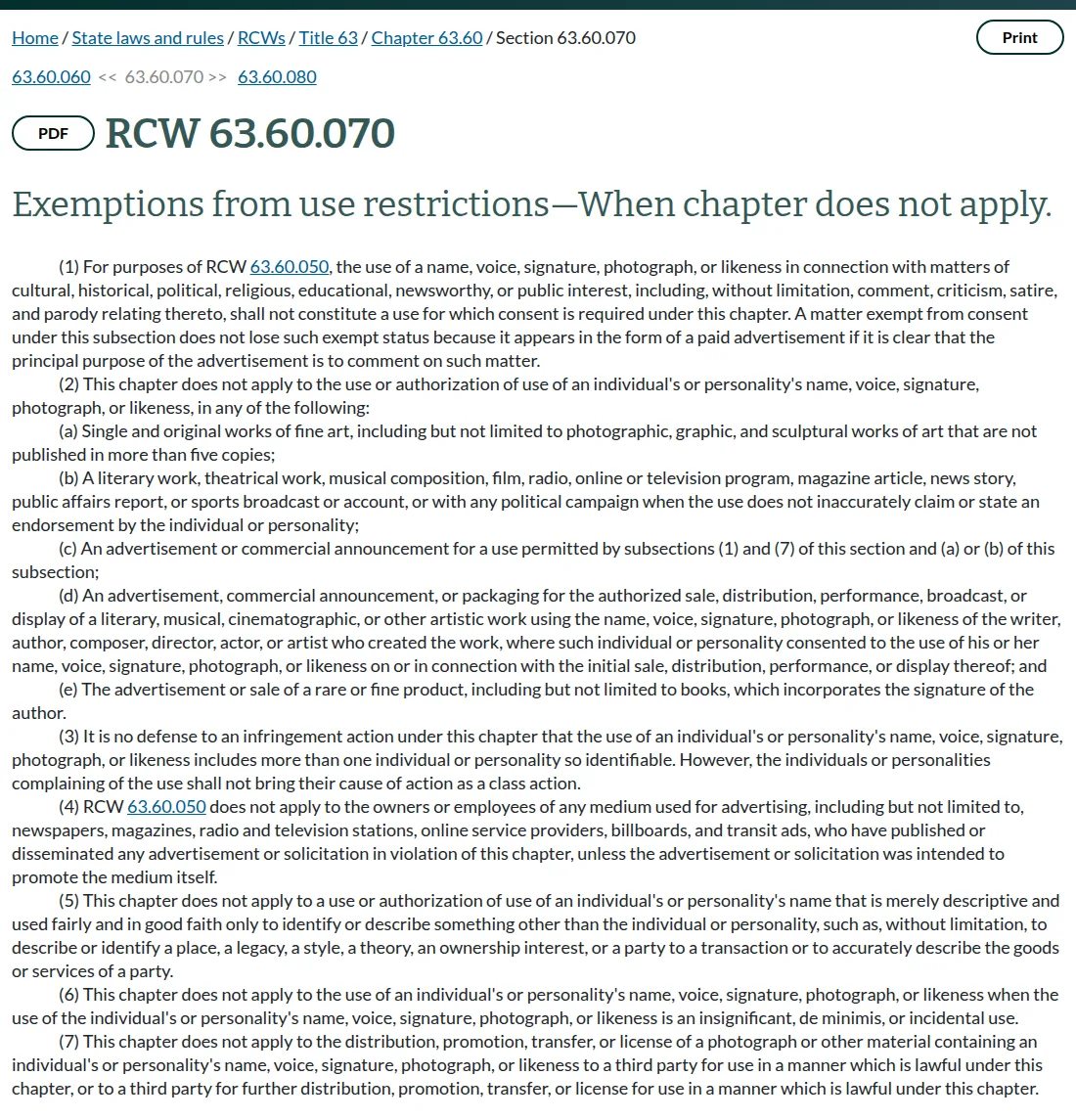
Screenshot: RCW 63.60.070, Washington State Legislature, checked October 16, 2026.
What this law doesn't cover
Sexual deepfakes and criminal fakes sit in other Washington statutes, and federal law adds a takedown clock:
| Law | What it does | In force |
|---|---|---|
| HB 1999 (Chapter 88, Laws of 2024) | Crime of disclosing fabricated intimate images (a gross misdemeanor on a first offense) and a civil claim for the person depicted. For that claim, consent counts only in a plain-language written agreement the person signed | June 6, 2024 |
| HB 1205 (Chapter 51, Laws of 2025) | Criminal impersonation in the second degree, a gross misdemeanor: knowingly distributing a forged digital likeness as genuine "with intent to defraud, harass, threaten, or intimidate". Interactive computer services aren't liable solely for other people's content | July 27, 2025 |
| TAKE IT DOWN Act (Public Law 119-12) | Federal offense to knowingly publish an intimate digital forgery of an identifiable adult without consent where publication is meant to cause, or causes, harm; covered platforms must remove reported depictions within 48 hours, with the FTC enforcing the takedown duty | Signed May 19, 2025; platforms had one year to set up the process |
If your product lets users generate images of real people, those are the laws that put duties on you. SSB 5886 is about what your own marketing does with someone else's face and voice. Our TAKE IT DOWN Act guide covers the platform side.
The checklist
- 1. List every asset with a real, identifiable person in it. Ads, product pages, packaging, merchandise, donation appeals, sales-call avatars. Include assets where AI edited a real recording, not only fully generated ones.
- 2. Mark which ones are forged. Does the asset show or say something the person didn't actually do or say, convincingly enough to pass as real? Those carry the noneconomic-damages exposure.
- 3. Find the consent for each one. Note who gave it, when, and for what. Implied or oral consent is legal; write down how you'd prove it, or replace it with a signed version.
- 4. Check who owns the right. The right is "freely transferable, assignable, and licensable", so a talent agency or estate may hold it. For someone who has died, it runs ten years after death, or 75 years if their name or likeness had commercial value.
- 5. Re-read old talent releases. A release signed for a photo shoot may not mention digital alteration. Cooley's advice is blunt: existing consent language "may not be sufficient to cover AI-generated digital likenesses under the new statutory definition."
- 6. Put the consent duty on your agency in writing. Because "authorizes the use" reaches you, require any agency or freelancer to deliver the consent record with every asset featuring a real person.
- 7. Don't lean on the satire exemption for clones. If the creative depends on a real person's forged voice or face, get consent or a lawyer's sign-off first.
- 8. Have a pull-down plan. Courts can impound and order destruction of infringing material. Know who can stop a campaign across every channel the same day a complaint lands.
A consent clause you can adapt
The clause mirrors the statute's own words so nobody can argue later that "likeness" didn't include a forged one. Have counsel adapt it to your contracts.
AI likeness consent

[Name] ("Talent"), as owner of the rights in Talent's name, voice,
photograph and likeness, consents to [Company] and agencies acting on
its behalf creating and using visual representations and audio
recordings of Talent that are digitally created, adapted, altered or
modified, including representations transmitted in real time, for:

  Purpose:  [advertising of named products/services | packaging |
             fundraising]
  Media:    [web, social, video, audio, live sales calls]
  Scripts:  only content approved by Talent under [approval process]
  Term:     [start date] to [end date]
  Payment:  [fee or "included in fee under agreement dated ..."]

Talent may withdraw this consent for new uses by written notice to
[contact]. [Company] will stop new publication of affected material
within [N] business days of receiving notice.

Signed: ____________________   Date: __________
How to fill it in: name the owner of the right, which may be an estate or an agency rather than the person. Keep "Purpose" narrow, because a yes for a product video isn't obviously a yes for a fundraising appeal. Keep the approval step: it's what stops the clone from saying things the person never agreed to. The withdrawal line is our recommendation, not a statutory requirement.
What we could not confirm
The amended RCW 63.60.060 doesn't say who collects the civil penalty; the text gives a single figure next to actual damages. We found no court decision applying the amended law as of October 16, 2026, so how a court reads "likely to deceive a reasonable person" is untested. The sponsor's signing release and one law-firm summary say the law took effect June 10; the session law and the Legislature's bill page both say June 11, and that's the date we use.
Correction (October 16, 2026): We re-checked this post against the enacted text of SSB 5886 and rewrote it. Earlier versions said the law bans AI sexual deepfakes and deceptive AI media generally (it covers use in goods, advertising and fundraising; sexual deepfakes fall under HB 1999 of 2024), that consent must be written and that oral consent is not enough (the law accepts written or oral, express or implied consent), that the attorney general enforces it (the bill gives the attorney general no role), that platforms and distributors carry takedown and moderation duties (the bill has none, and RCW 63.60.070(4) exempts advertising media owners, including online service providers), that damages are statutory with a cap (a $3,000 civil penalty plus actual damages, profits and, for a forged digital likeness, noneconomic damages), and that the satire exception requires clear labeling (RCW 63.60.070 has no labeling requirement). An earlier version also gave the effective date as June 10, 2026; the Legislature's bill page lists June 11, 2026.
Related Reading
- Korea AI washing guidelines: virtual person labels and the KFTC ad checklist
- Deepfake CEO fraud: the Fideuram case and how small teams stop it
- Connecticut AI law 2026 compliance checklist
- Maryland AI pricing law 2026
- EU AI Act compliance guide for small teams
- AI governance for small teams: complete guide
- New York AI synthetic performer ad disclosure law, effective June 9 2026
- Tennessee ELVIS Act: AI voice and likeness compliance
- Denmark deepfake bill (Oct 8, 2026): consent and takedown kit
- Pennsylvania SB 806 AI Ad Disclosure: Text, $3,000 Fine, Checklist
- Kangana Ranaut deepfake order: what the Delhi High Court blocked