

Image: Unsplash.
You need this checklist if your company sells to Texans, does business in Texas, or builds or runs an AI system there. The Texas Responsible Artificial Intelligence Governance Act reaches all three, with no size threshold (HB 149, Sec. 551.002). Governor Abbott signed HB 149 on June 22, 2025, and it took effect January 1, 2026 (bill history).
For a private company the law asks for very little paperwork. It bans a short list of uses you'd have to intend, adds one disclosure duty for health care providers, and leaves enforcement to the Attorney General alone. What it doesn't do is hand you a safe harbor for adopting the NIST framework. Plenty of summaries say it does, and an earlier version of this page did too. The checklist below follows the enrolled text, section by section.
The checklist
1. Scope
- You promote, advertise or conduct business in Texas, produce a product or service used by Texas residents, or develop or deploy an AI system in Texas (Sec. 551.002). Any one of the three is enough.
- The system fits the definition: a machine-based system that "infers from the inputs the system receives how to generate outputs," such as content, decisions, predictions or recommendations (Sec. 551.001). Chat assistants, scoring models and recommenders all do.
- You know whether you're a "governmental entity." The term excludes hospital districts and public universities (Sec. 552.001), and it decides whether the government-only duties in step 3 apply to you.
2. The bans that apply to every company
| Ban | Section | What the Attorney General has to show | What to check |
|---|---|---|---|
| AI that pushes people toward self-harm (including suicide), harming someone else, or crime | 552.052 | The system was built or deployed in a manner that "intentionally aims to incite or encourage" it | Companion bots, agents, persuasion features |
| AI that infringes constitutional rights | 552.055 | "Sole intent" to infringe, restrict or impair rights under the US Constitution | Rare for commercial products; document the real purpose |
| AI that unlawfully discriminates against a protected class | 552.056 | "Intent to unlawfully discriminate"; disparate impact alone isn't enough | Hiring, lending, housing, pricing models |
| AI for child sexual abuse material or sexual deepfakes | 552.057 | "Sole intent" to produce material barred by Penal Code 43.26 or deep fakes barred by 21.165; for text chats that describe sexual conduct while imitating a minor, "intentionally" | Image generators, character and persona chat |
The discrimination ban doesn't apply to insurers subject to Texas insurance anti-discrimination rules, and a federally insured financial institution that complies with banking law is treated as compliant (Sec. 552.056(d)-(e)).
- Write down each system's intended purpose, who approved it and when. Every ban turns on intent, so a dated purpose statement is your first piece of evidence.
- If you run a chatbot or companion product, test it against self-harm and minor-impersonation prompts and keep the results.
- Keep bias test results for systems used in hiring, lending or housing. Disparate impact alone won't make a TRAIGA case, but the results show what you knew and when you knew it.

Image: Pexels, used under the Pexels License.
3. Disclosures and government-only duties
- Health care providers (private ones included): if an AI system is used "in relation to health care service or treatment," the provider must tell the patient or their personal representative no later than the date the service or treatment is first provided. In an emergency, as soon as reasonably possible (Sec. 552.051(f)). Clinics, telehealth companies and practice groups using AI scribes or triage tools should check this one first.
- Government agencies: an agency that makes available an AI system intended to interact with consumers must disclose it before or at the time of the interaction, even when it's obvious. The notice must be clear and conspicuous, in plain language, with no dark patterns; a hyperlink to a separate page is allowed (Sec. 552.051(b)-(e)).
- Governmental entities: no AI social scoring (Sec. 552.053), and no AI that identifies a specific person from biometric data or scraped images without consent where that would infringe the person's rights (Sec. 552.054).
- Vendors to Texas agencies: the duties above sit with the agency, not with you. Ask whether your product needs to show the disclosure.
4. Biometric data (changes to Texas's older biometric law)
HB 149 also amended Business & Commerce Code Section 503.001, the state's biometric identifier law. Our biometric hiring guide covers that law in more depth.
- Scraped images don't count as consent. A photo online doesn't mean the person agreed to capture of their biometric identifiers, unless they made it public themselves (Sec. 503.001(b-1)).
- Training is exempt, identification isn't. Using biometric identifiers to develop, train or evaluate AI is outside Section 503.001 unless the system is used to uniquely identify a specific person (Sec. 503.001(e)(2)).
- If identifiers collected for training are later used for another commercial purpose, the full Section 503.001 rules and penalties apply (Sec. 503.001(f)).
5. Enforcement, cure and penalties
| Element | What HB 149 says | Section |
|---|---|---|
| Who enforces | The Attorney General, exclusively; no private right of action | 552.101 |
| Complaints | An online complaint mechanism on the Attorney General's website, due by September 1, 2026 | 552.102; Act Sec. 8 |
| Investigation | After a complaint, a civil investigative demand | 552.103 |
| Notice and cure | Written notice naming the provisions; no lawsuit before day 60, and none at all if you cure within 60 days and send a written statement | 552.104 |
| Curable violation, or breaking a cure statement | $10,000 to $12,000 per violation | 552.105(a)(1) |
| Uncurable violation | $80,000 to $200,000 per violation | 552.105(a)(2) |
| Continuing violation | $2,000 to $40,000 per day | 552.105(a)(3) |
| Licensed businesses | Agency sanctions, including license suspension and up to $100,000, only after a violation finding under Section 552.105 and an Attorney General recommendation | 552.106 |
| System not deployed | No civil penalty action | 552.105(f) |
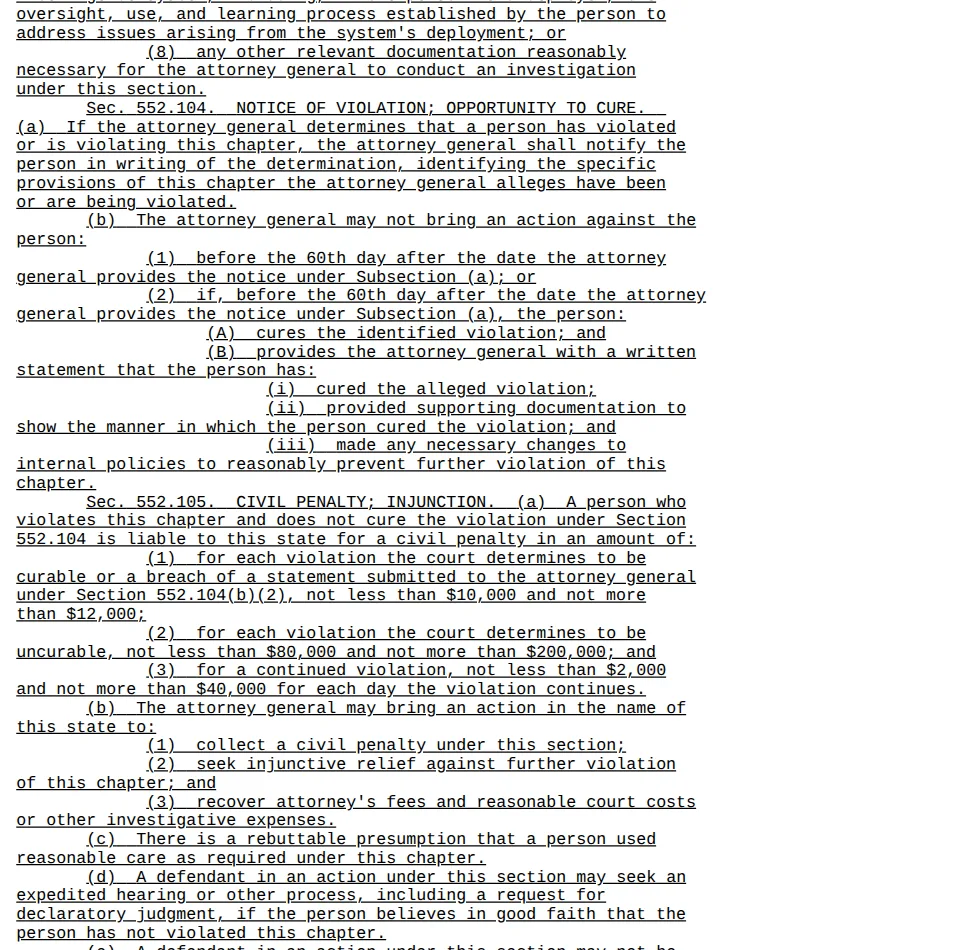
Screenshot: HB 149 enrolled text, Sections 552.104-552.105, Texas Legislature Online.
- Keep the answers to a civil investigative demand ready for each system. Section 552.103(b) lets the Attorney General ask for a high-level description of purpose, intended use and deployment context; the type of data used to train it; input data categories; outputs; performance metrics; known limitations; post-deployment monitoring and safeguards; and other documentation reasonably necessary. That's the closest TRAIGA comes to a documentation list, and it only starts with a complaint.
- Write the cure playbook now. The written statement has to say you cured the violation, include supporting documentation showing how, and describe the internal policy changes that prevent a repeat (Sec. 552.104(b)(2)). If you later break that statement, the fine sits in the lowest tier, the same as a curable violation, but you've lost the cure.
The gap between policy and proof came up in a February 2026 r/grc thread on TRAIGA, where u/Top-Refrigerator2918 wrote: "They can write the policy document but can't produce system-level evidence on demand." The demand list above is system-level by design. Read the thread for the evidence discussion, not the law: its opening post cites a "Section 546.103" that HB 149 doesn't have.
https://www.reddit.com/r/grc/comments/1r2z35j/nist_ai_rmf_now_has_statutory_teeth_in_texas/
6. The NIST-linked defense
Section 552.105(e) says a defendant can't be found liable if someone else used its AI system in a prohibited way, or if "the defendant discovers a violation of this chapter through" feedback from a developer, deployer or other person; testing, including adversarial or red-team testing; following guidelines set by state agencies; or, in the words of route (D):
(D) if the defendant substantially complies with the most recent version of the "Artificial Intelligence Risk Management Framework: Generative Artificial Intelligence Profile" published by the National Institute of Standards and Technology or another nationally or internationally recognized risk management framework for artificial intelligence systems, an internal review process.
Law firms read route (D) two ways. Baker Botts lists it as a defense of its own: organizations may not be found liable if they "Substantially comply with the NIST AI Risk Management Framework or other recognized standards." Norton Rose Fulbright ties it to discovery: internal review is one of the ways a company finds a violation, and "If a company discovers a potential violation in one of these ways, they cannot be found liable." We plan around the narrower reading, because (D) sits in the list of routes through which a defendant "discovers a violation," and we found no court ruling on it. Separately, the law presumes you used reasonable care, and the Attorney General can rebut that (Sec. 552.105(c)).
Either way, the defense isn't a certificate that stops an investigation, and the framework it names is the Generative AI Profile (NIST AI 600-1, published July 26, 2024), not AI RMF 1.0 on its own.
- If you want this defense, map your internal review to NIST AI 600-1 or to another recognized framework. ISO/IEC 42001 is a strong candidate, though the text doesn't name it.
- Date every review, and keep what it found and what you changed. Our TRAIGA safe harbor guide walks through the review record.
7. Local and federal preemption
- Drop city and county AI rules from your Texas tracker: TRAIGA "supersedes and preempts" any local ordinance, rule or regulation on the use of AI systems (Sec. 552.003).
- Keep watching Washington, but don't count on it. Executive Order 14365 of December 11, 2025 asked White House advisers to prepare "a legislative recommendation establishing a uniform Federal policy framework for AI that preempts State AI laws that conflict" with its policy, and set up a Justice Department AI Litigation Task Force to challenge state laws (Federal Register). An executive order doesn't preempt a state statute on its own. As of October 20, 2026, Congress hadn't passed a preemption law: none of the public laws of the 119th Congress published on govinfo through October 9, 2026 deals with state AI laws.
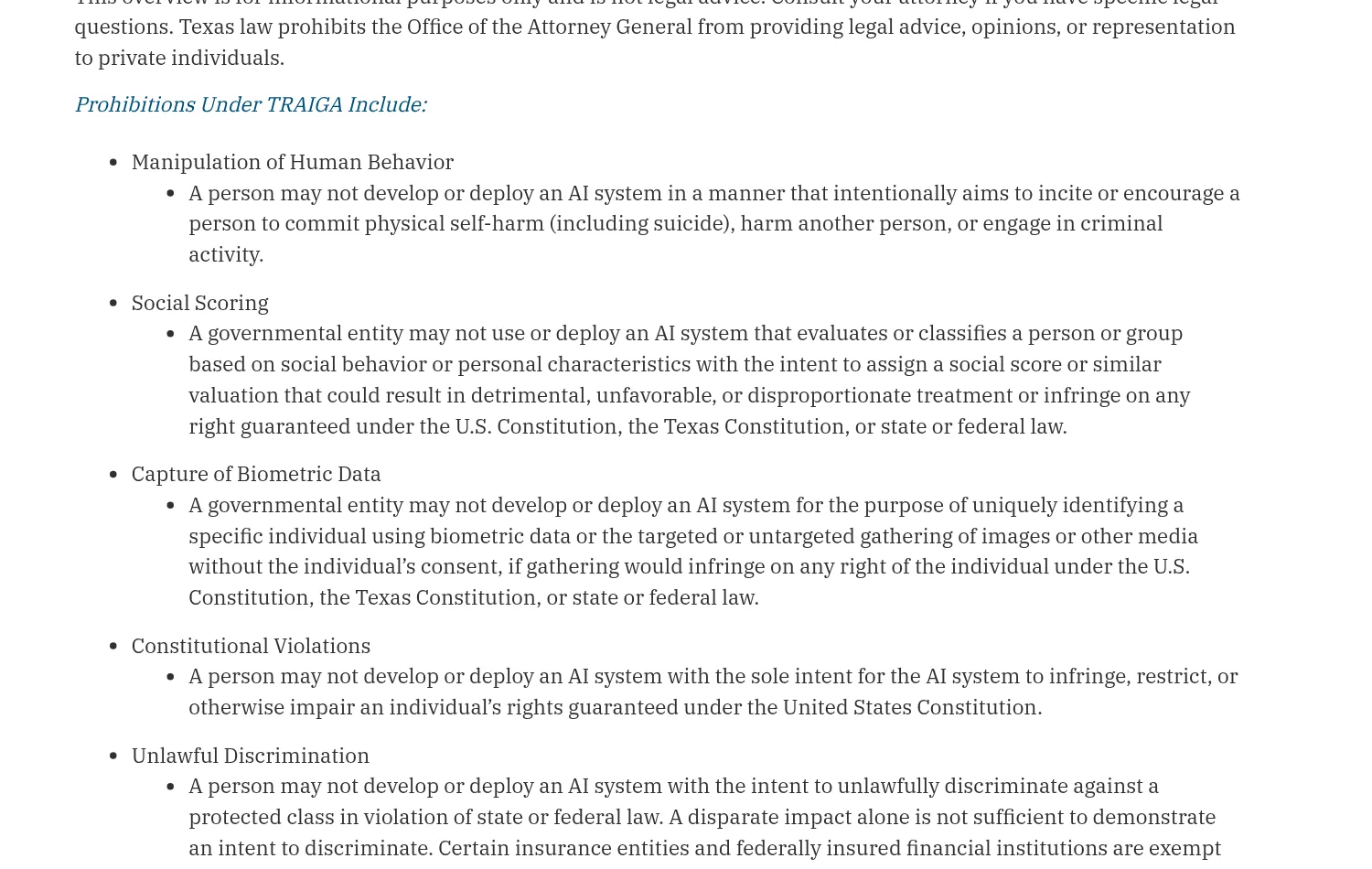
Screenshot: Consumer AI Rights, Office of the Texas Attorney General.
What this checklist doesn't cover
- The regulatory sandbox. Chapter 553 lets an approved company test an AI system for up to 36 months without a state license, run by the Department of Information Resources. If you want in, read Chapter 553 itself.
- The Texas Artificial Intelligence Council (Chapter 554). It issues reports and runs training, and it may not adopt binding rules or guidance (Sec. 554.103).
- Sector law. Insurance and banking rules, federal anti-discrimination law and the Texas Data Privacy and Security Act still apply on their own terms. HB 149 did add one AI line to that privacy law: processors must help controllers secure personal data processed by an AI system (Sec. 541.104(a)).
What we could not confirm: we found no public TRAIGA enforcement action and no Attorney General guidance on what "substantially complies" means. The office's Consumer AI Rights page, checked October 20, 2026, summarizes the bans and penalties but says nothing about the defense. Its news search doesn't filter by statute, so we can't rule out an action we missed.
Correction (October 20, 2026): Earlier versions said the NIST safe harbor covers frameworks "approved by the Texas AG" and requires "running the required assessments." Section 552.105(e) names NIST's Generative AI Profile or another nationally or internationally recognized framework, with no AG approval, as part of a defense for violations found through internal review. The federal preemption note, dated May 2026, now reflects October 20, 2026.
Correction (October 20, 2026, second pass): We re-checked the whole page against the enrolled text. Earlier versions also said that substantial compliance with NIST AI RMF 1.0 is an affirmative defense that stops the Attorney General from suing, and told readers to "formally adopt" AI RMF 1.0. The statute names the Generative AI Profile, as part of an internal-review defense. They said private companies owe no consumer notice; health care providers must disclose AI use under Section 552.051(f). They limited the constitutional-rights ban to state actors (it covers any person), described the deepfake ban as covering all non-consensual deepfakes (it covers sexual deep fakes under Penal Code 21.165 and child sexual abuse material), said the CSAM ban applies "regardless of intent" (the text says "sole intent"), and said breaking a cure statement moves you to the uncurable penalty tier (it's the $10,000-$12,000 tier). An out-of-scope list (academic research, national security, internal testing) had no basis in the text and was removed.
Related reading
- Texas TRAIGA safe harbor: what the NIST defense covers
- Texas TRAIGA complaint portal is live
- Texas TRAIGA and biometric AI in hiring
- ISO 42001 vs NIST AI RMF for small teams
- Connecticut AI law 2026, another active state AI law
- Colorado AI Act SB 189 rewrite, Colorado's revised framework
- US State AI Law Tracker: Which Laws Are in Force, Pending, or Repealed (June 2026)
- AI vendor due diligence checklist
References
- Texas Legislature Online, HB 149, enrolled text and bill history
- Office of the Texas Attorney General, Consumer AI Rights
- NIST, AI RMF: Generative Artificial Intelligence Profile (NIST AI 600-1)
- Federal Register, Executive Order 14365
- Norton Rose Fulbright, The Texas Responsible AI Governance Act: What your company needs to know