If you screen, promote or discipline Connecticut staff with software, you've already crossed one SB 5 date without noticing. Since October 1, 2026, "the algorithm did it" is not a defense to a Connecticut discrimination complaint. The notice rules everyone wrote about in May don't start until October 1, 2027.
That gap matters more than the notice wording. A discrimination complaint can be filed today. A notice violation can't happen for another year, and even then the first round comes with a cure window.
We read the enacted text, Public Act 26-15, all 74 pages, and rebuilt this checklist from the clauses. The May version of this page listed obligations the final act doesn't contain, including a right to submit "supplemental information" before an adverse decision, individual data rights, and scheduling tools as covered decisions. They're gone. What's left is narrower and, for most employers, more manageable.
What's in force, and what waits
| Rule | Section | Effective | Who it hits |
|---|---|---|---|
| Using an AEDT is no defense to a discrimination complaint | Secs. 13, 14 | Oct 1, 2026 | Every Connecticut employer |
| WARN notices must say whether layoffs relate to AI | Sec. 26 | Oct 1, 2026 | Employers filing federal WARN notices with the Labor Department |
| Whistleblower protections at frontier developers | Sec. 2 | Oct 1, 2026 | Companies training models above 10^26 operations |
| Provenance data in AI-generated images, audio, video | Sec. 15 | Oct 1, 2026 | Consumer generators with more than 1 million monthly users |
| Plain-language disclosure when a tool interacts with a person | Sec. 9 | Oct 1, 2027 | Deployers |
| Six-item written notice before the decision | Sec. 10 | Oct 1, 2027 | Deployers |
| Developers must hand deployers the information they need | Sec. 8 | Oct 1, 2027 | Vendors of hiring tools |
| AG cure option ends | Sec. 12 | Violations after Dec 31, 2027 | Deployers and developers |
The Governor approved the act on May 27, 2026, per the signature line on the act itself. Two law-firm summaries give May 29 and June 2; we went with the document.
Is your tool even covered?
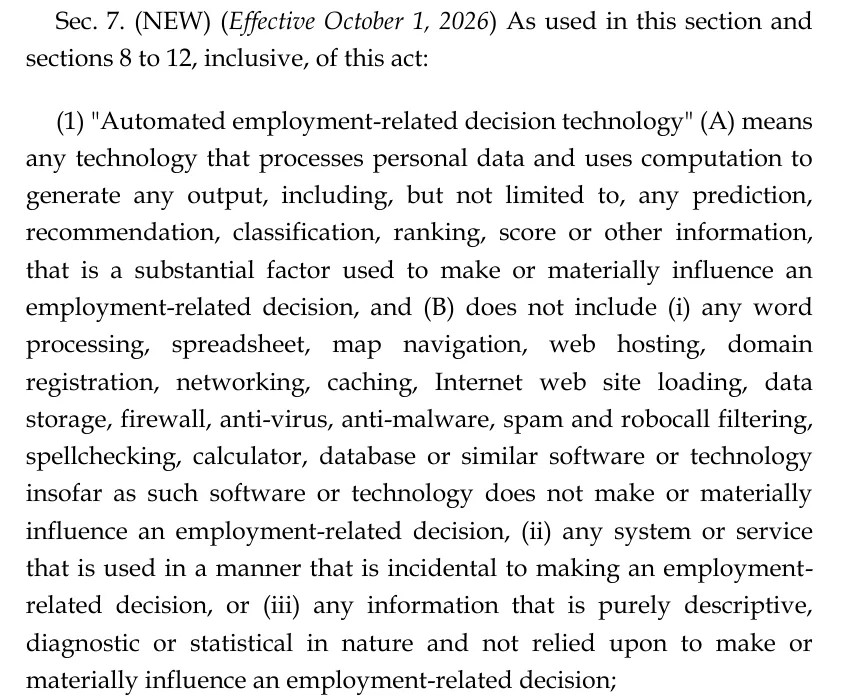 Screenshot: Public Act 26-15, Sec. 7, Connecticut General Assembly.
The act calls it an "automated employment-related decision technology". We'll say AEDT. It's any technology that processes personal data and computes an output (a score, ranking, recommendation, classification) that is a "substantial factor" in an employment-related decision. Substantial factor means it "meaningfully alters the outcome".
Covered decisions are hiring, promotion, discipline, discharge, renewal, picking someone for training or an apprenticeship, and the terms and conditions of the job. Two carve-outs will surprise people who read the bill drafts:
- Scheduling, workplace safety and productivity monitoring decisions are out. So are decisions that make only a nonmaterial change to someone's tasks or hours.
- Ordinary software is out (word processing, spreadsheets, spam filtering and the like) as long as it doesn't make or materially influence the decision. So is information that's purely descriptive or statistical and not relied on.
A resume ranker, a video-interview scorer or a performance model that feeds promotion lists is in. A shift-scheduling optimizer, on this text, is not.
The 10-step checklist
Step 1: List every tool that touches a covered decision
Go through recruiting, promotion, discipline and termination workflows and write down each tool whose output someone looks at before deciding. For each, note the decision it feeds and whether a human regularly overrides it. That last column is your evidence on "substantial factor". If nobody can explain what the score does to the outcome, assume it's in.
Step 2: Run an adverse impact test now and keep the file
This is the step that's already live. Under the amended Sec. 46a-60, a commission or court "may consider evidence of anti-bias testing", and the act lists what they'll look at: the quality, efficacy, recency and scope of the testing, the results, and what you did about them. That's a description of the file you want to be able to hand over.
The usual yardstick is the federal four-fifths rule: a group's selection rate below 80% of the highest group's rate is generally treated as evidence of adverse impact. Run it per tool, per job family, and date it. Our EEOC AI hiring checklist walks through the math.
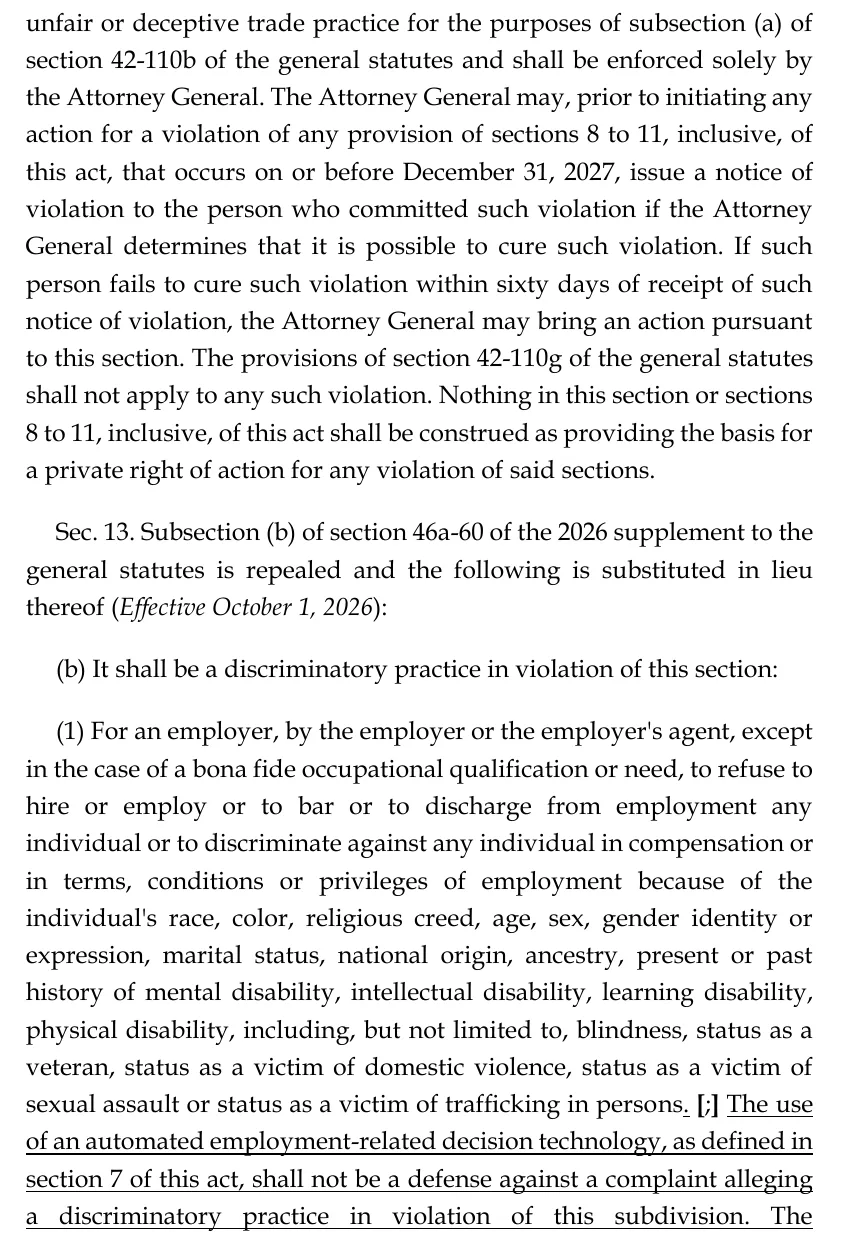 Screenshot: Public Act 26-15, Secs. 12 and 13, Connecticut General Assembly.
Sec. 14 adds the same "not a defense" sentence to claims based on sexual orientation or civil union status. And unlike the notice rules, discrimination claims keep their private right of action.
Step 3: Add the AI question to your WARN process
Also live since October 1, 2026: an employer that serves a federal WARN notice on the Connecticut Labor Department must say whether the layoffs relate to its "use of artificial intelligence or another technological change", in a form the Labor Commissioner sets. Federal WARN covers employers with 100 or more employees and requires 60 days' notice. If you're in that group, decide now who answers the AI question and on what evidence, before a reduction is on the calendar.
Step 4: Reopen your vendor contracts
From October 1, 2027, a developer must give you "all information that such deployer requires" for your notices, but only if the tool was advertised, marketed, configured, contracted for, sold or licensed to materially influence employment decisions. The act doesn't define what that information is, as Mintz points out. Write it into the contract yourself: trade name, data categories, how each is weighed, data sources.
Sec. 8(c) also lets a vendor take over your notice duties by contract, as long as the contract "clearly set[s] forth" which ones. If your ATS vendor already sends candidate emails, that's worth asking for. Our AI vendor contract redline template has clause language to start from.
Step 5: Plan for the trade-secret gap
Sec. 11 lets anyone withhold trade secrets, but whoever withholds must send a notice saying so and why. Picture the vendor declining to explain how it weighs your applicants' data. You still owe the applicant a notice. Ask each vendor now what it will refuse to disclose, so you aren't finding out in September 2027.
Step 6: Draft the interaction disclosure
Sec. 9 applies when a tool is "intended to interact" with an applicant or employee: a chatbot screener, an asynchronous video interview. You must disclose, in plain language, that they're dealing with the technology. No disclosure is needed where a reasonable person would find it obvious. Don't lean on "obvious" for anything that sounds like a human recruiter.
Step 7: Build the six-item notice
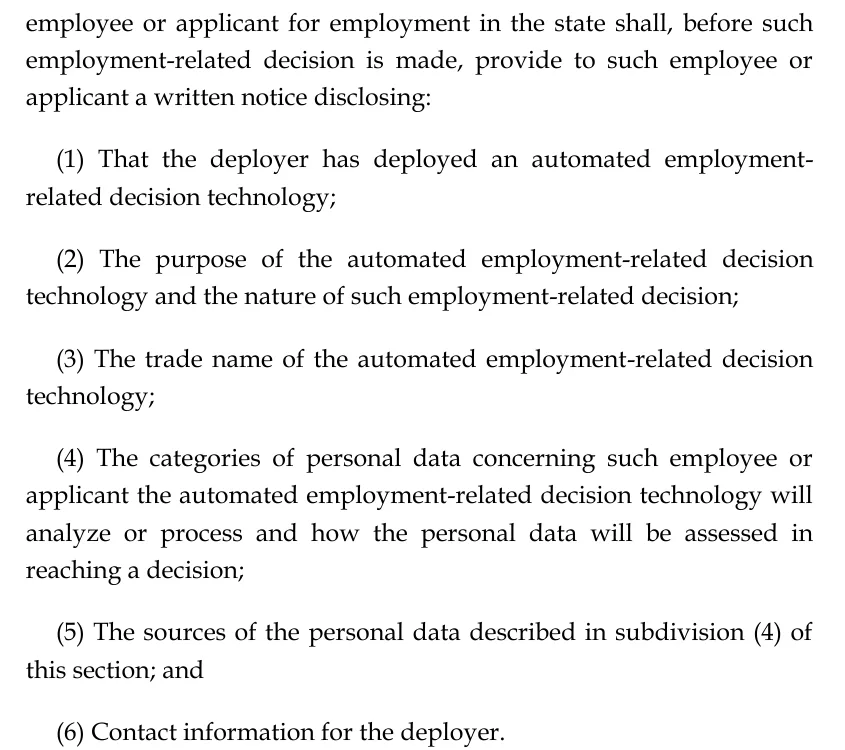 Screenshot: Public Act 26-15, Sec. 10, Connecticut General Assembly.
Sec. 10 requires a written notice before the decision is made. The six items are fixed by statute. Here's a draft we'd start from, one line per item. It's our wording, so have counsel review it:
How we use automated tools in this decision. (1) We use an automated employment-related decision technology in this [hiring / promotion] process. (2) It [ranks applications / scores interview answers] to help us decide [who moves to interview]. (3) The tool is [trade name], provided by [vendor]. (4) It analyzes [work history, skills listed, assessment answers] and assesses them by [matching against the job requirements]. (5) This information comes from [your application and the assessment you completed]. (6) Questions: [name, email, phone].
Items 3 to 5 are the ones you can't fill without the vendor, which is why Step 4 comes first.
Step 8: Put the notice where the decision happens
The notice has to land before the decision, so tie it to the workflow, not the careers page. For applicants that usually means the application confirmation or the assessment invite. For current staff it means before a promotion round or a disciplinary review that uses a scored output. Add a line to job postings too. The act doesn't require that, but it's cheap and it covers you on the Sec. 9 disclosure.
Step 9: Name an owner and an AG response path
The notice rules are unfair trade practice violations enforced solely by the Attorney General, with no private right of action. For violations on or before December 31, 2027, the AG may send a notice of violation first, and you get 60 days to cure. After that date the AG can go straight to court. One person should own the tool list, the vendor file and the notice templates, and should know where an AG letter goes on day one.
Step 10: Check whether you're a frontier developer (you probably aren't)
Sec. 2 protects employees at companies that train a foundation model with more than 10^26 operations. Those companies can't penalize staff for reporting catastrophic-risk concerns, must post or send a notice of rights, and if annual revenue tops $500 million, must run an anonymous internal reporting process by January 1, 2027. Violations carry up to $1,000 each. If you buy models rather than train them at that scale, this isn't yours. Write that down in your inventory and move on.
Our take
SB 5's employment sections are narrower than most coverage suggested: no bias-audit mandate, no appeal right, no scheduling. But the one live sentence shifts the burden. Once the tool can't be your defense, the anti-bias file from Step 2 is the closest thing you have to one, and the act tells courts to judge it on recency. We'd spend October on Steps 1 to 4 and leave notice wording for spring 2027, when the vendor answers are in.
How we checked this: on October 13, 2026 we read the full text of Public Act 26-15 (Secs. 2, 7 to 15 and 26) from the Connecticut General Assembly PDF and took the three screenshots above, then compared it with summaries from Mintz and Ogletree Deakins and the four-fifths rule in 29 CFR 1607.4. We found no Reddit or official social post about the employment sections to embed. Earlier claims that the act creates a pre-decision appeal, data-access rights and an October 2027 synthetic media rule for employers were removed. Last reviewed: October 13, 2026.
 Image: Pexels, used under the Pexels License.
Related Reading
- Connecticut AI law 2026, full compliance guide
- AI hiring tool compliance, US state laws 2026
- EEOC AI hiring guidance 2026, employer checklist
- AI vendor contract redline template
- NYC Local Law 144 bias audit employer guide
- Colorado AI Act compliance, January 1, 2027 deadline
- Connecticut Data Privacy Law Expands July 1: CTDPA SB 4 Small Team Compliance
- US State AI Law Tracker: Which Laws Are in Force, Pending, or Repealed (June 2026)
- AI Agent Workforce Policy: Template for HR Teams Managing Automation