
Image: Unsplash.
If you're searching for "AI monitoring laws", start with three statutes that never mention AI. The rules that bite today are plain electronic-monitoring laws in New York, Delaware and Connecticut, and they apply whether or not the software uses AI. The AI-specific rules are thinner than the headlines: Illinois requires a notice but has no rules saying what it looks like, Connecticut's AI notices start next October, and Colorado's law is paused by agreement in federal court.
The tracker
Reviewed October 20, 2026, against each statute.
| State | Law | Who it covers | What you must do | In force | Enforcement and penalty |
|---|---|---|---|---|---|
| New York | Civil Rights Law §52-c (A430/S2628, Chapter 583 of 2021) | Employers with a place of business in New York that monitor phone calls, email or internet use by any electronic device or system | Written or electronic notice upon hiring, acknowledged by the employee in writing or electronically; post the notice where monitored employees can see it | May 7, 2022 | Attorney General; maximum $500 first offense, $1,000 second, $3,000 third and each later offense |
| Delaware | 19 Del. C. §705 | Employers with a place of business in Delaware that monitor a Delaware employee's phone, email or internet use | Either an electronic notice each day the employee uses the employer's email or internet, or a one-time notice the employee acknowledges in writing or electronically | Long in force (73 Del. Laws c. 148) | Civil penalty of $100 per violation; a claim may be filed in any court of competent jurisdiction |
| Connecticut (monitoring) | Conn. Gen. Stat. §31-48d (P.A. 98-142) | Any employer with employees, the state included, that collects information about employees' activities or communications on its premises by any means other than direct observation (computer, telephone, camera and similar systems) | Prior written notice to the employees who may be affected, naming the types of monitoring; a notice posted in a conspicuous place counts. No notice needed when the employer has reasonable grounds to suspect misconduct and monitoring may produce evidence of it | Long in force (P.A. 98-142) | Labor Commissioner, after a hearing; maximum $500 first offense, $1,000 second, $3,000 third and each later offense; no private lawsuit |
| Illinois | HB 3773, P.A. 103-0804 (Human Rights Act Sec. 2-102(L)) | Employers with one or more employees in Illinois for 20 or more weeks a year | Notice to employees when AI is used for recruitment, hiring, promotion, renewal, training selection, discharge, discipline, tenure or terms of employment; no AI with a discriminatory effect, no zip codes as a proxy | January 1, 2026 | A civil rights violation under the Illinois Human Rights Act; no AI-specific fine. Notice rules withdrawn June 2, 2026 |
| Connecticut (layoffs) | Public Act 26-15 (SB 5), Sec. 26 | Employers that file a federal WARN notice | Tell the state Labor Department whether the layoffs relate to the employer's use of AI | October 1, 2026 | Not confirmed (see below) |
| Connecticut (AI in employment decisions) | Public Act 26-15 (SB 5), Secs. 9-10 | Deployers doing business in Connecticut that use automated employment-related decision technology in the state | Plain-language disclosure when the tool interacts with an employee or applicant; written six-item notice before the decision | October 1, 2027 | Unfair trade practice, Attorney General only; 60-day cure period through December 31, 2027; no private right of action |
| Colorado | SB 26-189 (replaces SB 24-205) | Deployers of covered automated decision-making technology (ADMT), including for decisions about employees and Colorado-resident job applicants | Clear and conspicuous notice before use; within 30 days after an adverse outcome, a plain-language description of the decision and the tool's role; correction of incorrect data and human review where commercially reasonable; keep records 3 years | Decisions on or after January 1, 2027 | Deceptive trade practice, Attorney General only; enforcement paused by agreement in federal court |
What changed since the last review
- New York: the statute is Civil Rights Law §52-c, not "Labor Law § 740A" as this tracker said before. The notice is due upon hiring, and the acknowledgment can be electronic.
- Delaware: an acknowledgment is needed only if you choose the one-time notice. The daily electronic notice needs none.
- Illinois: the Department of Human Rights withdrew its draft notice rules on June 2, 2026. We removed the comment deadline, a four-year retention rule we couldn't trace to the act, and the penalty and Attorney General claims.
- Connecticut: added the state's general monitoring law, §31-48d, which earlier versions left out. The layoff disclosure has been in force since October 1.
- Remote workers: the answer differs by state. It's now set out state by state below.
- Removed: a line saying Ohio and Minnesota had monitoring bills pending, which we couldn't source.
How to read each law
New York: notice upon hiring, plus a posting
Section 52-c applies to any employer "with a place of business in the state" that monitors or intercepts phone calls, email or internet use "by any electronic device or system". It requires "prior written notice upon hiring to all employees who are subject to electronic monitoring". The notice can be on paper or electronic, and the employee acknowledges it "either in writing or electronically". You also post the notice "in a conspicuous place" those employees can see.
The statute even supplies the wording: employees are advised that "any and all" phone calls, email and internet use "may be subject to monitoring at any and all times and by any lawful means". So a broad notice that tracks the statute does the job. Naming your actual tools is good practice, not a New York requirement. Spam filters and similar system-maintenance processes that don't target one person are excluded.
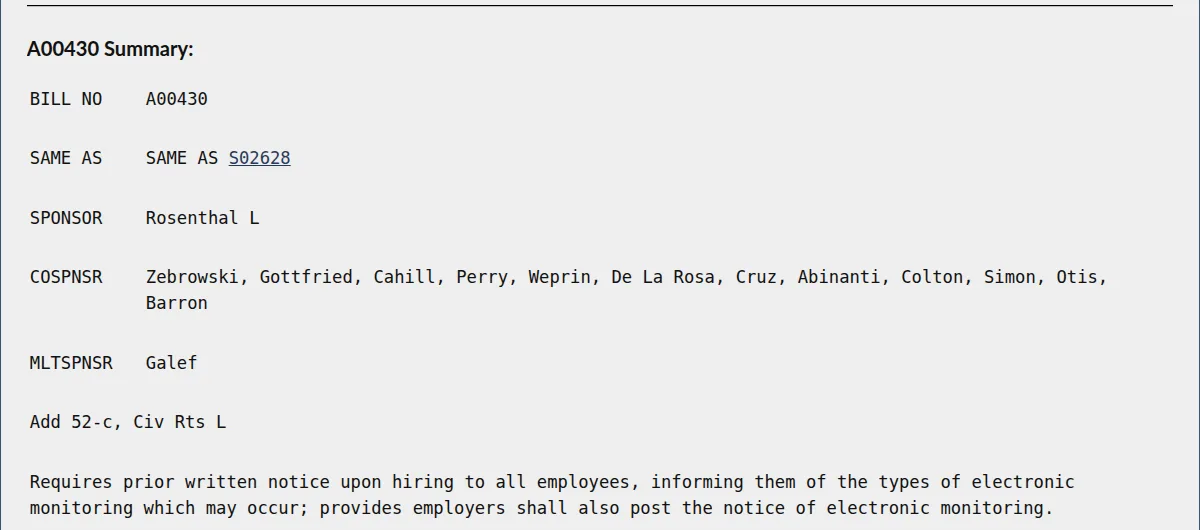
Screenshot: New York State Assembly, bill A00430 (2021-22), captured October 20, 2026.
Delaware: a daily banner or a signed-off notice
19 Del. C. §705 gives employers two routes before they monitor a Delaware employee's phone, email or internet use. Route one is an electronic notice "at least once during each day the employee accesses" the employer's email or internet, which in practice is a login banner; no acknowledgment is needed. Route two is a one-time notice, in writing or electronic form, "acknowledged by the employee either in writing or electronically". Pick one and keep the evidence: banner screenshots for route one, acknowledgments for route two.
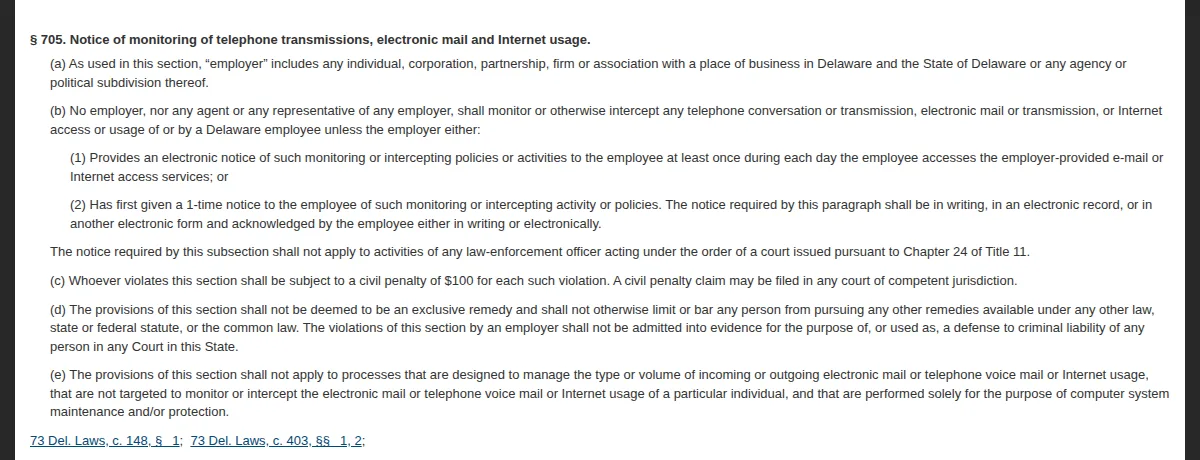
Screenshot: Delaware Code Online, Title 19, §705, captured October 20, 2026.
Connecticut monitoring: a posted notice is enough
Conn. Gen. Stat. §31-48d covers any employer that collects information "on an employer's premises concerning employees' activities or communications by any means other than direct observation", which takes in computer, phone and camera monitoring, AI or not. The employer gives "prior written notice to all employees who may be affected, informing them of the types of monitoring which may occur", and a notice posted where employees can see it "shall constitute such prior written notice". The exception: no notice is needed when the employer has reasonable grounds to suspect conduct that breaks the law or creates a hostile workplace and monitoring may produce evidence of it.
Enforcement sits with the Labor Commissioner, after a hearing, at the same three penalty steps as New York. The official annotation adds that there is "no private cause of action" under the section. The statute doesn't say whether a remote employee's home counts as the employer's premises.
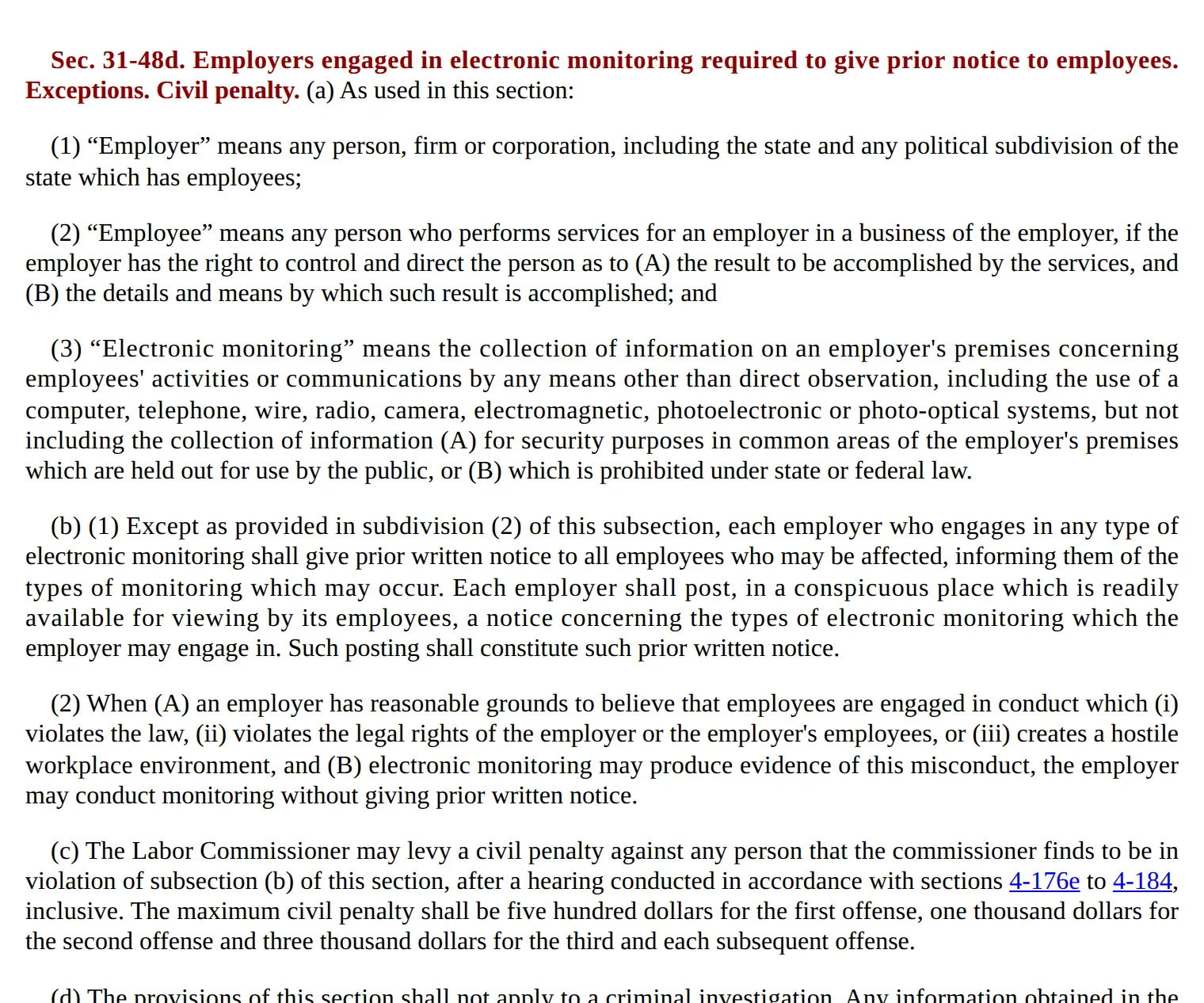
Screenshot: Conn. Gen. Stat. §31-48d, Connecticut General Assembly (cga.ct.gov), captured October 20, 2026.
Illinois: a notice duty with no rules behind it
P.A. 103-0804 made it a civil rights violation, from January 1, 2026, "to fail to provide notice to an employee that the employer is using artificial intelligence" for recruitment, hiring, promotion, discipline, discharge and the other listed decisions. The act left the details to the Department of Human Rights: "the circumstances and conditions that require notice, the time period for providing notice, and the means for providing notice".
Those rules don't exist. The department proposed them on May 15, 2026 and withdrew them on June 2, cancelling the June 10 hearing. When we checked on October 20, its AI-in-employment page returned a 404 and we found no replacement draft. So the duty is live and the format is up to you.
Our reading: give a written notice at hiring and before any new AI use in a listed decision, naming the tool and the decision it feeds. The act says "employee", defined as someone performing services for pay in Illinois, and names applicants only for apprenticeships. Recruitment and hiring are listed uses, though, so we'd give the same notice to applicants. It costs one paragraph.

Image: Pexels, used under the Pexels License.
Connecticut AI: layoffs now, AI notices next year
Public Act 26-15 (SB 5), approved May 27, 2026, works in two steps. Since October 1, an employer that files a federal WARN notice must tell the Labor Department whether the layoffs "are related to the employer's use of artificial intelligence". From October 1, 2027, a deployer that uses automated employment-related decision technology in Connecticut must disclose it in plain language when the tool interacts with an employee or applicant, and must send a written notice before the decision covering six items: that the tool is used, its purpose and the decision, its trade name, the data categories and how they're assessed, the data sources, and a contact.
Decisions about scheduling and productivity monitoring are carved out, so a pure activity tracker isn't covered by the notice rules. Violations of the notice sections are unfair trade practices enforced "solely by the Attorney General", with a 60-day cure window through 2027 and no private right of action. For the full checklist, see our Connecticut SB 5 employer guide.
Colorado: in the statute, on hold in practice
SB 26-189, signed May 14, 2026, replaces the original Colorado AI Act. It applies to consequential decisions, employment included, made on or after January 1, 2027, and its "consumer" includes employees and Colorado-resident job applicants. The duties are in the table. The Attorney General's draft rules are open for comment until October 26, and the Attorney General has agreed in federal court not to start enforcement until 14 days after a ruling on xAI's planned preliminary-injunction motion (order). More in our Colorado SB 26-189 guide.
Remote workers: which state's rule applies
- New York: the test is whether the employer has "a place of business in the state". The statute doesn't limit the notice to employees who work in New York.
- Delaware: two tests at once, an employer with "a place of business in Delaware" and monitoring of "a Delaware employee".
- Illinois: an employer with one or more employees "within Illinois", and an employee is someone "performing services for remuneration within this State". A remote worker living and working in Illinois counts.
- Connecticut (monitoring): the collection has to happen "on an employer's premises"; the statute doesn't say whether a home office counts.
- Connecticut (AI notices): a deployer "doing business in the state" that deploys the tool in the state.
- Colorado: turns on the consumer: employees, and job applicants who are Colorado residents.
Whether a remote employee's home office makes it a "place of business" for New York or Delaware has not, as far as we found, been decided by any court. We'd give the notice to anyone working in those states, and in Connecticut.
Which tools trigger what
- Email, chat, browser or call monitoring software (including AI "productivity" scoring of that activity): New York, Delaware and Connecticut monitoring notice. Illinois only if the output feeds a listed decision. Not Connecticut's AI notice rules when the decision is about productivity monitoring.
- AI note-takers that record or transcribe calls: arguably monitoring of "telephone conversations or transmissions" in New York and Delaware, and of "communications" by telephone or computer in Connecticut. We'd cover them in the notice.
- Cameras, including AI video analytics: Connecticut's definition names cameras, except security monitoring of common areas open to the public; New York and Delaware cover phone, email and internet use.
- AI resume screeners and candidate ranking: Illinois now; Connecticut from October 2027; Colorado for decisions from January 2027.
- AI in performance reviews, promotion or discipline: Illinois now; Connecticut and Colorado on their dates.
- Spam filtering and security tools not aimed at one person: excluded in New York and Delaware.
Notice language to copy
Adapt the brackets. The second paragraph uses New York's statutory wording, which also works for Delaware's one-time notice. For Connecticut, fill in the tools list so the notice names the types of monitoring, and post it where staff can see it.
Notice: Electronic Monitoring and Use of Artificial Intelligence
[Company Name] monitors company systems and uses automated tools in some employment decisions. This notice explains both.
Electronic monitoring. Any and all telephone conversations or transmissions, electronic mail or transmissions, or internet access or usage by an employee by any electronic device or system, including but not limited to the use of a computer, telephone, wire, radio or electromagnetic, photoelectronic or photo-optical systems, may be subject to monitoring at any and all times and by any lawful means. Tools we currently use: [list, e.g. email retention, web filtering, call recording, AI meeting transcription].
Artificial intelligence in employment decisions. We use [tool name] to assist with [recruitment / hiring / promotion / performance review / discipline / scheduling]. It [describe what it does, e.g. ranks applications against the job requirements]. [Optional: A person reviews its output before any decision is made.] To ask which tools were used in a decision about you, contact [HR contact].
Questions: [HR contact].
Acknowledged by: _________________ Date: _________________
How to use this tracker
- List every tool that monitors phone, email, chat or browsing, and every AI tool that touches hiring, reviews, promotion or discipline.
- List the states where you have a place of business and where your employees work.
- New York: give the notice at hiring, collect the acknowledgment (electronic is fine), and post it. For current staff hired before you started monitoring, we'd collect acknowledgments now.
- Delaware: choose the daily login banner or the acknowledged one-time notice, and keep the evidence.
- Connecticut monitoring: give written notice of the types of monitoring, or post it in a conspicuous place, before you monitor.
- Illinois: give a written AI notice to employees, and we'd add applicants; recheck the Department of Human Rights for new rules.
- Connecticut AI: if you filed or will file a WARN notice, answer the AI question in it. Put October 1, 2027 in the calendar for the AI notices.
- Colorado: watch the Attorney General's rules and the xAI case; prepare the pre-use notice for decisions from January 1, 2027.
- Put the notice in the handbook and onboarding, and recheck this page at your next policy review.
What we could not confirm: whether a remote worker's home is a "place of business" under the New York or Delaware statute, or the employer's premises under Connecticut's; the Illinois department's own announcement of the withdrawal (its page returned a 404, so the withdrawal date comes from BakerHostetler's dated update); and a penalty tied to Connecticut's layoff question. New York City adds a bias audit for automated hiring tools: see our NYC bias audit guide.
Correction (October 20, 2026, second update): Earlier versions said the rules with teeth today were two monitoring statutes, in New York and Delaware, and left Connecticut's general monitoring law out of the tracker. Conn. Gen. Stat. §31-48d has required prior written notice of electronic monitoring, enforced by the Labor Commissioner with civil penalties, since P.A. 98-142. We added it to the table, the verdict, the FAQ and the checklist.
Correction (October 20, 2026): Earlier versions cited New York "Labor Law § 740A"; the law is Civil Rights Law §52-c, and its notice is given upon hiring with a written or electronic acknowledgment, not before monitoring with a signed one, and it does not require tool-by-tool detail. The tracker also said Delaware always requires a written acknowledgment (only the one-time notice does), described Illinois draft rules that were withdrawn on June 2, 2026, listed a four-year Illinois retention rule and Attorney General enforcement with civil penalties that are not in the act, and said remote workers are covered wherever they live, which is wrong for New York and Delaware.
Correction (October 16, 2026): Earlier versions said Colorado AG enforcement begins in January 2027. The law applies to decisions from that date, but the Attorney General has agreed in federal court not to start enforcement until 14 days after a ruling on xAI's planned preliminary-injunction motion (order).
Related Reading
- California SB 690 Ends Most CIPA Pen Register Lawsuits: What Survives
- California AB 1898 died in committee: what passed instead
- Illinois AI Employment Disclosure Law 2026: Employer Compliance Guide
- Connecticut AI Law 2026 Compliance Checklist
- Colorado AI Act compliance: what SB 26-189 requires in 2027
- Shadow AI Policy for Small Teams
- AI Governance Checklist 2026
