
 Image: Pexels, used under the Pexels License.
This is for anyone hiring or managing people in Illinois with software that scores, ranks or screens them. Illinois has two laws here, and they don't overlap much. The older one only bites if you ask applicants to record video interviews and let AI analyze them. The newer one, HB 3773, reaches almost any AI used in a job decision and has applied since the start of 2026.
Earlier versions of this guide blended the two, then added duties neither contains: an opt-out to human review, a ban on AI as the sole factor, a daily fine. We read both statutes on ilga.gov. Below is what they actually say, a checklist, and notice wording you can adapt.
The two laws at a glance
| Artificial Intelligence Video Interview Act | HB 3773 (Illinois Human Rights Act) | |
|---|---|---|
| Citation | 820 ILCS 42 (P.A. 101-260; Section 20 added by P.A. 102-47) | P.A. 103-0804, new 775 ILCS 5/2-102(L) |
| In force | January 1, 2020 (Section 20: January 1, 2022) | January 1, 2026 |
| Covers | Employers that ask applicants to record video interviews and use AI analysis of them, for positions based in Illinois | Employers with one or more employees in Illinois during 20 or more calendar weeks, using AI in recruitment, hiring, promotion, renewal, training selection, discharge, discipline, tenure or terms of employment |
| Core duties | Notify before the interview; explain how the AI works and what general characteristics it uses; get consent before the interview | Don't use AI that has the effect of discriminating on a protected class; don't use zip codes as a proxy; notify employees that AI is used for these purposes |
| Video handling | Share only with people whose expertise or technology is needed; delete within 30 days of a request, backups included, and tell recipients to delete | None specific |
| Reporting | If AI alone decides who gets an in-person interview: report race and ethnicity data to DCEO by December 31 | None |
| Enforcement | No penalty or enforcement section in the act | Civil rights violation: charge with the Department of Human Rights within 2 years |
| Rules | None | IDHR to set notice rules; draft proposed May 15, 2026, withdrawn June 2, 2026 |
| Checked | October 20, 2026, full act on ilga.gov | October 20, 2026, P.A. 103-0804 on ilga.gov |
Video Interview Act: it applies only if AI scores recorded interviews for Illinois-based jobs, and then you need consent before the video, so build it into the interview invite.
HB 3773: it applies to nearly every employer using AI on Illinois staff or applicants; give the notice now and check the tool's outcomes, because the effect, not your intent, is what's tested.
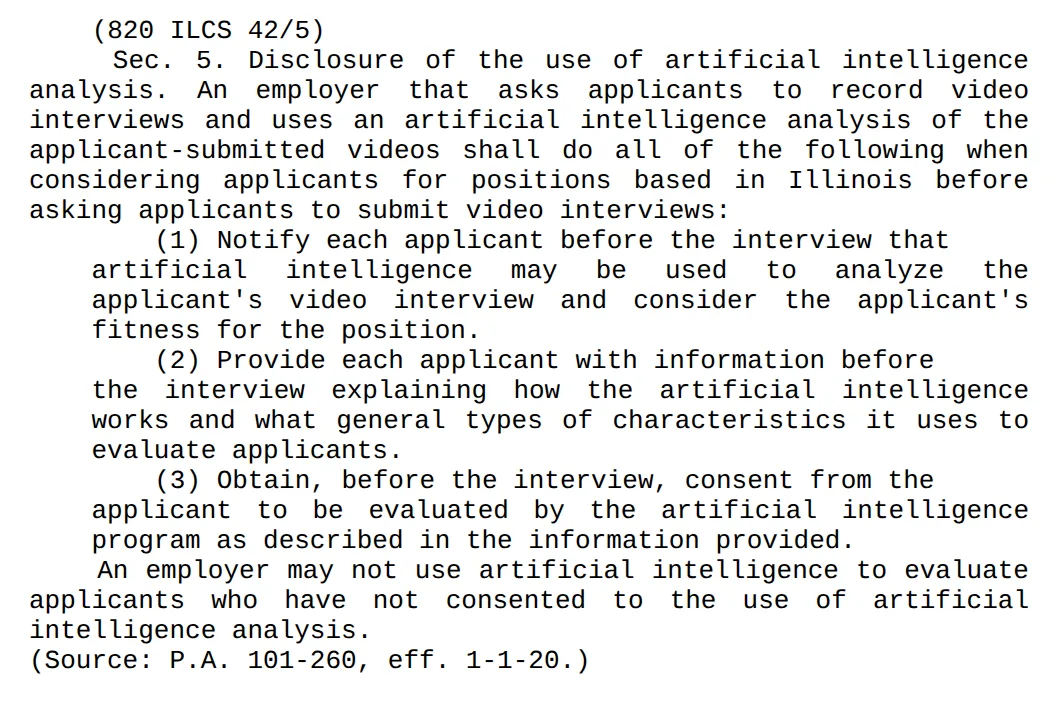 Screenshot: 820 ILCS 42/5, Illinois General Assembly (ilga.gov).
The Video Interview Act: narrow, and already old
Section 5 applies to "an employer that asks applicants to record video interviews and uses an artificial intelligence analysis of the applicant-submitted videos" when considering applicants "for positions based in Illinois." Three things must happen before you ask for the video:
- Tell each applicant before the interview that AI may be used to analyze the video and consider their fitness for the position.
- Give each applicant information explaining how the AI works and what general types of characteristics it uses to evaluate applicants.
- Get the applicant's consent, before the interview, to be evaluated by the AI as described.
You may not use AI to evaluate an applicant who hasn't consented. Sections 10 and 15 add two video rules: share the videos only with people whose expertise or technology is needed to evaluate the applicant, and delete them within 30 days of the applicant's request, telling everyone who got a copy to delete theirs, backups included.
A few things the act doesn't say, despite what you may have read. It doesn't say "written" notice or "written" consent (we'd still keep a written record, because you'll want proof). It doesn't require an opt-out to a human reviewer. It doesn't ban AI as the only factor. It has no fine and names no enforcing agency. The coverage test is where the job is based, not where the applicant lives: a remote applicant in Illinois applying for a job based in Texas isn't clearly covered, and a Chicago-based role is covered wherever the applicant sits.
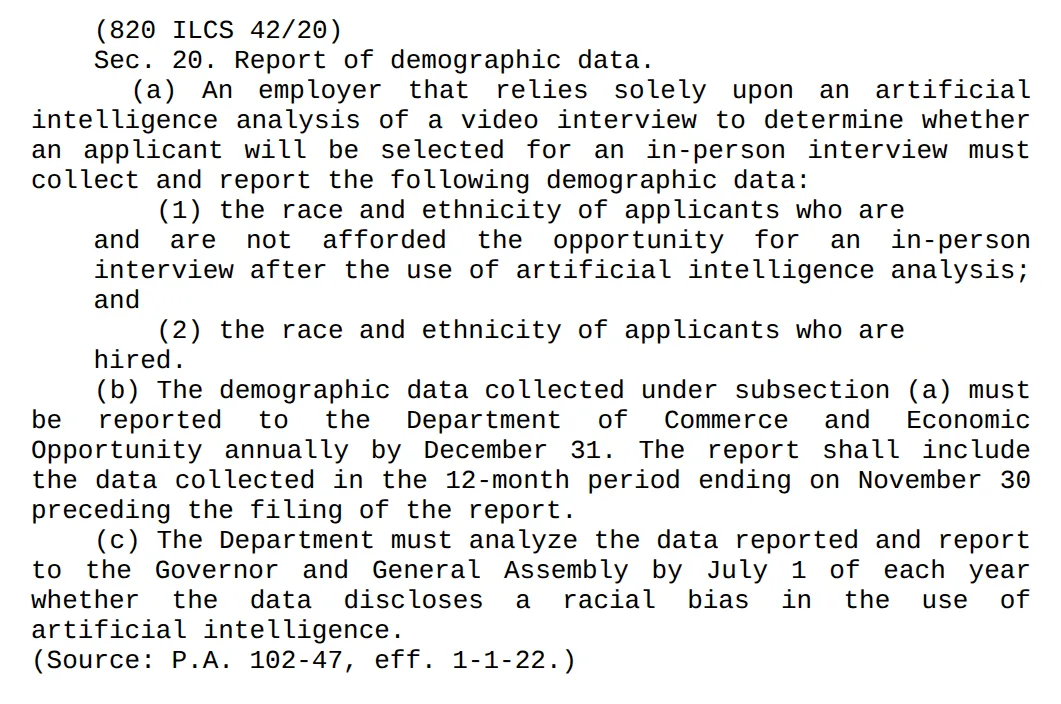 Screenshot: 820 ILCS 42/20, Illinois General Assembly (ilga.gov).
The one "solely" rule is in Section 20. If you rely solely on AI analysis of a video interview to decide who gets an in-person interview, you must collect the race and ethnicity of applicants who do and don't get one, and of those hired, and report it to the Department of Commerce and Economic Opportunity by December 31 each year, covering the 12 months ending November 30. DCEO then tells the Governor and General Assembly by July 1 whether the data shows racial bias. If a recruiter reviews every AI score before deciding, Section 20 doesn't apply; that's a reason to keep a person in the loop, not a legal duty to.
HB 3773: broad, new, and still without rules
HB 3773 was signed on August 9, 2024 and took effect January 1, 2026. It doesn't touch the Video Interview Act. It adds subdivision (L) to the employment section of the Illinois Human Rights Act, which makes two things civil rights violations:
- Using AI "that has the effect of subjecting employees to discrimination on the basis of protected classes," or using "zip codes as a proxy for protected classes," in recruitment, hiring, promotion, renewal of employment, selection for training or apprenticeship, discharge, discipline, tenure, or the terms, privileges, or conditions of employment.
- Failing to "provide notice to an employee that the employer is using artificial intelligence" for those purposes.
"Effect" matters: intent isn't required. "Artificial intelligence" is defined broadly as a machine-based system that infers from its input how to generate outputs such as predictions, content, recommendations, or decisions, and it includes generative AI. A resume screener, a chatbot that schedules or rejects candidates, or a model that flags low performers for review all fit. The law doesn't require a bias audit or an impact assessment, though checking the tool's results is the only way to know whether you have a discriminatory effect to defend.
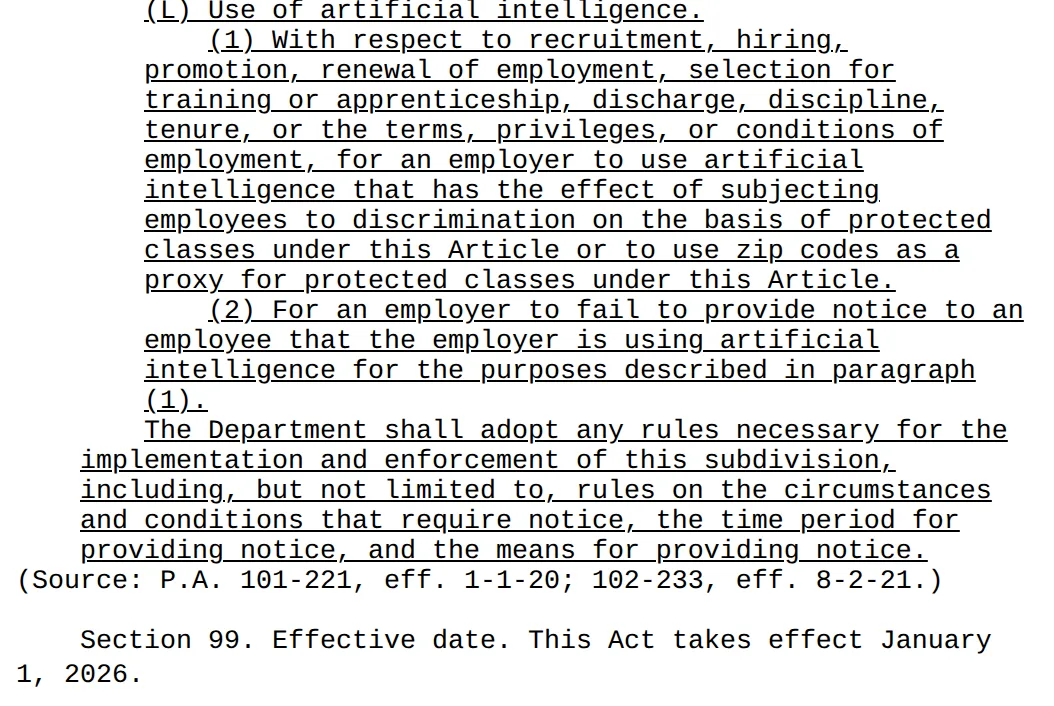 Screenshot: Public Act 103-0804, Section 2-102(L) and Section 99, Illinois General Assembly (ilga.gov).
The statute tells the Department of Human Rights to adopt rules on when notice is required, how fast, and by what means. A draft came out on May 15, 2026: notice in the job posting for applicants, and for employees an annual notice plus one within 30 days of adopting a new AI system, in the handbook and posted, naming the system, the positions, the decisions it influences and the data it uses. IDHR withdrew it on June 2, 2026 and cancelled the June 10 hearing. IDHR's AI-in-employment page returned a 404 when we checked on October 20. So the duty is live and the format is up to you. The withdrawn draft is still a reasonable model.
Enforcement runs through the Human Rights Act. An applicant or employee can file a charge with the Department of Human Rights within 2 years of the violation, and remedies can include back pay, reinstatement, emotional distress damages and attorneys' fees.

The checklist
Both laws
- List every tool in hiring and people decisions that uses AI, including features inside your ATS, scheduling bot, video platform and performance software. Note which decisions each one touches.
- For each, note the Illinois jobs or employees it affects (Video Interview Act: jobs based in Illinois; HB 3773: people working in Illinois, plus applicants).
HB 3773 (any AI in employment decisions)
- Write a plain notice that you use AI, for which decisions, and whom to ask (template below). Put it in the job posting or application flow and in the employee handbook, and keep a dated copy of each version.
- Ask each vendor for the inputs the tool uses. Remove zip code, or anything standing in for it, as a scoring input.
- Check outcomes by protected group at least once a year (selection rates at each stage the tool touches). Keep the analysis and what you changed.
- Decide who reviews a complaint about an AI-driven decision, and log the review.
Video Interview Act (AI analysis of recorded video interviews)
- Before you ask for the video: send the notice, the explanation of how the AI works and what it looks at (get this from the vendor), and a consent request. Store the consent with a timestamp.
- Don't send AI-analysis interviews to applicants who haven't consented. Give them another route, such as a live interview, and evaluate it without the AI.
- Limit video access to the vendor and the people evaluating the applicant.
- Set up a deletion request route with a 30-day clock. On a request, delete your copies and backups and instruct the vendor in writing to do the same.
- If AI alone decides who moves to an in-person interview, collect race and ethnicity data and file the DCEO report by December 31. Better: put a person on every decision.
Notice and consent wording (adapt it)
HB 3773 notice (applicants and employees)
[Company] uses artificial intelligence tools in some employment decisions. We currently use [tool name] to [screen applications / rank candidates / schedule interviews / flag performance trends] for [positions or teams]. A person at [Company] reviews [describe the human step]. The tool uses [types of data, e.g. resume text, assessment answers]. Questions or requests for an accommodation: [name, role, email]. Last updated [date].
Video Interview Act notice, explanation and consent (before the interview)
Your recorded interview and AI analysis. [Company] may use artificial intelligence to analyze your recorded video interview and consider your fitness for the position.
How it works. We use [tool name]. It [describe how it works in plain terms, from the vendor's documentation]. It evaluates general characteristics such as [list, from the vendor].
Who sees your video. Only [vendor] and the people at [Company] evaluating your application.
Deleting your video. Email [address] and we'll delete your interview within 30 days, and tell everyone who received a copy to delete theirs.
Your choice. We won't use AI to evaluate your interview unless you agree. If you'd rather not, reply to [address] and we'll arrange [a live interview / another format].
[ ] I have read this information and consent to AI analysis of my video interview as described. Name, date.
Fill the brackets from the vendor's documentation, not from marketing copy. If the vendor can't tell you what characteristics the tool evaluates, you can't give the explanation Section 5 requires, and that's a reason to switch tools.
What this doesn't cover
- Biometrics. If the tool extracts face geometry or voiceprints, Illinois BIPA applies separately, with its own written release and retention policy. See our BIPA AI hiring checklist.
- Disparate impact from January 2027. SB 3777, the Civil Rights Safeguard Act (P.A. 104-0744), signed July 31, 2026 and effective January 1, 2027, adds a general rule against employment "criteria or methods" with a discriminatory effect unless they're job related and consistent with business necessity. It isn't AI-specific, but an AI screener is a method.
- Other states and federal law. New York City's bias audit rule, Colorado's 2027 rules and federal guidance are in the state-by-state AI hiring law comparison and the AI hiring compliance guide.
- Monitoring notices. Notices for monitoring email, phones and browsing are in the employee monitoring laws tracker.
What we could not confirm: whether IDHR will propose new notice rules, or when; IDHR's AI page was a 404 on October 20. The Video Interview Act doesn't define "artificial intelligence" or "positions based in Illinois," and we found no court decision applying it.
Correction (October 20, 2026): Earlier versions treated the Video Interview Act and HB 3773 as one law. They said the Video Interview Act took effect January 1, 2026 (it has applied since 2020; 2026 is HB 3773), that it carries a $500-per-day penalty enforced by the Department of Labor or DCEO (it has no penalty section), that it requires written consent, an opt-out to human review and a ban on AI as the sole hiring factor (it requires none of these), and that it covers Illinois residents wherever the job is (it covers positions based in Illinois). The tool table and the descriptions of what AI interview tools evaluate had no sources and were removed.
Related reading
- AI hiring tool laws by state: NYC, Illinois, Connecticut, Colorado
- BIPA AI hiring compliance checklist for Illinois employers
- Employee monitoring laws by state: AI notice tracker
- AI hiring compliance for small teams
- HR AI governance for hiring decisions
- Workday AI lawsuit: what HR teams using AI screening must do
- FTC drops disparate-impact claims: what AI hiring tools owe
