 Image: Pexels, used under the Pexels License.
TL;DR: California AB 1898 is not law. The Assembly Appropriations Committee held it under submission on May 14, 2026, and it never reached Governor Newsom. Drop any plan built on its 90-day notice and signed acknowledgments. The bill that did pass alongside it is AB 1883, which bans AI tools that read emotions or collect neural data from January 1, 2027.
If you started drafting 90-day notices or acknowledgment forms because of AB 1898, you can stop. The bill stalled in the Assembly in May, so there was never a signature or veto to wait for. The work that still matters is checking your monitoring tools against AB 1883, which the governor approved on September 30, 2026.
What happened to AB 1898
AB 1898 (Schultz), titled "Workplace artificial intelligence tools," went through two Assembly policy committees in March 2026. On April 29 it was sent to the Appropriations Committee's suspense file, and on May 14, 2026 the committee held it under submission. The legislature's status page still lists it as "In Committee Process," with no action after May 14.
The bill never passed the Assembly, so it never reached the governor. There was nothing for Newsom to sign or veto.
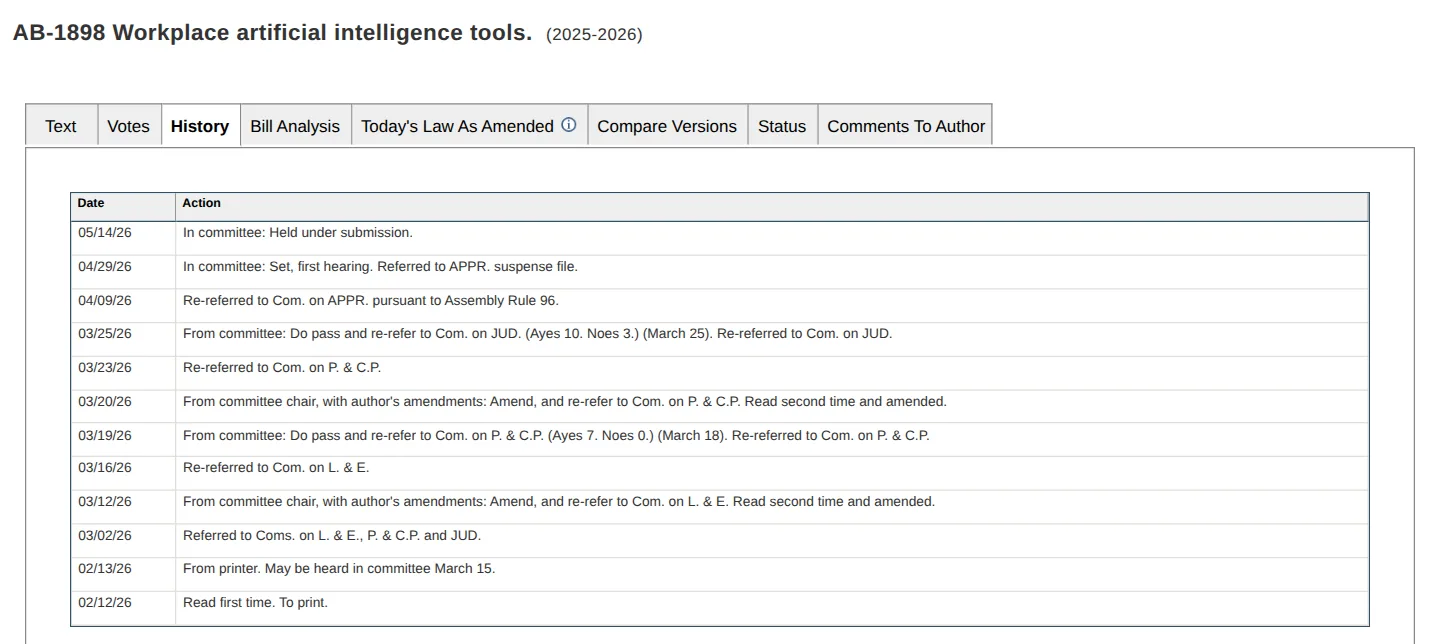 Screenshot: AB 1898 bill history, California Legislative Information, captured October 16, 2026.
The objections were public before the bill stalled. On March 20, 2026, Sacramento lobbying firm Sheehy Strategy Group posted a short video calling AB 1898 well-intentioned but unworkable; its description says the bill "would impose sweeping and impractical requirements that risk undermining innovation, creating operational gridlock, and exposing employers to significant legal and security risks." It is one side's argument, not an official record, but it shows the case opponents made while the bill was in committee.
Video: Sheehy Strategy Group, YouTube, March 20, 2026.
An earlier version of this article said the bill cleared Assembly Appropriations on August 13, 2026 and was waiting for the governor. That was wrong; see the correction below.
What AB 1898 would have required
For the record, the last version (amended March 20, 2026) would have:
| Duty | AB 1898 as last amended |
|---|---|
| Advance notice | At least 90 days before a workplace AI tool is first deployed |
| Tools already in use | Notice by February 1, 2027 |
| Deployment gate | No use until affected workers return their signed notices |
| Annual list | All workplace AI tools in use, from February 1, 2028 |
| Penalty | Up to $500 per employee for each violation |
None of this applies. A similar bill could come back in a later session, but nothing in this table is a legal duty today.

What passed instead: AB 1883
AB 1883 (Bryan), "Workplace surveillance tools," was approved by the governor on September 30, 2026 and chaptered as Chapter 853, Statutes of 2026. It adds Part 5.8 to the Labor Code. The core rule: an employer may not use a workplace surveillance tool that uses AI on employees to recognize, or make inferences or predictions about, a person's emotional state, or to collect neural data.
What that means in practice:
- Who is covered. Private employers and public ones, including state agencies, cities, counties, school districts and the University of California, plus labor contractors and the businesses that use them.
- What counts as a surveillance tool. Any system that collects employee data, communications, biometrics or behavior other than by a person watching directly, including video or audio surveillance, time-tracking and geolocation.
- Exceptions. Safety uses are allowed, as are uses reasonably necessary to meet a federal statute, regulation or binding contract for aircraft development or national security, military, space or defense work.
- Enforcement. The Labor Commissioner or a public prosecutor can enforce it, with penalties of up to $500 for each violation; an employee can also recover the penalty. In a civil action the petitioner may seek injunctive relief, including punitive damages, and attorney's fees.
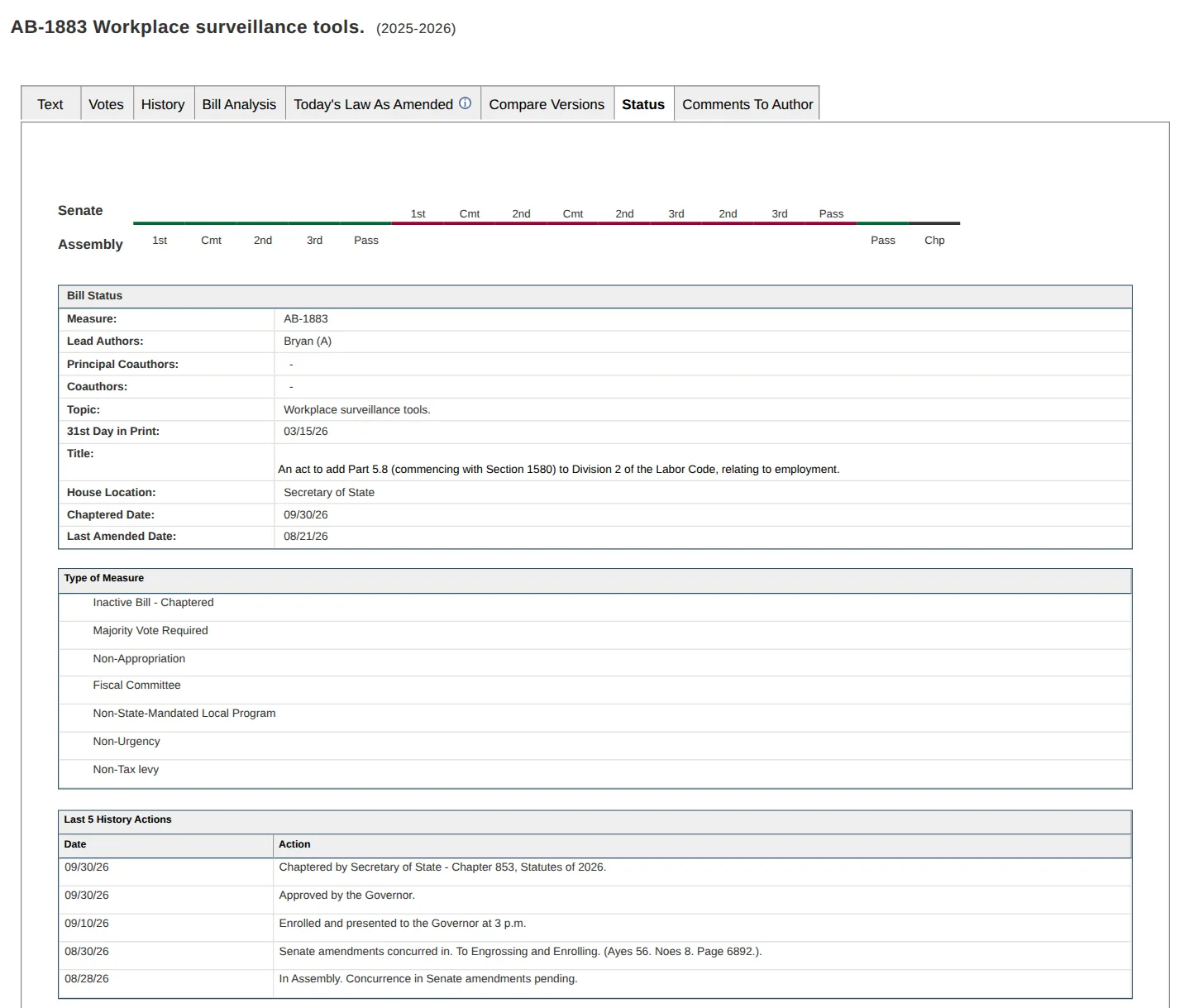 Screenshot: AB 1883 bill status, California Legislative Information, captured October 16, 2026.
AB 1883 has no urgency clause, so under the California Constitution it takes effect January 1, 2027.
Expect changes. In his signing message, Newsom wrote that AB 1883 "lacks key definitions, which may create confusion about which tools are covered," and asked the Legislature to refine it. Plan for the current text until an amendment passes.
Workers noticed the penalty first. When AB 1883 cleared the legislature, one of the most upvoted replies in an r/California thread said "A $500 fine is a pretty low price for spying on your employees." Another commenter answered that "per violation can add up quick," and a third asked "how is it enforced?" The text answers that one: the Labor Commissioner or a public prosecutor enforces it, and an employee can recover the penalty.
SB 947 and SB 951 were signed the same day. We cover them in our SB 947 and SB 951 guide; the September 30 signings roundup lists the rest.
What to do before January 1, 2027
- Stop AB 1898 work, or keep it as good practice only. Telling workers about AI tools before rollout is still sensible, but no California law requires a 90-day wait or signed acknowledgments.
- Check every monitoring and HR tool for emotion or neural features. Look for sentiment scoring on calls, facial-expression analysis in video meetings, "engagement" or mood scores, and wearables or headsets that measure nervous-system activity. Ask vendors in writing whether those features exist and whether they can be switched off for California employees.
- Turn off or replace what you find before January 1, 2027. Notice and consent don't fix it; the use itself is barred unless an exception applies.
Our take
AB 1898 drew law firm alerts and our own coverage, but it stopped in May; Mintz's list of the workplace AI bills signed on September 30 doesn't include it. The law that actually changes California employers' tool stacks is the narrower one. If a vendor sells you emotion analytics, that feature becomes a liability in California on January 1, 2027.
Correction (October 16, 2026): An earlier version of this article said AB 1898 cleared the Assembly Appropriations Committee 5-2 on August 13, 2026, that employers must give 90-day notice and collect signed acknowledgments, and that notices for existing tools were due February 1, 2027. The committee held the bill under submission on May 14, 2026 and it never became law (bill history). We also corrected AB 1883's status: it was signed September 30, 2026 (status). We removed the earlier descriptions of SB 947 and SB 951; see our separate guide.
Related Reading
-
California SB 947 and SB 951: No Robo Bosses and Worker Displacement Act
-
AI Employee Monitoring Disclosure Laws 2026: State-by-State Tracker
Sources: AB 1898 bill history, AB 1898 status and text as amended March 20, 2026; AB 1883 status and chaptered text; California Constitution, Article IV, Section 8. All read October 16, 2026.