Image: Unsplash.
If your ads use an AI avatar, a synthetic spokesperson or an invented "customer", New York now wants a label on them. General Business Law 396-b is short: a definition, one disclosure duty, a penalty and a list of exemptions. We read the enacted bill, S8420-A, on the New York State Assembly site and corrected an earlier version of this guide, which described a platform takedown duty that doesn't exist. Below is what the text says, the wording we'd use, and a checklist for a small marketing team.
What the law requires
Governor Kathy Hochul signed S8420-A (same as A8887-B), sponsored by Senator Michael Gianaris and Assemblymember Linda Rosenthal, on December 11, 2025 as Chapter 617 of the Laws of 2025. It took effect on June 9, 2026.
| Element | What the text says |
|---|---|
| Who must disclose | Any person "engaged in the business of dealing in any property or service" who, for a commercial purpose, produces or creates an ad for that property or service |
| Which ads | Ads "in any medium or media" |
| The duty | Conspicuously disclose in the ad that a synthetic performer is in it |
| Knowledge | Only "where such person has actual knowledge" |
| Penalty | A civil penalty of $1,000 for a first violation and $5,000 for any later one (the amounts in the verdict above) |
| Who enforces | Not stated |
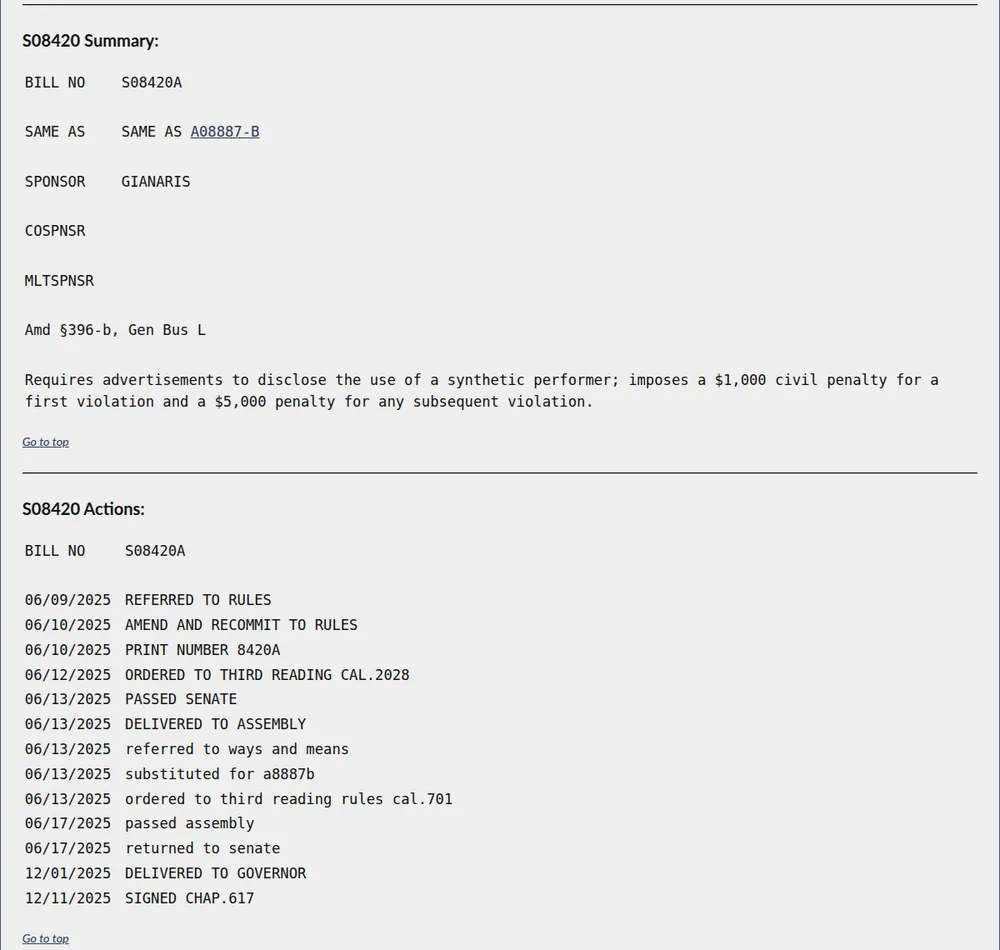
Screenshot: S08420A bill page, New York State Assembly, checked October 16, 2026.
When the governor announced on June 9 that the law was in force, Rosenthal said "consumers have a right to know if the person featured in those ads is real or fake." SAG-AFTRA, the performers' union, backed it as protection against "performance replacement".
What counts as a synthetic performer
The statute defines it as "a digitally created asset created, reproduced, or modified by computer, using generative artificial intelligence or a software algorithm, that is intended to create the impression that the asset is engaging in an audiovisual and/or visual performance of a human performer who is not recognizable as any identifiable natural performer."
Three things follow from that sentence. It covers software, not only AI, so a digital human built with ordinary visual-effects tools can count, as Cooley's lawyers point out. It needs a visual performance, which is why audio-only ads are also exempt. And it excludes anyone recognizable, which is where likeness laws take over.
| Content in your ad | Covered by 396-b? | Why |
|---|---|---|
| An AI avatar spokesperson who isn't any real person | Yes | A digital human performance, not recognizable as a real person |
| An invented "customer" in a testimonial video | Yes | Same reasoning |
| A CGI digital human made without generative AI | Yes | "or a software algorithm" |
| Digital extras in the background of a scene | Possibly | The law doesn't define "performer"; Cooley thinks it may reach extras |
| An AI clone of a real, named employee or influencer | No | Recognizable as a real person: a likeness and consent question |
| An AI voice-over with no on-screen human | No | Not a visual performance, and audio ads are exempt |
| An AI dub of a real actor's own lines into another language | No | Exempt when AI is used solely for translation |
| A video game character in that game's own ad | No | Expressive works exemption, if used as in the game |
Who isn't covered
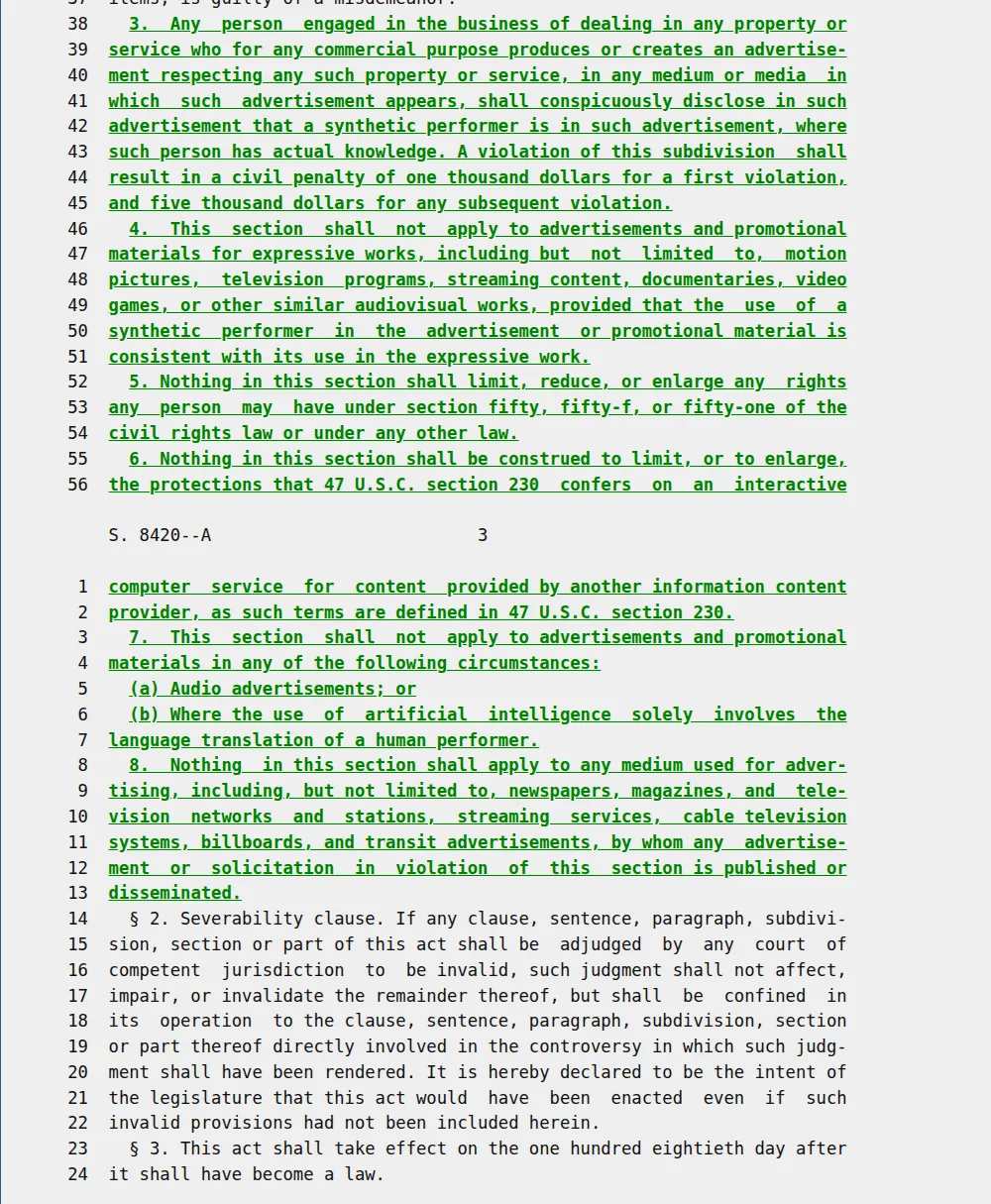
Screenshot: S8420-A text, subdivisions 3 to 8, New York State Assembly.
- Ads for expressive works (subdivision 4): films, TV programs, streaming content, documentaries, video games and similar works, provided the synthetic performer is used in the ad the same way it is in the work.
- Audio ads and translation (subdivision 7): audio advertisements, and cases where AI "solely involves the language translation of a human performer".
- The media that carry the ad (subdivision 8): newspapers, magazines, TV networks and stations, streaming services, cable systems, billboards and transit ads that publish or disseminate it. There is no takedown or remediation duty for them.
- Other rights stay as they are (subdivisions 5 and 6): the section doesn't change rights under New York Civil Rights Law sections 50, 50-f and 51, and neither limits nor enlarges Section 230 protection for online services.
Deceased performers' digital replicas are handled by a different bill signed the same day, S8391 (Chapter 616 of the Laws of 2025), which amends Civil Rights Law 50-f. It isn't an exemption inside 396-b.
Writing the disclosure
The statute says "conspicuously" and nothing more: no wording, placement, size or duration. McDermott Will & Schulte suggests the FTC's "clear and conspicuous" standard as a working benchmark, meaning close to what it qualifies, big and long enough to notice, and not hidden behind a link or in fine print. We'd go one step further on video. A bill introduced in the Assembly on September 2, 2026, A11683, would require the disclosure in audiovisual ads to stay "visible for the entire duration" the synthetic performer is on screen. It's only in committee, but it tells you what the sponsor thinks "conspicuous" should mean.
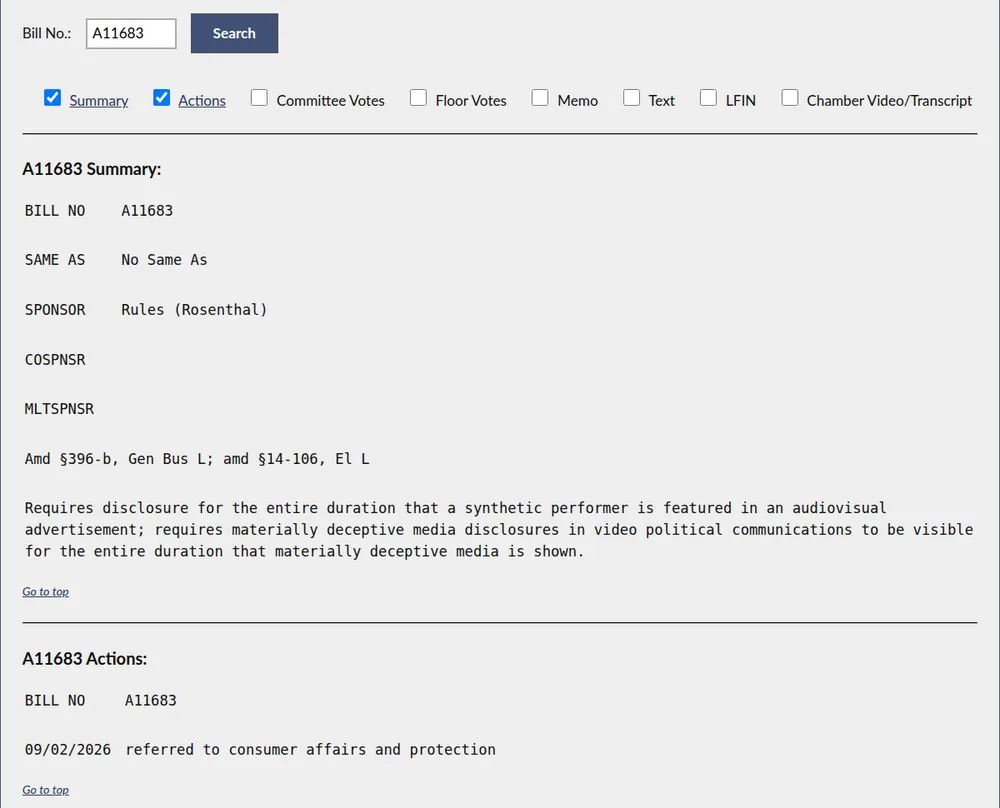
Screenshot: A11683 bill page, New York State Assembly, checked October 16, 2026.
Wording you can copy
No wording is a safe harbor until the state or a court says so. These say plainly that a synthetic performer is in the ad:
Short (on-screen overlay, social captions):
"This ad contains an AI-generated performer."
Standard (video card, ad copy):
"This advertisement contains one or more synthetic performers generated using artificial intelligence."
Long (landing pages, print):
"One or more people shown in this advertisement were digitally created and do not depict any real individual."
The standard line is also one of McDermott's examples. If the performer was built with CGI rather than generative AI, drop the AI wording and say "digitally created".
Where to put it
Our suggestions, based on the FTC benchmark and the A11683 approach, not on rules in the statute:
- Video ads on social platforms and pre-roll: burn the line into the video while the performer is on screen, and repeat it in the ad text above any "more" cutoff.
- Image ads: on the image itself, near the performer, at a readable size.
- CTV and streaming: on screen for the whole time the performer appears, since there is often no text field.
- Landing pages: next to the content with the performer, not only in the footer.
Penalties and enforcement
The penalty is a civil penalty for each violation, at the two amounts in the verdict. The statute doesn't say who brings the case or whether a violation is counted per ad, per placement or per day. McDermott notes there is no express private right of action, "suggesting that enforcement would likely rest with the New York attorney general or another state enforcement authority." We found no announced enforcement action as of October 16, 2026.
Checklist for a small marketing team
- 1. List every live and recent ad with a digital human. Avatars, AI spokespeople, invented testimonial "customers", CGI extras.
- 2. Sort each one with the table above. Fully synthetic (disclose), a real person's likeness (consent question under other laws), voice-only or translation-only (exempt).
- 3. Ask your agency and AI vendors in writing which assets are synthetic. The duty turns on actual knowledge, so find out rather than guess.
- 4. Add the disclosure using the wording above, on screen while the performer is visible.
- 5. Decide the New York question once. If ads are national or you can't confirm New York is excluded from targeting, treat them as in scope.
- 6. Put a synthetic-performer check in creative approval so no ad ships without a disclosure decision.
- 7. Add a contract clause making agencies and freelancers flag synthetic performers and the disclosure before delivery.
- 8. Keep a record of what you reviewed, what you decided and who told you an asset was synthetic.
- 9. Watch A11683. If it passes, it takes effect 30 days after it becomes law and changes both the duration rule and the definition.
How it fits with likeness laws
| Law | What it covers | Real person required? | Remedy |
|---|---|---|---|
| New York GBL 396-b (June 9, 2026) | Disclosure of synthetic performers in ads | No, the opposite: the performer must not be recognizable | Civil penalty, at the amounts above |
| Washington personality rights law (SSB 5886, June 11, 2026) | Use of a real person's name, voice, photograph, likeness or forged digital likeness in goods, ads or fundraising without consent | Yes | $3,000 civil penalty plus actual damages and profits; noneconomic damages for a forged digital likeness |
| Tennessee ELVIS Act (signed March 21, 2024) | Adds voice to Tennessee's existing protection of a person's name, image and likeness | Yes | See our ELVIS Act guide |
New York asks whether you told viewers a human was fake. Washington and Tennessee ask whether you had permission to use a real one. A campaign with both kinds of AI people needs both checks.
What we could not confirm
- Who enforces. The statute names no agency. The attorney general is the likely candidate but hasn't said so publicly that we could find.
- Out-of-state advertisers. The disclosure duty has no geographic wording, unlike the older dealer-ad rule in the same section, which says "in this state". How New York will treat an ad made elsewhere but shown to New Yorkers is untested.
- How violations are counted. Per ad, per placement or per impression is not stated.
- A11683's chances. It was referred to the Assembly consumer affairs committee on September 2, 2026, with no further action listed when we checked.
Correction (October 16, 2026): An earlier version said platforms must remove flagged non-compliant ads within 5 days of notice; the law has no such duty, and subdivision 8 exempts the media that publish or disseminate ads. It said the attorney general enforces the law; the statute names no enforcer. It said New York enacted the law in January 2026; Governor Hochul signed it on December 11, 2025 as Chapter 617 of the Laws of 2025. It said the law applies to any ad that reaches New York consumers wherever the advertiser is based; the statute doesn't say. It listed deceased performers' digital replicas as an exemption; they are covered by a separate law, Chapter 616, and 396-b has no such exemption. It said several states had introduced copies of the law in 2026, which we could not source. An earlier version also dated Washington's AI likeness law June 10, 2026; the Washington Legislature's bill page for SSB 5886 lists June 11, 2026, and the same row said the Washington law covers sexual and deceptive AI content with statutory damages; the enacted text covers use in goods, advertising and fundraising, with a civil penalty plus actual damages, profits and, for a forged digital likeness, noneconomic damages.
Related Reading
- Washington AI likeness law (SSB 5886): consent checklist
- Tennessee ELVIS Act AI voice and likeness compliance guide
- FTC AI marketing claims checklist 2026
- State chatbot disclosure laws 2026 compliance checklist
- EU AI Act Article 50 chatbot and deepfake disclosure
- Multi-state AI compliance strategy 2026
- AI Acceptable Use Policy template for small teams
- Germany Deepfake Law: Cabinet Bill and Platform Court Orders
- Pennsylvania SB 806 AI Ad Disclosure: Text, $3,000 Fine, Checklist
- Kangana Ranaut deepfake order: fake quotes and false endorsements