


Use this page if your product generates or edits images, audio, video or text for people in the EU. On December 2, 2026, two things start under Regulation (EU) 2026/1744, the "Digital Omnibus on AI" that amended the AI Act on July 8, 2026:
| What starts on December 2, 2026 | Who it hits | Where it is in the law | Maximum fine |
|---|---|---|---|
| Ban on AI systems that generate realistic intimate images, video or audio of an identifiable person without explicit consent | Providers whose system is built for it or produces it foreseeably without safeguards; deployers who use a system for it | AI Act Article 5(1)(ba), (1a), (1b) | 35 million euros or 7% of worldwide turnover |
| Ban on AI systems that generate child sexual abuse material | Same split between providers and deployers | Article 5(1)(bb), (1a) | Same |
| Machine-readable marking of outputs, for generators placed on the market before August 2, 2026 | Providers of the generative system | Article 50(2), deadline in Article 111(4) | 15 million euros or 3% |
For SMEs and start-ups, each cap is whichever of the two figures is lower (Article 99(6)).
A generator launched on or after August 2, 2026 got no grace period. Article 50 has applied since that date, so a feature you shipped in September has needed marked outputs from day one. The December date only buys four months for systems already on the market, which is how Recital 38 of the Omnibus describes it.
The rest of this page is in the order we would do the work: work out your role, run the ban screen, fix marking, then labels and paperwork.
Step 1: Decide whether you are the provider
The AI Act calls you a provider when you place an AI system on the market "under its own name or trademark, whether for payment or free of charge" (Article 3(3)). If you wrap a vendor's image model in your own app and sell it under your brand, you are very likely the provider of that AI system, even though someone else trained the model. Your vendor is the provider of the model and, often, of its own consumer app.
That matters because both December duties land mostly on providers. A deployer is a business using a system under its authority; deployers are caught by the ban only when they use a system for the banned purpose, and their Article 50 duty is disclosure, not marking.
One supervision detail: after the Omnibus, the AI Office, not a national authority, is exclusively competent for AI systems built on a general-purpose model "where the model and the system are developed by the same provider" (Article 75(1) as amended). For a small team building on someone else's model, expect the national market surveillance authority.
Step 2: Run the ban screen
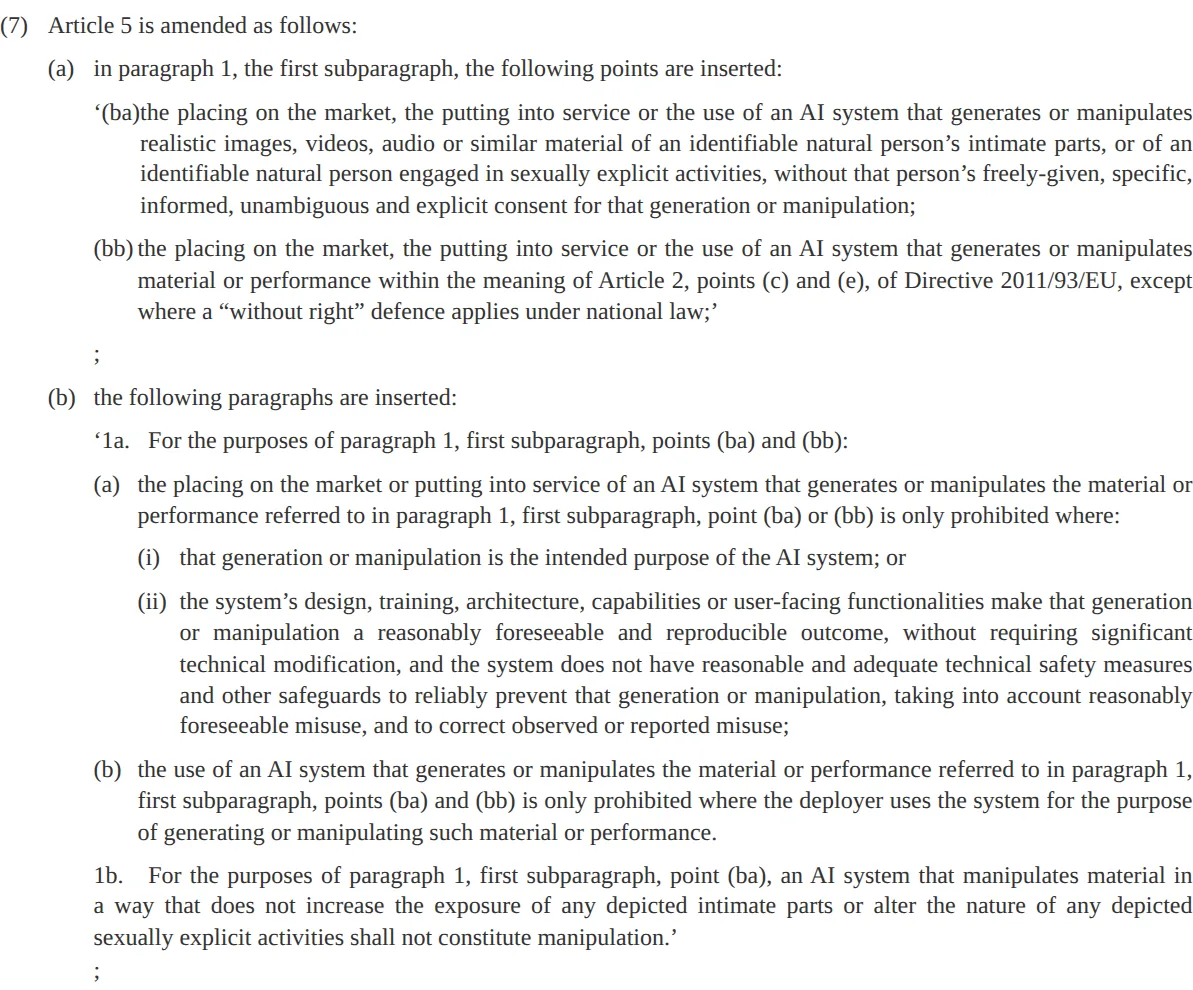 Screenshot: Regulation (EU) 2026/1744, Article 1, point 7 (amendments to Article 5 of the AI Act), EUR-Lex, taken October 24, 2026.
We read the amended Article 5 on EUR-Lex. Point (ba) covers "realistic images, videos, audio or similar material of an identifiable natural person's intimate parts", or of that person engaged in sexually explicit activity, without their "freely-given, specific, informed, unambiguous and explicit consent". Point (bb) covers child sexual abuse material as defined in Article 2(c) and (e) of Directive 2011/93/EU.
Paragraph 1a is the part to read twice. A provider breaks the ban in one of two cases:
- Producing that material is the intended purpose of the system.
- The system's design, training or features make it "a reasonably foreseeable and reproducible outcome", "without requiring significant technical modification", and the system lacks reasonable and adequate safeguards to reliably prevent it and "to correct observed or reported misuse".
So a general-purpose image tool is not banned because a determined user could jailbreak it. It is banned if an ordinary user can get the output repeatedly and you have no working safeguards or no way to act on reports. Paragraph 1b adds that an edit which does not increase the exposure of intimate parts, or change the sexual activity shown, is not "manipulation".
Recital 12 lists what counts as safeguards: "data cleaning, refusal training, safe prompt design and output controls, runtime prompt guardrails, content classification and filtering mechanisms, usage restrictions, abuse detection mechanisms, and notice and action mechanisms". It also puts cartoonish or physically impossible depictions outside the ban, along with consented try-on and medical applications, and says a deployer is not caught by "accidental generation".
Screen each feature with these questions:
- Can a user upload or name a real, identifiable person and get a realistic altered image, video or voice of them?
- If yes, which of the Recital 12 safeguards are actually running in production, and has anyone tested them against obvious prompts?
- Is there a report button or abuse inbox, and a written process for acting on a report?
- For CSAM: are classifiers and refusals in place at both prompt and output?
- If the feature is meant to generate intimate content of real people (an adult platform, say), can you collect and prove explicit consent from the person depicted?
If the first answer is yes and any of the next three is no, fix that before December 2 or switch the feature off for EU users. The ban covers placing the system on the EU market, so a server outside the EU does not help.
Step 3: Check your output marking
Article 50(2) requires providers of systems "generating synthetic audio, image, video or text content" to mark outputs "in a machine-readable format" so they are detectable as AI-generated. The solution has to be "effective, interoperable, robust and reliable as far as this is technically feasible". Text was in the original 2024 Act; the Omnibus did not add it. There is an exception for systems that "perform an assistive function for standard editing" or do not substantially alter the input.
The law does not say which technique. The Code of Practice on Transparency of AI-generated Content does, and it now carries weight: the Commission published the final Code on June 10, 2026, and on July 8 concluded that it adequately covers Articles 50(2), (4) and (5); the AI Board adopted its adequacy assessment the following day. Signing is voluntary. The Commission's guidelines say a company that does not sign "will have to demonstrate compliance" by other adequate means, and signing is not "conclusive evidence" either.
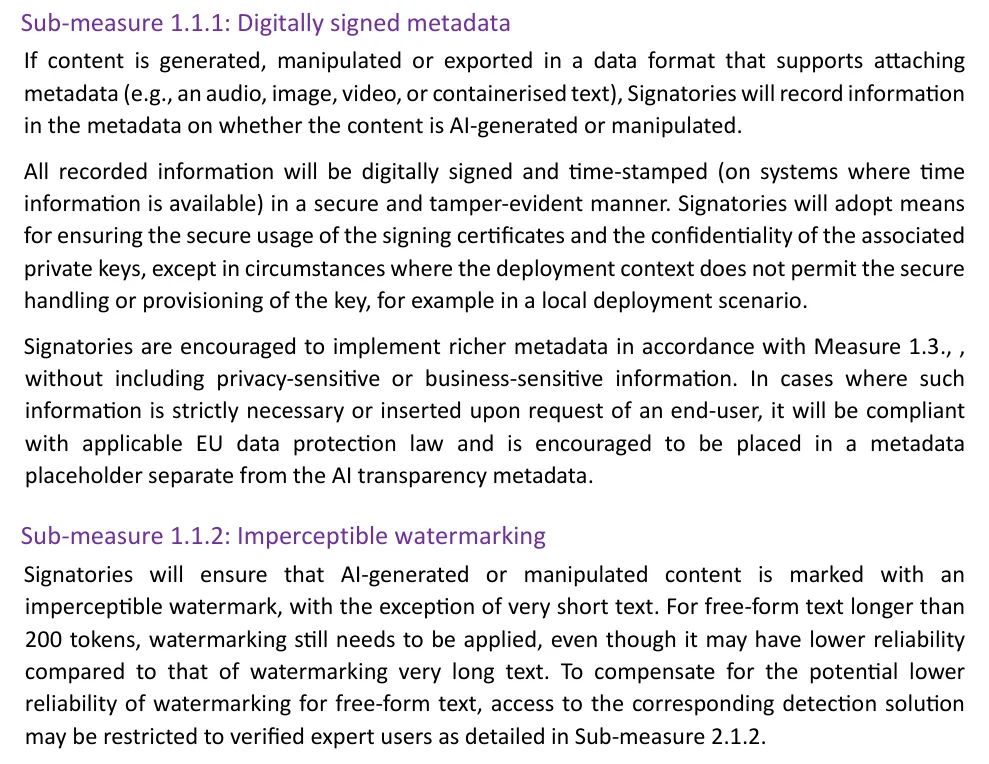 Screenshot: Code of Practice on Transparency of AI-generated Content, page 9 (Sub-measures 1.1.1 and 1.1.2), European Commission.
What the Code asks of providers, from Section 1:
| Content | What the Code expects | Where |
|---|---|---|
| Audio, images, video, containerised text | At least two layers: digitally signed, time-stamped metadata and an imperceptible watermark | Measure 1.1, Sub-measures 1.1.1 and 1.1.2 |
| Free-form text | A watermark alone is enough, since plain text cannot carry metadata; text over 200 tokens must be watermarked, very short text is excepted | Measure 1.1, Sub-measure 1.1.2 |
| Logging or fingerprinting | Optional extra; "relying on fingerprinting or logging alone is not considered sufficient" | Sub-measure 1.1.3 |
| Marks already on input files | Keep them; put a ban on removing or tampering with marks in your terms or acceptable use policy | Measure 1.2 |
The Code lets marking happen upstream: a model provider or a specialist vendor can apply it, and you "may rely on those third-party technical solutions without prejudice to" your own responsibility. For a small team, that is the realistic path. The checklist:
- List every feature that outputs audio, images, video or text to EU users, with its EU launch date (before or after August 2, 2026).
- For each, find out in writing what your model vendor marks: metadata, watermark, both, and for which output types.
- Generate a sample through your own product, download it the way a user would, and check whether the metadata survived your resizing, compression and CDN.
- Add the marking-removal ban to your terms.
- If you sell text generation under your own brand, ask your vendor how text over 200 tokens is watermarked. If the answer is "we log outputs", the Code says that is not enough by itself.
- Decide whether to sign the Code. By the end of July about 190 organisations had, including Anthropic, Google, Meta, Microsoft, Mistral and OpenAI for Section 1. When we opened the list on October 24 it showed 95 Section 1 and 192 Section 2 signatories.
The metadata test is where teams get surprised. A September 2026 feature request on the django CMS image manager, written to meet Article 50, puts it plainly: "C2PA signatures cannot simply be copied from the original to a modified asset after resizing, cropping or format conversion" (django-filer issue 1636). Every thumbnail step in your stack is a place where the first layer can fall off, which is why the Code wants the second layer inside the content. On the text side, the vLLM RFC proposing built-in watermarking makes the matching point: the watermark "is a modification of the sampling process, which cannot be modified by downstream consumers" (vllm issue 53916). If you call a hosted model, a sampling-time text watermark is something only your vendor can switch on.
Step 4: Labels you show as a deployer
If you publish AI output rather than build the generator, Article 50(4) applies, and has since August 2, 2026. Disclose a deep fake, which the Act defines as content that "resembles existing persons, objects, places, entities or events and would falsely appear to a person to be authentic or truthful". Disclose AI-generated text published to inform the public on matters of public interest, unless it "has undergone a process of human review or editorial control" and someone holds editorial responsibility. Section 2 of the Code describes a label built around the letters "AI", and the Commission has published a set of EU icons deployers may use for it.
What to keep on file
- The role decision from Step 1, per feature, with the reasoning.
- The ban screen from Step 2: which safeguards run, when they were last tested, and the misuse process.
- Your vendor's written answer on marking, and the result of your own sample test, dated.
- The terms clause banning mark removal.
- If you signed the Code, the date and the sections signed.
What we could not confirm
National penalty rules. Article 99(1), as amended, leaves penalties to Member States and asks them to take SMEs' "economic viability" into account; we did not check national laws one by one. We also have not seen an updated version of the Commission's Article 5 guidelines covering points (ba) and (bb). We will update this page when either appears.
Timeline
| Date | Event |
|---|---|
| June 10, 2026 | Commission publishes the final Code of Practice on Transparency of AI-generated Content |
| June 16, 2026 | European Parliament adopts its position on the Omnibus |
| June 29, 2026 | Council decision |
| July 8, 2026 | Regulation (EU) 2026/1744 signed; Commission concludes the Code is adequate |
| August 2, 2026 | Article 50 applies; new generators must mark outputs from launch |
| December 2, 2026 | Bans in Article 5(1)(ba) and (bb) apply; marking deadline for generators placed on the market before August 2, 2026 |
Correction (October 13, 2026): An earlier version said all AI watermarking and deployer disclosure start December 2, 2026, that the Omnibus added text to the watermarking scope, and that the ban only covers systems whose primary purpose is explicit content. Article 50 applies from August 2, 2026, text was already covered, and the ban also reaches foreseeable outcomes without safeguards.
Update (October 24, 2026): Rewritten against the Omnibus text, the final Code of Practice and the Commission's adequacy opinion. We removed advice that logging could stand in for a text watermark (the Code says it cannot) and an internal October 1 target date that had passed.
Related reading
- EU AI Act deadline extended to December 2027, full Omnibus timeline
- GPAI enforcement August 2026, enforcement powers that activate in August
- EU AI Act compliance guide for small teams, full obligation map
- EU AI Act Article 5 prohibited practices, the full prohibition list including points (ba) and (bb) as amended by the Omnibus
- EU AI Act Article 50: AI Content Labeling and Deepfake Disclosure Checkl
- Minnesota Nudify App Ban Is Live After xAI Loses First Round
- OpenAI text watermark in the EU: what a watermark cannot prove
- Denmark deepfake bill (Oct 8, 2026): consent and takedown kit
- EU Product Liability Directive and AI: what applies from December 9, 2026
References
- Regulation (EU) 2026/1744 (Digital Omnibus on AI), EUR-Lex
- Regulation (EU) 2024/1689 (AI Act), EUR-Lex
- European Commission, Code of Practice on Transparency of AI-generated Content (PDF)
- European Commission, Commission publishes Code of Practice on marking and labelling AI-generated content, June 10, 2026
- European Commission, Commission opinion on the assessment of the Code of Practice, July 9, 2026
- European Commission, Guidelines on transparency obligations for providers and deployers of certain AI systems
- European Commission, Strong backing for the Code of Practice (signatory list)