 Image: Pexels, used under the Pexels License.
This checklist is for teams that sell software with AI features to people in the EU, or build AI into a product someone else sells. The date is December 9, 2026. Directive (EU) 2024/2853 replaces the 1985 product liability directive for every product "placed on the market or put into service after 9 December 2026", and the same day is the deadline for Member States to write it into national law.
What changes, in one line each:
| Question | Answer under Directive (EU) 2024/2853 | Article |
|---|---|---|
| Is AI software a product? | Yes. Software is a product; the recitals name AI systems and software supplied "through a software-as-a-service model" | Art. 4(1), Recital 13 |
| Who can claim? | Natural persons only | Arts. 1, 5 |
| For what? | Death or injury, including "medically recognised damage to psychological health"; damage to property not used exclusively for professional purposes; destruction or corruption of data not used for professional purposes | Art. 6 |
| Must they prove fault? | No. They prove the defect, the damage and the causal link, and courts can presume the defect or the link in set cases | Arts. 10(1) to 10(4) |
| Who pays? | The manufacturer, the maker of a defective component, a company that substantially modified the product, and for non-EU makers an EU importer or authorised representative | Art. 8 |
| Can a contract cap it? | Not toward the injured person | Art. 15 |
| How long? | 3 years from when the person knew; no claim 10 years after the product was placed on the market (25 for latent personal injury) | Arts. 16, 17 |
The old version of this page called this "strict liability for AI deployers". That overstated it. Most of the exposure lands on whoever puts the AI product on the market, and only people, not companies, can claim.
Step 1: Work out whether you are a manufacturer
The Directive's word is "manufacturer", and it is wider than the company that trains a model. Article 4(10) includes anyone who "by putting their name, trademark or other distinguishing features on that product, presents themselves as its manufacturer", and anyone who develops a product for their own use. Recital 13 adds that providers of AI systems under the AI Act "should be treated as a manufacturer".
Sort each AI feature into one of these rows:
| Your situation | Likely PLD role | Why |
|---|---|---|
| You sell an app or device under your brand that includes a vendor's model | Manufacturer of the product; the model vendor can also be liable as maker of a defective component | Art. 4(10), Art. 8(1)(b) |
| You fine-tune or reconfigure a product after it is on the market, outside the original maker's control, and sell or deploy it | Possibly a new manufacturer, if the change is a "substantial modification" | Art. 8(2), Art. 4(18) |
| You resell a non-EU AI product into the EU | Importer, liable alongside the non-EU maker | Art. 8(1)(c) |
| You distribute someone else's product unchanged | Liable only if you cannot name an EU-based operator within one month of a request | Art. 8(3) |
| You build an internal tool used in your business | Manufacturer of a product "put into service", but only people (staff, customers) harmed by it can claim | Art. 4(9), Art. 4(10)(c) |
The substantial modification test is two-part where no product safety rule sets its own threshold: the change alters the product's "original performance, purpose or type" in a way the original maker's risk assessment did not foresee, and it "changes the nature of the hazard, creates a new hazard or increases the level of risk". In our reading, a fine-tune that only changes the tone of a support bot fails the second part, and a fine-tune that lets the same bot give dosing advice may pass both. Recital 40 adds that "continuous learning of an AI system" can produce a substantial modification, dated to when it happens.
Step 2: Find the failure modes that can hurt a person
 Image: Pexels, used under the Pexels License.
Because only natural persons can claim, and only for the damage types in Article 6, the useful exercise is narrow. List where a wrong output from your AI feature could:
- injure someone or harm their psychological health (health, mobility, physical control, safety advice, companion chat);
- damage property a consumer owns (smart home, vehicle, device control);
- destroy or corrupt a consumer's data (file management, sync, automated deletion).
A B2B analytics tool that gives a customer a bad forecast is, under this Directive, mostly outside scope: the loss is the business's, and its professional data is excluded. That is not a shield against contract claims or national law, which Article 2(4) leaves untouched.
Defect is judged against "the safety that a person is entitled to expect". For AI, Article 7 tells courts to weigh "any ability to continue to learn or acquire new features after it is placed on the market", the point at which the product left the manufacturer's control, and "safety-relevant cybersecurity requirements". Write down, for each failure mode above, what a user is told about limits and what guardrails run.
Step 3: Treat updates as part of the product
This is where AI products differ from a toaster. A manufacturer normally escapes liability if the defect did not exist when the product was released. Article 11(2) removes that escape, within the manufacturer's control, when the defect comes from "software, including software updates or upgrades", or from "a lack of software updates or upgrades necessary to maintain safety". The Commission's summary puts it plainly: manufacturers can be liable for defects that appear "as a result of updates, upgrades or a machine-learning feature".
- Keep dated release notes for model and prompt changes that affect safety-relevant behaviour.
- Have a written policy for how long you ship security and safety updates.
- Log when you learned of a safety issue and when you shipped the fix.
The development-risk defence survives in Article 11(1)(e): you are not liable if the state of scientific and technical knowledge could not reveal the defect, judged also "during the period in which the product was within the manufacturer's control". For a model you keep updating, that period does not end at launch. Article 18 lets Member States limit this defence, so check national law once it exists.
Step 4: Prepare for disclosure and the presumptions
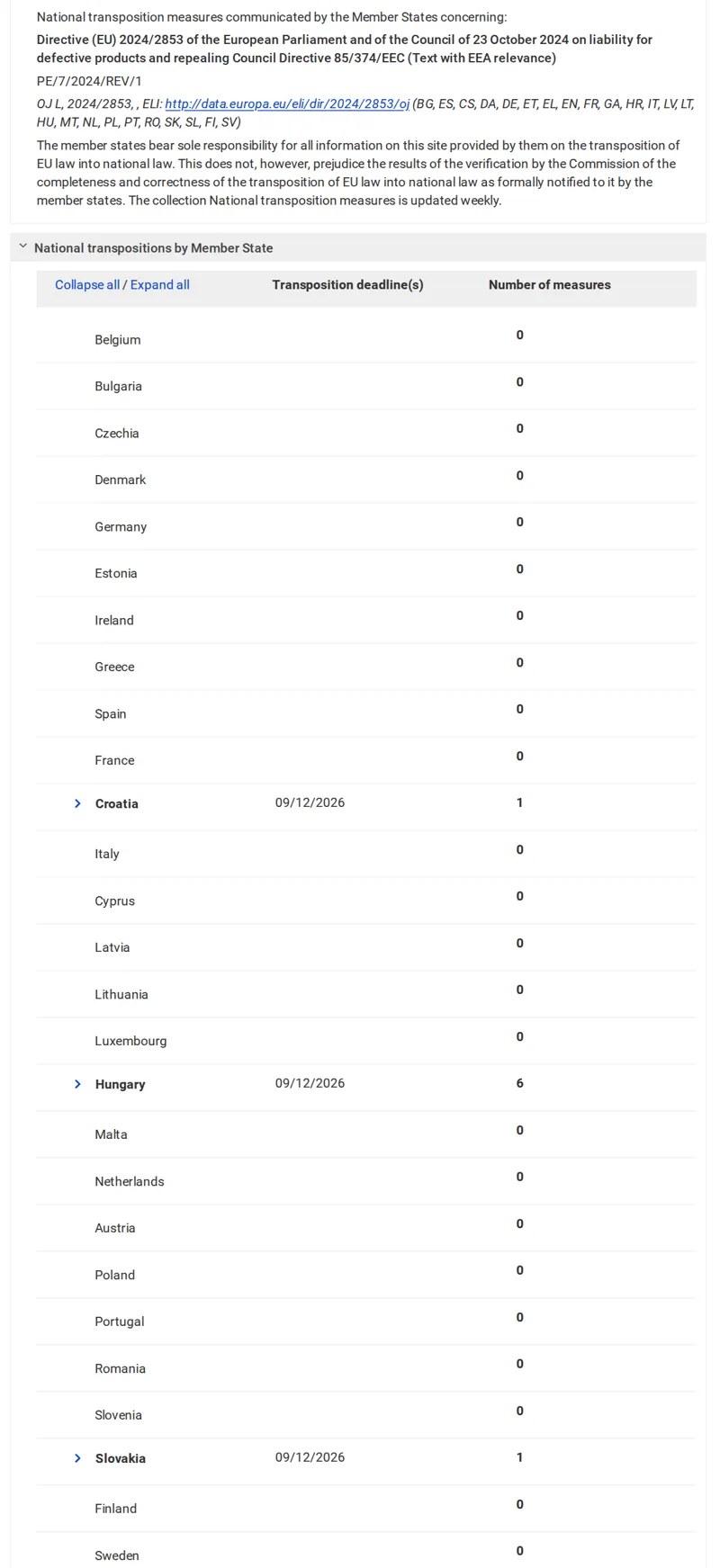 Screenshot: EUR-Lex, national transposition measures for Directive (EU) 2024/2853, taken October 24, 2026.
A claimant who shows a plausible case can get a court order making you "disclose relevant evidence that is at the defendant's disposal" (Article 9). Trade secrets are not a reason to refuse: courts are told to take measures "to preserve the confidentiality of that information" instead. If you fail to disclose, the defect is presumed (Article 10(2)(a)).
Courts must also presume the defect, the causal link or both where the claimant "faces excessive difficulties, in particular due to technical or scientific complexity" and shows the defect or link is likely (Article 10(4)). Every presumption can be rebutted. Your rebuttal is your documentation.
- Know where your model cards, evaluation results, incident records and change logs live, and who can produce them.
- Make sure your vendor contract obliges the model provider to give you the documentation you would need in a claim.
We checked national transposition on EUR-Lex on October 24, 2026, six weeks before the deadline. Only three of the 27 Member States had notified measures: Croatia one, Hungary six and Slovakia one. The other 24 showed none. Member States report this themselves and it lags, but it means the national procedural rules courts will use are mostly not public yet.
Step 5: Fix your contracts
Article 15 means a disclaimer in your consumer terms does nothing against an injured person's PLD claim. Where the money ends up is a matter between companies. Article 12 makes several liable operators jointly and severally liable, and Article 14 gives the one who paid a right of recourse under national law. One exception matters for small software suppliers: a manufacturer that integrates a software component from a micro or small enterprise has no recourse against that supplier if the two "contractually agreed" to waive it (Article 12(2)).
- In vendor contracts, check whether the indemnity covers product liability claims by third parties, not only IP claims.
- If you are a small software supplier, ask your integrator customers for the Article 12(2) waiver.
- Ask your insurer in writing whether your policy covers product liability claims for software placed on the EU market after December 9, 2026.
What this Directive does not cover
- Products placed on the market before December 9, 2026. The 1985 directive continues to apply to them (Article 21).
- Free and open-source software developed or supplied outside a commercial activity (Article 2(2)). If you build it into a commercial product, you can be liable for it; the open-source author is not (Recital 15). Where the line sits is still open among practitioners: on September 15, 2026 the Open Regulatory Compliance working group's FAQ task force logged "What is the FOSS carve-out in the Product Liability Directive (PLD)?" as "a first step towards the question of FOSS SDKs for commercial PaaS offerings" (orcwg/cra-hub issue 359).
- Information. The content of digital files and "the mere source code of software" are not products (Recital 13).
- Fault-based AI claims. The AI Liability Directive is gone. The Commission listed it for withdrawal in its 2025 work programme and the withdrawal notice was published in the Official Journal on October 6, 2025 (C/2025/5423). The Parliament's Legislative Train records: "Proposal officially withdrew in October 2025." Fault claims stay under national law.
What we could not confirm
How national courts will handle disclosure and presumptions in practice: the national laws are not written yet in most Member States. We also did not read the three notified national measures in their own languages. We will review this page when more transposition measures appear on EUR-Lex.
How this fits with the EU AI Act
The two laws are separate. The AI Act sets duties before and after release; the PLD decides who pays when a product injures someone. They meet in Article 10(2)(b): a defect is presumed when the product breaches mandatory safety requirements in EU or national law meant to protect against the damage suffered. For a high-risk AI system, an AI Act breach can therefore feed a PLD presumption. The documentation you keep for the AI Act is also the material you would disclose under Article 9.
Correction (October 24, 2026): The earlier version of this page said the Directive was adopted in November 2024, published on December 18, 2024 and in force "since December 9, 2024". The Council decided on October 10, 2024, the Directive is dated October 23, 2024, and it entered into force on December 8, 2024; December 9, 2026 is both the transposition deadline and the start of application to new products. It also said the AI Liability Directive was still at proposal stage; the Commission withdrew it in 2025. And it said trade secrets would not shield documentation in disclosure; Article 9 requires courts to protect confidential information. The page has been rewritten against the text of Directive (EU) 2024/2853.
Related Reading
- UK Law Commission proposes treating software and AI as products (Oct 2026)
- German court rules Google liable for false AI Overviews (Landgericht München I, May 2026)
- EU AI Act nudification ban and watermarking: December 2, 2026
- Agentic AI liability: who is responsible when AI causes harm
- AI vendor contract redline template 2026
- AI governance checklist 2026
- AI regulation deadline calendar 2026
References
- Directive (EU) 2024/2853 on liability for defective products, EUR-Lex
- National transposition measures for Directive (EU) 2024/2853, EUR-Lex, read October 24, 2026
- European Commission, Liability for defective products
- Withdrawal of Commission proposals, C/2025/5423, Official Journal, October 6, 2025
- European Parliament, Legislative Train: AI liability directive