Image: Pexels, used under the Pexels License.
You need this if anyone at your company reads text written by someone else and might be tempted to run it through a detector: a recruiter with a cover letter, a trainer with a course assignment, an editor with a freelancer's draft. On Monday, October 5, 2026, OpenAI published its approach to EU text provenance: an invisible watermark called textGrain on ChatGPT and Codex text in the EU, opt-in marking for API customers anywhere, and a detector that only approved researchers can use for now. The useful part isn't the watermark. It's OpenAI's own list of what a watermark can't tell you, and that list belongs in your policy before a "no watermark found" result ends up in someone's file.
What's rolling out, and where
| Item | What OpenAI says |
|---|---|
| Announced | October 5, 2026 |
| ChatGPT and Codex | Eligible users on all plans, EU only, "over the coming weeks" |
| API | Opt-in for select models, worldwide, from October 5; off by default |
| Cloud partners | Working on it "in the coming weeks" |
| Method | textGrain, an invisible statistical signal in the model's word choices |
| Detector | Applications open; access limited at first to approved researchers and expert organizations |
| Global default | Not at launch |
The trigger is Article 50 of the EU AI Act, which applies from 2 August 2026 and requires providers of generative AI to mark output in a machine-readable way. Providers whose systems were already on the market before that date have until 2 December 2026 to meet the marking duty, under the Digital Omnibus. The Commission's timeline puts the final Code of Practice on AI-generated content at the June 10, 2026 closing plenary, and its list of signatories includes Anthropic, Google, Meta, Microsoft and OpenAI. TechCrunch's report on the announcement adds that Anthropic said in August it would watermark Claude text, and is applying it worldwide.
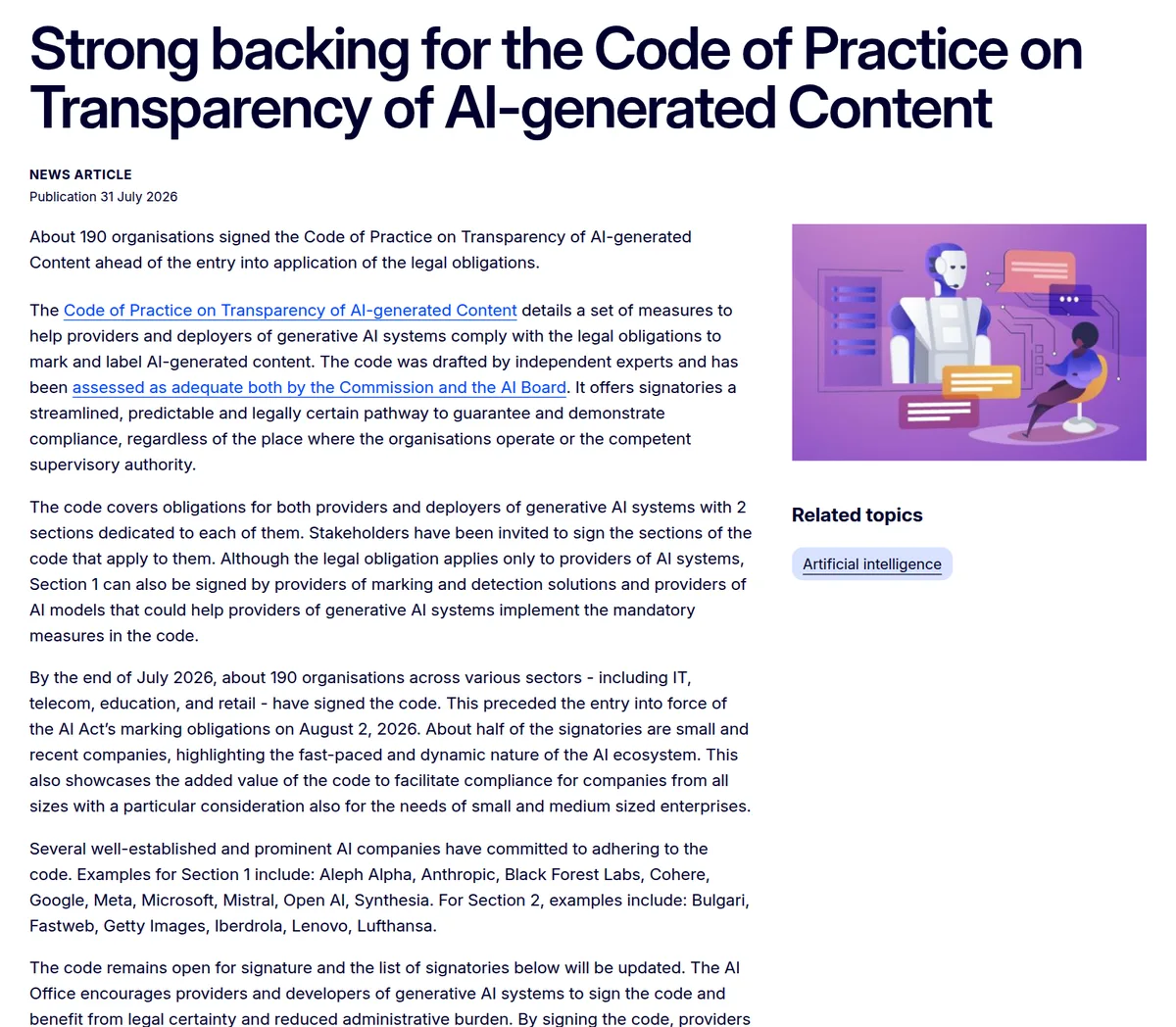
Screenshot: "Strong backing for the Code of Practice on Transparency of AI-generated Content", European Commission, Shaping Europe's digital future.
ThePrint's six-minute explainer, posted the day after the announcement, walks through what the mark can and can't show:
Copy this: staff rule on AI text provenance
AI TEXT PROVENANCE RULE (draft, review with counsel before adoption)

1. Some AI providers add an invisible watermark to generated text. We do not
   remove, disguise or try to defeat it.
2. We never treat the absence of a watermark as proof that a person wrote a text,
   and we never treat a watermark detection as proof of misconduct. A detection
   result is one weak signal and starts a conversation, not a decision.
3. Where we must tell people that content is AI-generated (client work, public
   statements, EU-facing material), we say so in plain words, whether or not the
   text carries a watermark.
4. We record which tool produced AI-assisted text we publish or send to
   clients: tool name, date, and who reviewed it.
5. Decisions about hiring, grading or discipline are never based on a watermark
   or detector result alone.
Owner: [role]        Review date: [date]
Rules 2 and 5 are the ones that protect you. They keep a weak signal from becoming an accusation. Rule 1 matters too: stripping a provider's mark from text you then publish to EU readers is a poor look if a regulator ever asks how you handle Article 50.
Why each clause is there: OpenAI's own limits
OpenAI lists five things a watermark doesn't tell you. They're blunt, and worth quoting in your own training material.
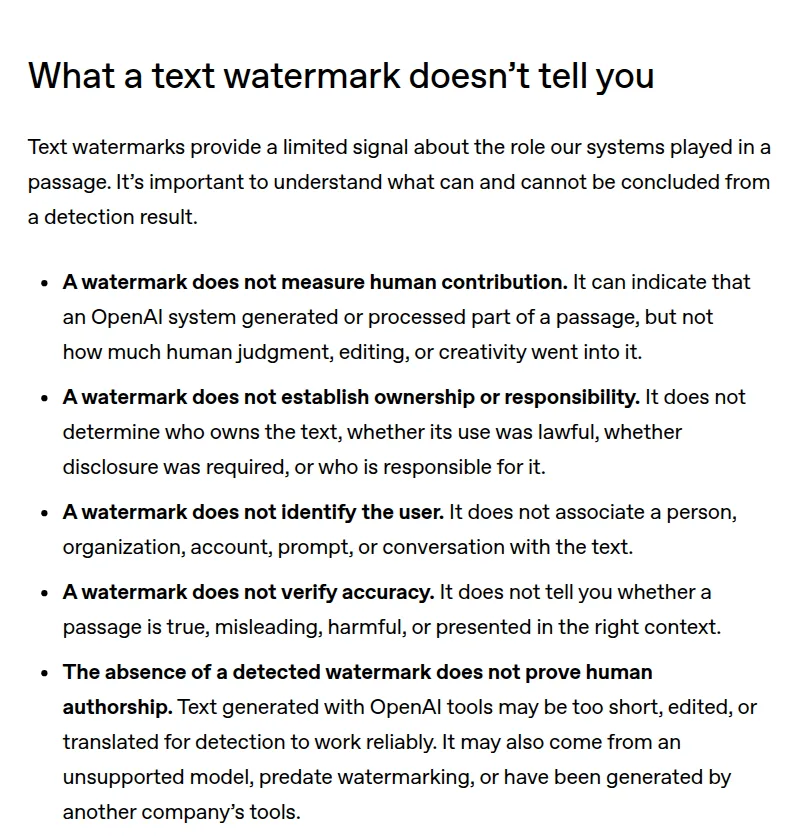
Screenshot: "Our approach to EU text provenance rules", OpenAI, October 5, 2026.
- It doesn't measure human contribution. It can show an OpenAI system generated or processed part of a passage, not how much judgment or editing a person added. That's why rule 5 exists.
- It doesn't settle ownership or responsibility, including whether disclosure was required. That's rule 3: your disclosure duty is yours to check.
- It doesn't identify the user. No person, account, prompt or conversation is tied to the text.
- It doesn't verify accuracy. A watermarked passage can be false.
- No watermark doesn't mean a human wrote it. The text may be short, edited, translated, from an unsupported model, from before watermarking, or from another company's tool. That's rule 2.
The detection numbers, read plainly
These are OpenAI's evaluations at a target false positive rate of 1%, on English answers from the ELI5 dataset.
| Test | Detection rate |
|---|---|
| 200-token passage, psychology content | About 80% |
| 400-token passage, psychology content | About 95% |
| Mathematics content | "Substantially lower" |
| 400 tokens, 10% of words swapped for synonyms | About 92% down to 66% |
| 400 tokens, 25% of words swapped | Down to 17% |
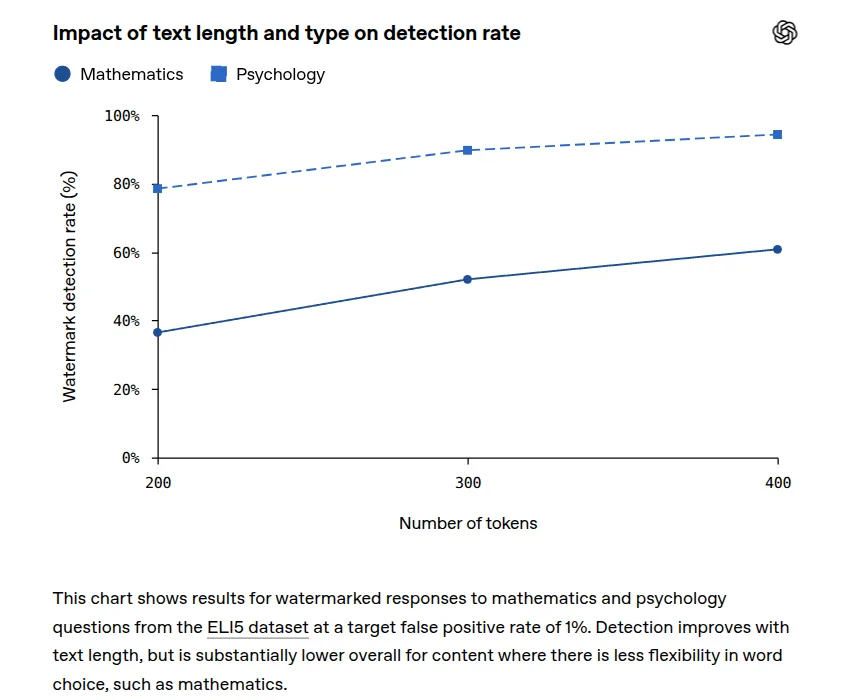
Screenshot: detection-rate chart, "Our approach to EU text provenance rules", OpenAI.
Treat the long-prose rows as the best case. A short email sits nearer the short end, math and code leave less room for word choice, and light editing knocks the rate down fast. OpenAI gives that as its reason for keeping the detector closed for now.
Three places this goes wrong
These are our reading of OpenAI's limits, not findings in the announcement.
A cover letter or work sample. A reviewer runs a detector, sees nothing, and concludes a person wrote it. A candidate who lightly edited an AI draft looks "clean," and one who wrote every word gains nothing from the result either. The check told you nothing; rule 5 stops it from deciding anything.
A training course or certification. Even at the long-passage best case, a 1% false positive target means roughly one honest person in a hundred could be flagged. A detection result should open a conversation, never end one.
A client deliverable. An agency delivers text drafted with an AI tool and the client later runs a detector. If your contract and policy already say AI assistance is disclosed, a hit is unremarkable. If they say nothing, you have a trust problem no watermark created and no watermark fixes.
Who needs to do what
You use ChatGPT in the EU: your staff's output will carry the mark. It isn't visible and doesn't identify them, but text pasted into a client email may later be flaggable by someone with detector access. Rule 3 covers you.
You build on the API: it's your call. OpenAI says opting in "lets customers decide how watermarking fits their transparency obligations." If you ship AI text to EU users, check with counsel whether the provider's marking covers your own Article 50 position. Our Article 50 guide and the December 2026 checklist cover the provider and deployer split.
You review other people's text: stop using "no watermark" as evidence of anything.
You use several vendors: marking differs by provider and region, so one detector won't cover your text. Ask the questions below.
Four questions for your AI vendors
- Do you watermark text output, in which regions, and is it on by default?
- Can we turn it on or off for our account, and who decides?
- What detection and false positive rates have you published, and for which text lengths?
- If we publish AI text in the EU, what do you state about whose disclosure duty applies?
Add these to your vendor due diligence checklist. If you sell to California as well, our SB 942 transparency guide covers the state rule that points the same way.
What readers said
On r/OpenAI, commenters went straight to the editing numbers. u/Sylvers read them as a how-to: "feed it to an open source AI with explicit instructions to minimally swap for synonyms, and you can clean up the watermark very easily." u/plymouthvan questioned the premise: "It's been a long time since text alone was considered any kind of proof in and of itself." Both points land in the same place as rule 2.
https://www.reddit.com/r/OpenAI/comments/1wyci57/openai_explains_how_it_will_watermark_chatgpt/
What this rule doesn't cover
- It's a staff rule, not your Article 50 assessment. Whether you're a provider or a deployer, and what you must disclose, depends on what you build and ship.
- We read OpenAI's post, the Commission's pages on Article 50 and the Code of Practice, and TechCrunch's report. We didn't read the textGrain technical report or the Commission's Article 50 guidelines in full.
- OpenAI gives no per-account date for the ChatGPT rollout beyond "over the coming weeks."
- The Anthropic worldwide detail is from TechCrunch's report; we didn't read Anthropic's own announcement.
Correction, October 15, 2026: an earlier version said systems already on the market before August 2, 2026 have until December 2 to meet the transparency obligations. The Digital Omnibus extension covers the marking duty in Article 50(2) only, for providers of systems placed on the market before that date.