Image: Pexels, used under the Pexels License.
Rows were re-checked against the vendor's own DPA, terms, help or docs page on October 14, 2026; Notion AI, Zoom, Grammarly and the DeepSeek API were added on October 16, 2026 and checked that day. The subprocessor column was added on October 16, 2026, and every link in it was opened that day. Where we couldn't confirm a cell, the table says so.
| Vendor / Product | Plan | DPA available? | Trains on your data? | EU data residency? | DPA / privacy link | Subprocessor list (checked Oct 16, 2026) | Checked |
|---|---|---|---|---|---|---|---|
| Anthropic Claude API | API | ✅ Yes (part of Commercial Terms) | ❌ No, by default | ❌ No: US only, SCCs in the DPA | Anthropic DPA | Anthropic list | Oct 14, 2026 |
| Claude Team / Enterprise | Claude for Work | ✅ Yes (part of Commercial Terms) | ❌ No, by default | ❌ No: US only, SCCs in the DPA | Anthropic DPA | Anthropic list | Oct 14, 2026 |
| Claude | Free / Pro / Max | ❌ No | ⚠️ Yes, if you allow it in Privacy Settings | ❌ No | N/A | N/A (no DPA on this plan) | Oct 14, 2026 |
| OpenAI API | API | ✅ Yes | ❌ No (since March 2023, unless you opt in) | ⚠️ Eligible projects can process data in Europe | OpenAI DPA | OpenAI list | Oct 14, 2026 |
| ChatGPT | Free / Go / Plus / Pro | ❌ No | ⚠️ Yes, opt-out in Data controls | ❌ No | N/A | N/A (no DPA on this plan) | Oct 14, 2026 |
| ChatGPT Business (formerly Team) | Business | ✅ Yes | ❌ No, by default | ⚠️ Rolling out gradually; region chosen at checkout, abuse-monitoring data stays in the US | OpenAI DPA | OpenAI list | Oct 14, 2026 |
| ChatGPT Enterprise / Edu | Enterprise | ✅ Yes | ❌ No, by default | ⚠️ EU storage at rest for new workspaces | OpenAI enterprise privacy | OpenAI list | Oct 14, 2026 |
| Azure OpenAI (Foundry Models sold by Azure) | Azure | ✅ Yes (Microsoft DPA) | ❌ No, without your permission | ✅ Regional or EU Data Zone deployments (Global deployments can process anywhere) | Microsoft DPA | Microsoft Online Services list (PDF, Sep 10, 2026) | Oct 14, 2026 |
| Google Gemini API / AI Studio | Unpaid | ❌ No | ⚠️ Yes, used to improve Google products, except for users in the EEA, Switzerland and the UK, who get the paid-service data terms | ❌ No (EEA, Swiss and UK apps must use paid services) | N/A | N/A (no DPA on this plan) | Oct 24, 2026 |
| Google Gemini API | Paid | ✅ Yes (Google processor terms) | ❌ No | ⚠️ Not stated in the API terms; use Google Cloud for EU regions | Gemini API terms | Google processor terms list (names no Gemini API entries) | Oct 14, 2026 |
| Gemini Enterprise Agent Platform (Google Cloud, formerly Vertex AI) | Google Cloud | ✅ Yes (Cloud DPA) | ❌ No, without your permission | ✅ Regional endpoints (global endpoint can serve any region) | Google Cloud DPA | Google Cloud list | Oct 24, 2026 |
| Gemini in Google Workspace | Business / Enterprise | ✅ Yes (Cloud DPA) | ❌ No, outside your domain without permission | ✅ Processing can be confined to the US or EU | Google Cloud DPA | Workspace list | Oct 14, 2026 |
| Mistral AI API / Studio | API | ✅ Yes | ⚠️ May be used unless an admin opts out | ✅ EU by default (US endpoint optional) | Mistral DPA | Mistral Trust Center | Oct 14, 2026 |
| AWS Bedrock | AWS | ✅ Yes (AWS DPA in Service Terms) | ❌ No | ✅ EU Regions available | AWS GDPR Center | AWS list | Oct 14, 2026 |
| Amazon Q Developer | Pro | ✅ Yes (AWS DPA) | ❌ No | ⚠️ Console runs in EU Regions incl. Frankfurt; confirm your profile Region | Q Developer data use | AWS list | Oct 14, 2026 |
| Amazon Q Developer | Free tier | ⚠️ AWS's subprocessor page lists the free tier; the AWS DPA itself doesn't say whether it covers it | ⚠️ Yes, opt-out available | ⚠️ Same as Pro | Q Developer data use | AWS list (lists the free tier under service improvement) | Oct 16, 2026 |
| Cohere | SaaS platform | ⚠️ On request ([email protected]) | ⚠️ Yes, unless you opt out in Data Controls | ❌ No: Canada (EU adequacy) and US cloud | Cohere data commitments | Cohere Trust Center | Oct 14, 2026 |
| DeepSeek API | API (Open Platform) | ❌ Not published; the privacy policy names Hangzhou DeepSeek Artificial Intelligence Co., Ltd. as data controller | ⚠️ Yes, de-identified inputs and outputs may be used; opt out with "Improve the model for everyone". The privacy policy's email opt-out ([email protected]) covers your own personal data as the account holder, not your end users' data (API terms 5.5) | ❌ No: collected, processed and stored in the People's Republic of China | DeepSeek privacy policy | Not published | Oct 16, 2026 |
| GitHub Copilot | Free / Pro / Pro+ / Max | ❌ No | ⚠️ Yes since April 24, 2026, opt-out available | ❌ No | N/A | N/A (no DPA on this plan) | Oct 14, 2026 |
| GitHub Copilot | Business / Enterprise | ✅ Yes (GitHub DPA) | ❌ No | ⚠️ Only on GitHub Enterprise Cloud with data residency | GitHub DPA | GitHub list | Oct 14, 2026 |
| Cursor | Free / Pro | ⚠️ Not stated for individual plans | ⚠️ Yes, unless Privacy Mode is on | ❌ No EU option documented | Cursor data use | Cursor Trust Center (DPA coverage not stated) | Oct 14, 2026 |
| Cursor | Teams | ✅ Yes (under Cursor's Master Services Agreement) | ❌ No (Privacy Mode on by default for teams) | ❌ No EU option documented; SCCs in the DPA | Cursor DPA | Cursor Trust Center | Oct 14, 2026 |
| Microsoft Copilot | Consumer | ❌ No | ⚠️ Yes, opt-out available | ❌ No | N/A | N/A (no DPA on this plan) | Oct 14, 2026 |
| Microsoft 365 Copilot | M365 Business / Enterprise | ✅ Yes (Microsoft DPA) | ❌ No | ✅ EU Data Boundary service | Microsoft DPA | Microsoft Online Services list (PDF, Sep 10, 2026); Anthropic is one | Oct 14, 2026 |
| Perplexity | Free / Pro / Max | ❌ No | ⚠️ Yes by default (AI Data Retention), opt-out available | ❌ No | N/A | N/A (no DPA on this plan) | Oct 14, 2026 |
| Perplexity Enterprise | Enterprise | ✅ Yes | ❌ No | ❌ No EU option documented; SCCs in the DPA | Perplexity DPA | Perplexity Trust Center | Oct 14, 2026 |
| Notion AI | Plus / Business / Enterprise, or any organization use | ✅ Yes (part of the Master Subscription Agreement) | ❌ No, on any of these plans; nothing to opt out of | ⚠️ Enterprise only: storage at rest in Frankfurt; AI subprocessors process outside the region | Notion DPA | Notion list (Oct 21, 2026) | Oct 16, 2026 |
| Zoom AI Companion (now Zoom AI features and ZoomMate) | Paid Zoom Workplace | ✅ Yes (Global DPA, part of Zoom's terms) | ❌ No; admins can switch AI features off per account or group | ⚠️ EU-hosted accounts use Zoom-managed models (ZM+) or Zoom-only models; the federated setup sends content to Anthropic, OpenAI and Google | Zoom DPA | Zoom list (Oct 2, 2026) | Oct 16, 2026 |
| Grammarly (now Superhuman) | Free / Premium / single-user Pro | ❌ No | ⚠️ Yes, unless you opt out in account privacy settings | ❌ No EU option documented; hosted on AWS US East | N/A | N/A (no DPA on this plan) | Oct 16, 2026 |
| Grammarly | Multi-user Pro bought on the website | ✅ Yes (Superhuman DPA) | ⚠️ Yes by default; an admin turns it off in data settings | ❌ No EU option documented; AWS US East, Data Privacy Framework with SCCs as fallback | Superhuman DPA | Superhuman list | Oct 16, 2026 |
| Grammarly | Enterprise / Education / bought through sales | ✅ Yes (Customer Business Agreement + DPA) | ❌ No, off by default | ❌ No EU option documented; AWS US East, Data Privacy Framework with SCCs as fallback | Superhuman DPA | Superhuman list | Oct 16, 2026 |
| Together AI | API | ⚠️ On request via Trust Center | ❌ No, without explicit opt-in | ❓ Not documented | Together AI Trust Center | Together AI Trust Center | Oct 14, 2026 |
| Hugging Face | Inference Endpoints | ✅ Yes (with Enterprise Hub) | ❌ No (payloads not stored) | ✅ EU data centers available | Inference Endpoints security | Hugging Face list (PDF, Jan 23, 2025) | Oct 14, 2026 |
| Replicate | API | ❓ No public DPA found as of Oct 14, 2026 | ❓ Could not verify | ❓ Could not verify | replicate.com/terms | Not published | Oct 14, 2026 |
Key: ✅ Yes / ❌ No / ⚠️ Conditional, opt-out required or partly confirmed / ❓ Could not verify from the vendor's public pages
Last verified row by row against the pages linked in the table: October 14, 2026, and October 16, 2026 for the four vendors added that day and for the whole subprocessor column. Terms change; confirm with the vendor before relying on a row for a compliance decision.
What we could not confirm: Replicate's terms and privacy policy don't mention a DPA or say whether API inputs are used for training, so that row stays open, and we found no subprocessor list on its site. Cursor's DPA is tied to its Master Services Agreement, and we found nothing on whether individual plans can sign it. AWS's DPA pages don't say directly whether the Q Developer free tier sits under the AWS DPA, though the subprocessor list AWS publishes under that DPA names the free tier. DeepSeek's API docs don't say whether the "Improve the model for everyone" setting covers API accounts, and we found no DPA or subprocessor list anywhere on DeepSeek's site. Zoom's DPA PDF carries no version date. Google's processor-terms list, which the paid Gemini API relies on, names no Gemini API subprocessors, and it doesn't say whether that means there are none.
What changed since the last review
Updated October 24, 2026: Google's Cloud documentation now calls Vertex AI the Gemini Enterprise Agent Platform, and the old Vertex AI pages redirect there, so the row we labeled "Google Cloud AI (formerly Vertex AI)" now uses Google's name. We re-checked that row the same day: Google still won't train on your data without permission, regional endpoints keep data in the chosen location, and the global endpoint can serve requests from any region. The same day we re-opened the Notion pages behind its row: Notion updated its subprocessor list on October 21, 2026, and OpenAI and Anthropic are still listed with a "Global" location, so the Notion row and section stand.
October 16, 2026: subprocessor column added. Every row now links the vendor's own subprocessor list, and each link was opened that day. Rows for plans without a DPA say N/A. We found no list from DeepSeek or Replicate. Microsoft's list is a PDF on its Service Trust Portal, last updated September 10, 2026, and Hugging Face's PDF is dated January 23, 2025.
October 16, 2026: four vendors added. Each row was checked against the vendor's DPA, terms, help pages and subprocessor list that day.
- Notion AI: no training on any organization plan, EU storage only on Enterprise. Notion's DPA, in force since August 14, 2026, sits inside its Master Subscription Agreement, which covers Plus, Business and Enterprise and anyone using Notion for an organization; personal use has separate terms without it. The Notion AI terms rule out training, so there's no toggle to hunt for. EU data residency keeps page content in Frankfurt for Enterprise workspaces, but prompts still go to AI subprocessors such as OpenAI and Anthropic, listed with a "Global" location. To hear about new subprocessors, email [email protected] with the subject "Subscribe to New Subprocessors"; you then get 10 days to object.
- Zoom AI Companion: the name is gone, the training ban isn't. Zoom dropped the AI Companion brand on June 24, 2026: summaries and the other built-in features still come with eligible paid plans, and ZoomMate is the new agent product. Zoom's AI whitepaper says it doesn't train its own or third-party models on audio, video, chat or similar content, so there's nothing to opt out of; admins can switch AI features off for the account or a group in the Admin Portal. Accounts hosted in the EU run AI features on Zoom-managed instances of third-party models in Amazon Bedrock (ZM+) or on Zoom's own models. The federated setup calls Anthropic, OpenAI and Google, and Zoom support can tell you which setup your account uses and move you to another. The DPA promises at least 30 business days' notice before a new subprocessor.
- Grammarly: the default depends on how you bought it. Grammarly's legal terms now sit with Superhuman Platform Inc., formerly Grammarly, Inc. Training is off by default for Enterprise, Education and plans bought through sales, but multi-user plans bought on the website start with training on until an admin turns it off at account.grammarly.com/admin/data_settings. Individual users opt out at account.grammarly.com/security/privacy. The DPA covers enterprise customers and any account opened on behalf of an organization. Grammarly hosts data with AWS in the US East region, and we found no EU hosting option in its security or legal pages.
- DeepSeek API: no DPA, data stored in China. DeepSeek's privacy policy, last updated February 10, 2026, makes Hangzhou DeepSeek Artificial Intelligence Co., Ltd. the data controller and says it collects, processes and stores personal data in the People's Republic of China. The API terms build on DeepSeek's Terms of Use, and section 4.3 there lets DeepSeek use de-identified inputs and outputs to improve its models unless you turn off "Improve the model for everyone". The privacy policy also gives a right to opt out of training by email to [email protected], but section 5.5 of the API terms limits that policy to the personal information you provide yourself: for your end users' data in an app built on the API, you are the controller and owe them your own privacy policy. For the transfer question, see our DeepSeek GDPR guide.
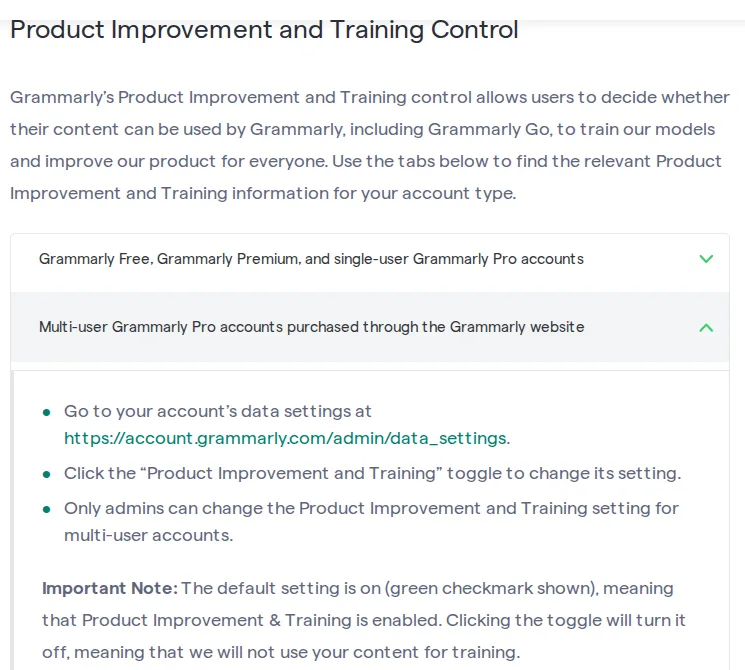
Screenshot: Product Improvement and Training Control, Grammarly Support, checked October 16, 2026.
October 14, 2026: full re-check. The table previously said "Last verified: June 2026". That review changed these rows:
- Mistral API: training is not off by default. Mistral's DPA lets it train on customer data "unless Customer is or has opted-out of training", and its help center says the Studio and API opt-out is a separate admin toggle. The row now reads "may be used unless an admin opts out".
- Cohere: training needs an opt-out, and the DPA is on request. Cohere's enterprise data page tells SaaS customers they can opt out of training in Data Controls and asks them to email [email protected] for the DPA.
- Cursor individual plans: training happens unless Privacy Mode is on. The old row said "No". Cursor's data-use page says it may train on code data when Privacy Mode is off; teams get Privacy Mode by default.
- GitHub Copilot Business and Enterprise: EU residency now exists, but only on GitHub Enterprise Cloud with data residency. Individual plans have been used for training by default since April 24, 2026.
- Claude Team and Enterprise added. We removed the claim that "Claude.ai for Business" launched in early 2026; Anthropic's commercial products are Claude for Work and the API, both under its Commercial Terms and DPA.
- ChatGPT Team is now ChatGPT Business. We dropped the old per-seat price, which we couldn't confirm on OpenAI's pricing page.
- Amazon Q Business is closed to new customers, so the row now covers Q Developer, split into Pro and free tier.
- Gemini API paid tier added. Google's terms say only paid services may serve users in the EEA, Switzerland or the UK.
- Broken links fixed for the Anthropic DPA, the Microsoft DPA, Mistral's DPA and GitHub's DPA.
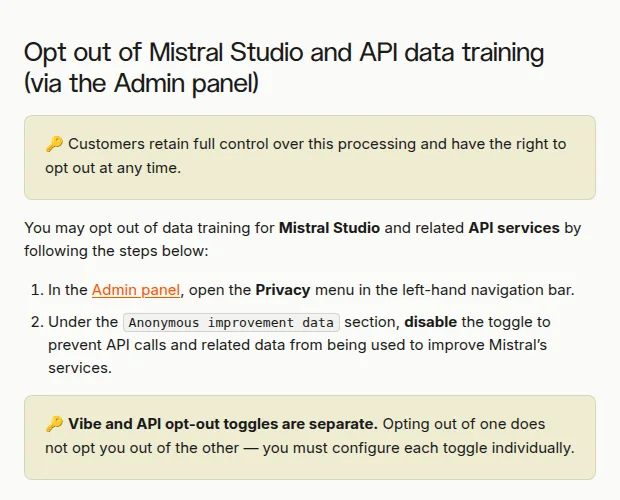
Screenshot: Can I opt out of my input or output data being used for training?, Mistral AI Help Center, checked October 14, 2026.
How to use this table
Read the columns this way. "DPA available?" means a Data Processing Agreement covering GDPR processor obligations exists for that plan. "Trains on your data?" is the default for that plan, not what's possible after you change settings. "EU data residency?" means you can keep processing or storage in the EU; "SCCs in the DPA" means data goes to the US under Standard Contractual Clauses.
Before anyone sends personal data to an AI tool:
- Confirm the plan. The DPA follows the plan, not the vendor. A Claude Pro seat and a Claude Team seat at the same company sit under different terms.
- Open the DPA from the table and check it cites the 2021 Standard Contractual Clauses for non-EU vendors.
- Check the training toggle yourself. For Mistral, Cohere, Cursor, Grammarly team plans bought on its website, DeepSeek and every consumer row, take a screenshot of the setting when you sign, so you can show what was switched off and when.
- Save the subprocessor list from the table, and sign up for change notices where the vendor offers them: Perplexity and Mistral (through its Trust Center) do, and Notion sends them if you email [email protected].
- Record it in your AI tool register: plan, DPA link, date accepted, training setting and EU residency choice.
On r/gdpr this month, u/throwaway_lmkg described the pattern this table keeps showing: "only the business plans come with a DPA", along with SSO and a support contact. If a vendor sells a business plan without a DPA, treat that as a reason to look elsewhere.

Image: Unsplash, used under the Unsplash License.
If your legal team won't accept SCCs
Your options are an EU-residency row from the table (Azure regional or EU Data Zone deployments, Google Cloud regional endpoints, Gemini in Workspace with EU processing, Microsoft 365 Copilot, Mistral, AWS EU Regions, Hugging Face EU endpoints, or OpenAI's European residency where eligible), a self-hosted open-weight model, or stripping personal data before it leaves the EU.
DPA red flags to raise before signing
| Red flag | What it looks like | Why it matters |
|---|---|---|
| "Improvement of services" carve-out | "Provider may use data to improve its services", with no explicit training ban | Broad enough to cover model training. Mistral's DPA, for example, lets it train unless you opt out |
| No sub-processor list | "Provider may engage sub-processors with reasonable data protection terms" | You can't meet the GDPR processor-contract rules (Article 28) without knowing who processes the data |
| No objection right on new sub-processors | "Provider may add sub-processors at any time" | Without advance notice and a right to object, you find out after the fact |
| Vague deletion | "Data will be deleted within a reasonable time after termination" | Ask for a fixed number of days and get it in writing |
| Unreachable audit rights | Audits only at your cost with long notice | Rights you can't use in practice aren't controls |
| Vague breach notice | No timeframe for telling you about a breach | You owe your supervisory authority notice within 72 hours where feasible (GDPR Article 33) |
| Old transfer clauses | The DPA cites the pre-2021 SCCs instead of the June 2021 set | The Commission's modernised clauses replaced the old sets; ask for an updated DPA |

Image: Unsplash, used under the Unsplash License.
The EU AI Act sits next to the DPA, not inside it
The AI Act's rules for general-purpose AI models took effect in August 2025, according to the European Commission. They bind the model provider, not you, but they give you two things to ask for at your next review: the provider's public summary of training content (the Commission published the template for it) and, for the largest models, how the provider assesses systemic risk. Keep that file next to the DPA. For training-data disclosure under California law, see the California AB 2013 training data transparency guide.
References
- Anthropic: Data Processing Addendum
- OpenAI: Data Processing Addendum and Enterprise privacy
- Microsoft: Products and Services Data Protection Addendum
- Google Cloud: Cloud Data Processing Addendum
- Mistral: Data Processing Addendum
- Notion: Data Processing Addendum and subprocessor list
- Zoom: Global Data Processing Addendum and subprocessors
- Grammarly (Superhuman): Data Privacy Addendum, subprocessors and Product Improvement and Training control
- DeepSeek: Privacy Policy
- European Commission: Standard Contractual Clauses
- Related: Privacy-first AI APIs for GDPR compliance
- Related: AI tool register template
Correction (October 13, 2026): An earlier version said OpenAI direct has no EU data residency and that only ChatGPT Team and Enterprise customers have a DPA backing OpenAI's no-training commitment. OpenAI offers European residency for eligible API projects and new Enterprise and Edu workspaces, and API customers can sign its DPA too.
Correction (October 14, 2026): Earlier versions said Mistral's API, Cohere and Cursor's individual plans don't train on your data; all three can, unless the setting is changed. They also said GitHub Copilot Business has no EU residency option, listed Replicate and Together AI as offering self-serve DPAs, and described "2026 DPA changes" (OpenAI zero retention, a Claude.ai for Business launch, a Workspace DPA change, GitHub AI Act terms) that we couldn't confirm. Those rows and claims have been corrected or removed, and the EU AI Act section now uses the Commission's August 2025 start date for general-purpose model rules.
Correction (October 15, 2026): The ChatGPT Business row said EU data residency isn't available on that plan. OpenAI says Business residency is rolling out gradually: the storage region is chosen at checkout, and safety and abuse-monitoring data stays in the United States.
Correction (October 16, 2026): The DeepSeek API row said the training opt-out also works by email to [email protected]. That email right comes from DeepSeek's privacy policy, which section 5.5 of the API terms limits to the account holder's own personal information; your end users' data in an app built on the API falls under your own privacy policy.
Correction (October 24, 2026): The unpaid Gemini API / AI Studio row said Google uses that content to improve its products without the exception in Google's terms: for users in the European Economic Area, Switzerland, and the UK, the paid-service data terms apply to AI Studio and the unpaid quota too.