Image: Unsplash.
Both vendors sign a GDPR Data Processing Addendum, both use the EU Standard Contractual Clauses, and neither trains on business or API data by default. So the choice doesn't turn on "is it GDPR compliant". It turns on four clauses you can read in ten minutes: where the data sits, how fast they tell you about a breach, how long you get to object to a new sub-processor, and what happens to your data when you leave.
We read both DPAs, both vendors' retention and residency docs, and Microsoft's Azure page again on October 15, 2026. Here's how they compare.
| Term | Anthropic (API, Claude Team and Enterprise) | OpenAI (API, ChatGPT Business and Enterprise) | Checked |
|---|---|---|---|
| DPA | Part of the Commercial Terms, no separate signature | Signed for Business, Enterprise and the API | Oct 15, 2026 |
| Transfer mechanism | SCCs, Module Two and Module Three | SCCs adopted June 4, 2021 | Oct 15, 2026 |
| Training on business data | Not by default | API: not since March 1, 2023 unless you opt in; Business and Enterprise: not by default | Oct 15, 2026 |
| Default API retention | Inputs and outputs deleted within 30 days, with exceptions | Abuse monitoring logs kept up to 30 days | Oct 15, 2026 |
| Zero retention | By agreement; "Covered Models" still kept 30 days | Zero data retention or modified abuse monitoring, on OpenAI's approval | Oct 15, 2026 |
| EU data residency | No. Storage is US only; inference runs "global" or "us" | Europe region for eligible new API projects; new Enterprise and Edu workspaces at rest; Business rolling out | Oct 15, 2026 |
| Breach notice to you | Within 48 hours | Without undue delay, no hour count | Oct 15, 2026 |
| New sub-processor | Reasonable notice before access; 15 days to object | Notice by blog post, in-product or email; 30 days to object | Oct 15, 2026 |
| Deletion after termination | Within 30 days of termination | At your instruction, no window stated | Oct 15, 2026 |
| Audit | On written request, at your expense | At your sole expense, once a year at most, or a summary of audit reports | Oct 15, 2026 |
| Consumer plans | Free, Pro, Max: user chooses whether chats train models; no DPA | Free, Plus: trains unless the user turns it off; no DPA | Oct 15, 2026 |
The Shared Security Podcast walks through the consumer privacy policies of ChatGPT, Gemini and Claude. It's the consumer side of the table above, and it's the side most small teams forget to govern.
Breach notice: a fixed clock against "without undue delay"
Under GDPR Article 33, you as controller must tell your supervisory authority "not later than 72 hours after having become aware of it", where feasible. Your processor only has to tell you "without undue delay". That gap is your problem, not theirs.
Anthropic's DPA closes most of it. Section G.1 promises written notice "without undue delay, but in any event within 48 hours". OpenAI's DPA, effective January 1, 2026, repeats the GDPR wording with no number attached.
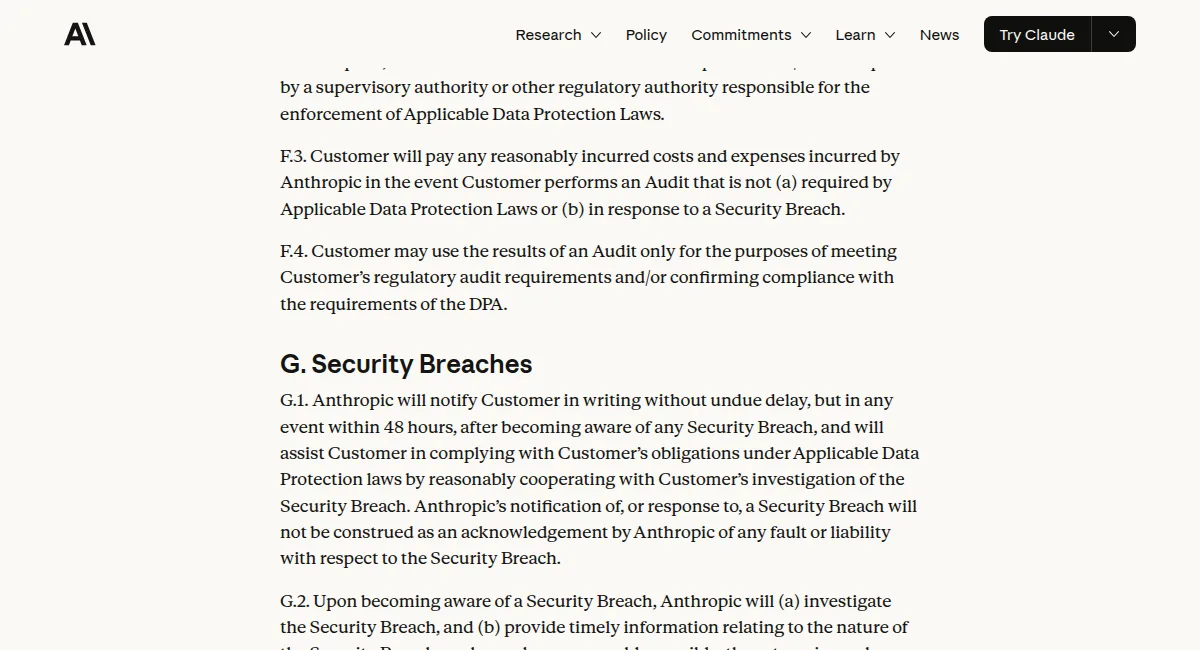
Screenshot: Data Processing Addendum, Anthropic.
Does "without undue delay" fail GDPR? No. It's the statute's own phrase. But if your incident plan assumes you'll hear within two days, write that assumption down for OpenAI as a risk, or ask for a fixed deadline when you negotiate. Our AI vendor contract redline template has wording for that clause.
Sub-processors: OpenAI gives you twice as long to object
Article 28(2) says a processor can't bring in another processor without your written authorisation. Both vendors use general authorisation plus an objection right, and the windows differ.
Anthropic gives "reasonable notice" before a new subprocessor gets access to personal data, then fifteen days from that notice to object. OpenAI announces changes by blog post, in-product notice or email, and you have a month from notice to object.
Neither gives you a fixed advance-notice period, and an earlier version of this guide said both did. Whoever owns vendor records should subscribe to both update channels, because an objection window you never saw isn't a right you can use.
Deletion and audit: Anthropic names a date, OpenAI waits for you
When the contract ends, Anthropic's DPA (section H.1) gives itself thirty days from termination to return data on request and then delete it. OpenAI's DPA (section 2.11) says it will "return or delete Customer Data" at your instruction, with no window. That isn't worse in practice if you send the instruction, but it means the offboarding step is yours: put "send OpenAI a deletion instruction" on your exit checklist.
On audits, both DPAs give you a right on terms. Anthropic allows an audit on written request at your expense. OpenAI allows one at your sole expense, no more than once a year, and may hand you a summary of its audit reports instead. A small team will almost always take the report route on both sides, so the practical step is to download the SOC 2 and ISO certificates from each trust portal and file them with the DPA.
EU data residency: OpenAI has a route, Anthropic doesn't
This is the row that decides it for most DPOs who ask.
OpenAI. The data controls guide lists a Europe region (EEA and Switzerland) at eu.api.openai.com. The conditions matter:
- It only works for new projects. OpenAI's launch post says existing projects can't be switched.
- You must be approved for abuse monitoring controls and sign a modified retention amendment before any non-US region.
- Models released on or after March 5, 2026 cost 10% more on residency endpoints.
- System data (account details, metadata, usage and billing data) isn't covered and may sit outside the region.
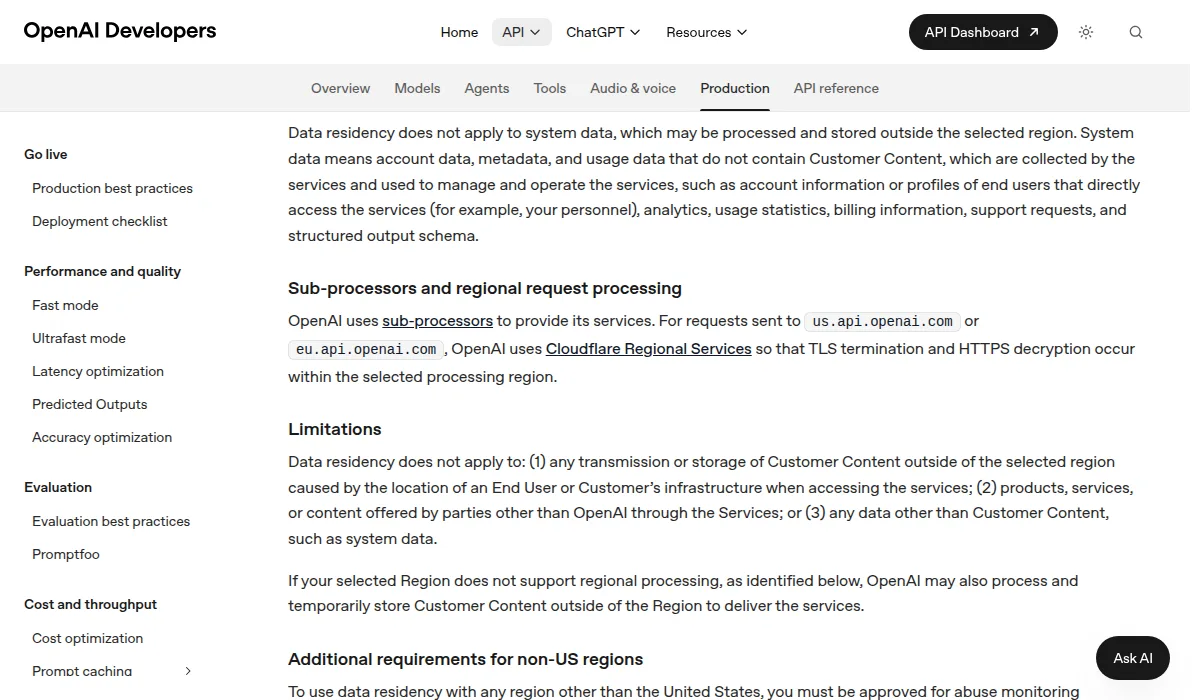
Screenshot: Data controls in the OpenAI platform, OpenAI.
For ChatGPT, new Enterprise and Edu workspaces can store content at rest in Europe. ChatGPT Business residency is rolling out gradually: you pick a region at checkout, and abuse-monitoring logs stay in the United States whatever you pick. Business costs $20 per seat per month billed annually, or $25 billed monthly.
Anthropic. The data residency docs set two controls. Inference runs "global" by default, meaning any available geography, or "us" if you pin it (at 1.1x the standard price on newer models). Storage at rest, the workspace geo, is US only. There's no EU option on Anthropic's own API.
If you need Claude models in Europe, Anthropic's docs point to the cloud platforms: on Amazon Bedrock and Google Cloud the inference region follows the endpoint or inference profile you call. Check your cloud account's region list before you promise anyone EU processing.
Azure OpenAI. Microsoft's data privacy page says a DataZone deployment in an EU member state may process prompts in that or any other EU member state, while a Global deployment can process them anywhere the model is deployed. So "we use Azure" proves nothing until you check the deployment type. Microsoft doesn't train foundation models on your prompts, and managed customers can apply to modify abuse monitoring rather than switch it off themselves.
Retention: about a month is the default on both sides
Anthropic deletes API inputs and outputs within 30 days of receipt or generation, except for Files API content and organizations with a zero data retention agreement. One exception cuts the other way. For a class Anthropic calls Covered Models, prompts and outputs are retained for a month even for zero-retention organizations, under a policy effective June 9, 2026. If your record of processing says "zero retention with Anthropic", check which models your team calls.
OpenAI keeps abuse monitoring logs for up to a month by default. Zero data retention and modified abuse monitoring exist, but OpenAI has to approve them. Stateful endpoints change the picture: the docs list /v1/conversations as kept "until deleted", so a feature built on stored conversations needs its own deletion job.
The consumer-account problem
Neither DPA covers consumer plans. Claude Free, Pro and Max users now choose whether their chats train Anthropic's models; if they allow it, retention runs to five years, and if they don't, it stays at a month. Free and Plus ChatGPT accounts train unless the user turns off "Improve the model for everyone".
In an r/gdpr thread on exactly this comparison, u/razrcallahan put the risk plainly: "your devs are almost certainly using personal consumer accounts alongside the enterprise API." In the same thread, u/latkde argued the transfer question is the smaller one: "Using AI services is not fundamentally different from a Microsoft 365 subscription." The harder GDPR work, in that view, is the risk assessment and what goes into the prompts.
We agree with both. The DPA comparison above takes an afternoon. Stopping personal accounts takes a written rule and a check, which is what our shadow AI policy guide and acceptable use policy template are for.

Image: Unsplash.
Two more documents to file next to the DPA
EU AI Act. Since the GPAI rules applied on 2 August 2025, model providers like Anthropic and OpenAI must publish a training-content summary on the AI Office template under Article 53(1)(d). If you only call their APIs, that's their duty, not yours, but a link to each summary belongs in your vendor file.
California AB 2013. Civil Code 3111 required developers to post training-data documentation on or before January 1, 2026 for systems released since January 1, 2022. Both vendors have posted one: OpenAI in its Help Center, Anthropic in its Trust Center. If you fine-tune a model and offer it to Californians, the law's definition of developer can reach you too. Our AB 2013 guide covers that case.
Image: Pexels, used under the Pexels License.
Verdict by vendor
Anthropic: pick it when your incident plan needs a fixed clock. The breach-notice cap and a named deletion date after termination are the strongest terms in this comparison. The catch is residency: storage is US only, and default inference can run in any geography, so you're relying on SCCs. That's lawful, but your DPO has to accept it.
OpenAI: pick it when data must stay in Europe. It's the only one of the two with an EU region on its own API, and the longer objection window helps a team that reads vendor mail once a month. Budget for the approval step, the new-project rule and the price uplift, and send a deletion instruction when you leave.
Azure OpenAI: pick it if you already run on Azure and need OpenAI models in the EU. Only an EU DataZone deployment gives you that; a Global deployment doesn't.
What we couldn't confirm: which EU regions offer Claude models on Amazon Bedrock or Google Cloud for your account, and Microsoft's breach-notice wording, which sits in a DPA download we didn't read for this update.
Correction (October 15, 2026): an earlier version said ChatGPT Business cost $25 per user per month billed annually or $30 monthly; the Help Center lists $20 annually and $25 monthly. It also said both vendors give 30 days' advance notice of new sub-processors and that OpenAI deletes data within 30 days of termination; neither DPA says that. We also removed the claim that Anthropic processes all API traffic in the US: default inference is global.
Related reading
- AI vendor DPA tracker 2026
- Privacy-first AI APIs that don't train on your data
- Claude vs ChatGPT: DPA, GDPR and data retention for business teams
- ChatGPT vs Claude vs Gemini: enterprise compliance by tier
- OpenAI trust portal: GDPR Article 28 guide
- OpenAI API governance and data privacy for developers
- AI vendor due diligence checklist
- GDPR Article 30 record of processing for AI tools
- AI data retention policy template
- DeepSeek and Chinese AI models: GDPR transfer risk