Image: Unsplash.
Vietnam now has an official list of high-risk AI systems. Decision 33/2026/QD-TTg, signed by Deputy Prime Minister Ho Quoc Dung on June 30 and in force since August 15, 2026, names 46 systems in six sectors. If you sell AI that decides things in Vietnam without a human approving the decision, and it touches transport, banking, health, education, the courts or ethnic-policy administration, it's probably on the list.
The obligations come from the Law on Artificial Intelligence (No. 134/2025/QH15), in force since March 1, 2026. Being listed means a conformity assessment before the system goes into use, plus the provider and deployer duties in Article 14 of that law. We read the decision in the Official Gazette and the law's text on October 15, 2026.
What the decision says
The list. Transport has 31 entries, ethnicity and religion 7, education 3, health 2, banking 2 and judicial proceedings 1. Almost every entry is conditional: it applies only when the AI acts on its own, for example executing a high-value bank transaction with no human check before it goes through, or ranking learners when the result is the official grade.
Who needs a certification body. The annex has two columns. Under Article 13(2)(b) of the law, the provider may self-assess or hire a registered body. Under Article 13(2)(a), a registered or recognised body must certify the system before use. Only six of the 46 sit in the second column:
| Mandatory certification (Art 13(2)(a)) | Checked |
|---|---|
| Final automated approval or refusal of applications to identify beneficiaries of ethnic policy | Oct 15, 2026 |
| Automatically stopping payments or locking benefits on suspicion of fraud | Oct 15, 2026 |
| Algorithmic allocation of budget or support policies | Oct 15, 2026 |
| Inferring or classifying people by ethnicity, belief or religion to apply management measures | Oct 15, 2026 |
| Surgical robots that carry out treatment without staff confirming each parameter change | Oct 15, 2026 |
| Large-scale biometric identification used in public-interest civil cases | Oct 15, 2026 |
Earlier versions of this article said the banking and health systems all needed third-party certification. They don't: both banking entries and the assisted-surgery entry can be self-assessed.
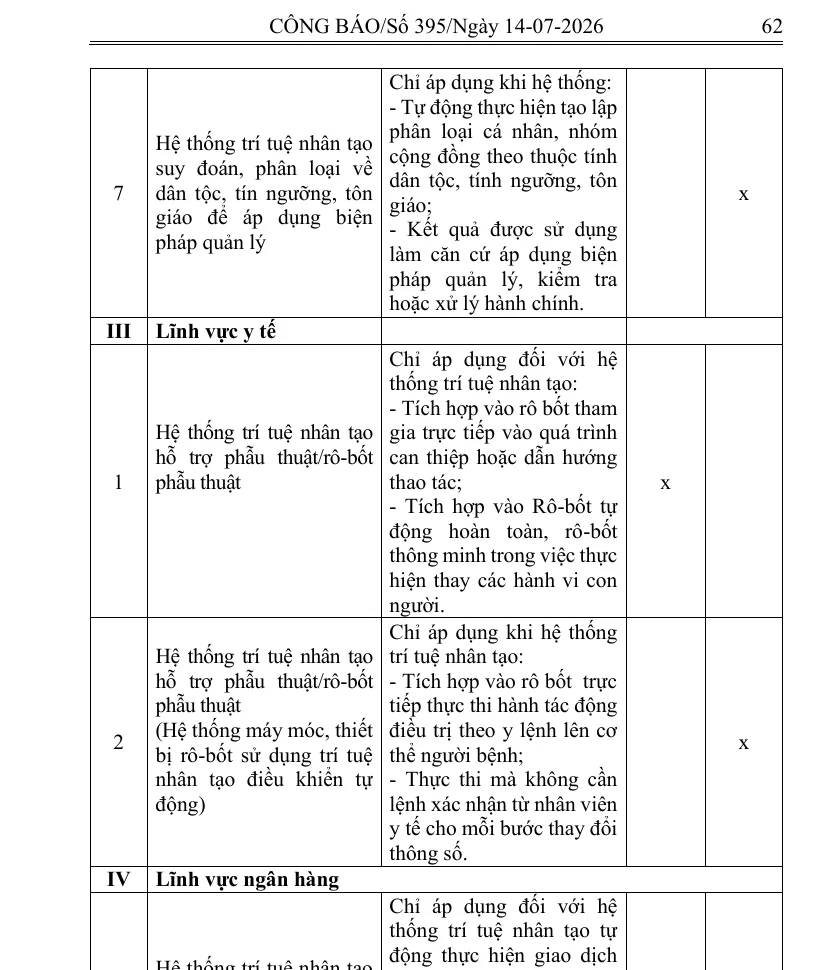
Screenshot: Decision 33/2026/QD-TTg annex, Cong bao (Official Gazette) No. 395, page 62. The left column is self-assessment allowed; the right is mandatory certification.
Deadlines. Systems already running before August 15, 2026 can keep running, but must meet the law's obligations before September 1, 2027 in health, education and finance, and before March 1, 2027 everywhere else. Systems launched in the six months after August 15 also have until March 1, 2027. During the transition, an authority that finds a risk of serious harm can still order a system suspended or shut down.
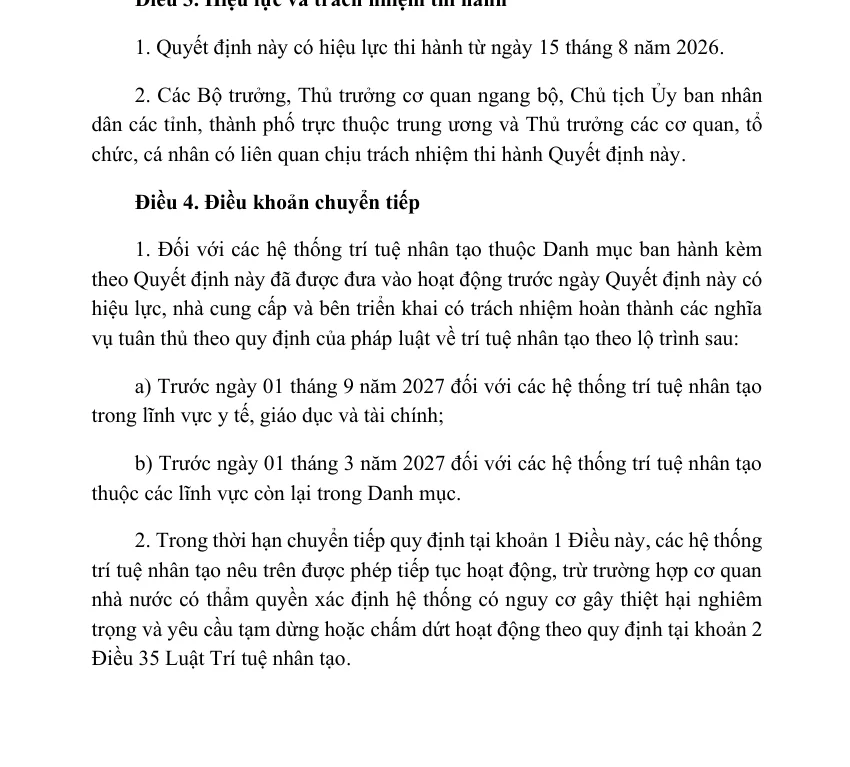
Screenshot: Decision 33/2026/QD-TTg, Articles 3 and 4, Cong bao (Official Gazette) No. 395, page 57.
The 46 entries, sector by sector
| Sector | Entries | What's listed | Checked |
|---|---|---|---|
| Transport | 31 | High-level autonomous driving; road and rail signal control; control of tunnels, bridges, expressways and critical utilities; air traffic management and conflict resolution; airport slot and gate allocation (at airports above 5 million passengers a year); aviation security screening | Oct 15, 2026 |
| Ethnicity and religion | 7 | Scoring or ranking applications for ethnic-policy benefits; verifying ethnicity or religion data; approving or refusing administrative applications; stopping benefits; allocating budgets; classifying people by ethnicity or religion | Oct 15, 2026 |
| Education | 3 | Self-study content from uncontrolled data at scale; automated testing and ranking used as the official result; monitoring learner behaviour with biometrics such as face or gaze tracking | Oct 15, 2026 |
| Health | 2 | AI in surgical robots that guide or perform procedures; robots that carry out treatment without staff confirming each step | Oct 15, 2026 |
| Banking | 2 | Automated high-value electronic transactions with no human approval, above a State Bank threshold; credit decisions made and paid out without an independent credit officer's approval | Oct 15, 2026 |
| Judicial proceedings | 1 | Large-scale biometric identification in public-interest civil cases | Oct 15, 2026 |
The education entries are the ones most likely to surprise software vendors: an online exam tool whose AI score becomes the official grade in the national education system is in scope, and so is proctoring software that tracks faces or eye movement.

Image: Pexels, used under the Pexels License.
What being listed requires
Article 14 of the law puts the work on providers: a risk-management process that's reviewed when the system changes, governance of training, test and operating data, technical records and activity logs kept for assessment and inspection, human oversight built into the design, and the law's transparency and incident duties. When authorities ask for explanations, the law says they can't demand source code, detailed algorithms or parameters.
Deployers, meaning the businesses running the system, must use it only for the purpose and risk level it was classified for, keep human intervention possible, and cooperate on incidents.
Foreign providers. Article 14(6) requires a lawful contact point in Vietnam for any high-risk system offered there. Only the six mandatory-certification types also need a commercial presence or an authorised representative. Earlier versions of this article said every foreign provider needed a local legal entity; the law doesn't say that.
The law firm Gamma Law's six-minute overview, from July 2026, covers the AI law as a whole for foreign technology companies rather than Decision 33 specifically.
What to do now
- Map every AI feature you run in Vietnam against the 46 entries, including the conditions. Most entries fall away if a human approves each decision.
- For each match, note the column. If it's self-assessment, assign an owner to produce the Article 14 file: risk process, data governance, technical records, logs and the human-oversight design.
- If you're a foreign provider, name a contact point in Vietnam now. If any system is one of the six mandatory-certification types, plan for a local entity or authorised representative and a certification body.
- Put the right date in your calendar: March 1, 2027, or September 1, 2027 for health, education and finance.
We couldn't confirm the detailed contact-point rules in Decree 142/2026/ND-CP, or whether the State Bank has published the value thresholds the two banking entries depend on.
Correction (October 15, 2026): an earlier version said all banking and health systems needed third-party certification, that new systems launched after August 15 had to comply immediately, that every foreign provider needed a local legal entity, and that the judicial entry covered AI in legal proceedings generally. The decision and the law say otherwise; this version reflects their text.