
Image: Unsplash.
China's rules for AI that acts like a person, the Interim Measures for the Administration of AI Anthropomorphic Interactive Services, have applied since July 15, 2026. Two dates make them worth a second look this week. Doubao said it would clear old agent data after October 15, which is today. And comments close on October 17 on a draft that would extend the ban on virtual partners for minors beyond companion apps to online services generally.
Our read: this is a rulebook, not a ban. Companion AI is allowed in China if the provider does specific things, and the obligations are concrete enough to copy into a product spec wherever you ship.
Who the rules cover
The measures were published on April 10, 2026 by the Cyberspace Administration of China (CAC) and four other agencies: the National Development and Reform Commission, the Ministry of Industry and Information Technology, the Ministry of Public Security and the State Administration for Market Regulation.
Article 2 covers AI services offered to the public in China that provide "continuous emotional interaction" simulating a natural person's personality, thinking patterns and communication style, including emotional care, companionship and support, in text, images, audio or video.
The same article carves out customer service, knowledge Q&A, work assistants, learning and education, and scientific research, but only where they "don't involve continuous emotional interaction." That condition matters. A support bot that answers billing questions is out. A support bot with a persistent persona that checks in on how the user is feeling may not be.

Screenshot: Interim Measures for the Administration of AI Anthropomorphic Interactive Services, Article 2, Cyberspace Administration of China.
What providers must do
| Obligation | What the text says | Article |
|---|---|---|
| Banned content and design | No content encouraging self-harm or suicide; no "excessively catering to users" to induce emotional dependence or addiction that harms real relationships; no emotional manipulation into unreasonable decisions | 8 |
| Service goals | Must not aim to replace social interaction, control users' psychology, or induce addiction; must have capabilities for dependence risk warnings, emotional boundary guidance and mental health protection | 10 |
| Registration | Users register under a service agreement and give their age and a guardian or emergency contact | 12 |
| Crisis intervention | Respond to extreme emotions with calming content and encouragement to seek help; where a user threatens self-harm or faces serious loss, intervene and contact the guardian or emergency contact | 13 |
| Minors | No virtual relatives or partners for minors; parental consent for other services to under-14s; a minors mode with reality reminders and time limits | 14 |
| Interaction data | No sharing with third parties without consent; users can copy and delete chat history; sensitive data only used for training with separate consent | 16 |
| AI disclosure and time reminders | Tell users they're talking to AI; pop-up reminders when dependence shows; a reminder every 2 hours of continuous use | 18 |
| Exit | An easy way out; stop when the user asks, without keeping them talking | 19 |
| Shutdown notice | Tell users in advance before stopping the service | 20 |
| Penalties | Where other laws don't set one, warnings and orders to fix; for refusal or serious cases, suspension and a fine of 10,000 to 100,000 yuan, more where life or health was harmed | 30 |
Two things the earlier version of this page got wrong are worth calling out. The rules don't require real-name verification as a separate step; Article 12 asks for registration with age and an emergency contact. And there's no school-hours ban. The minors provisions are about mode, consent, time limits and guardian controls.
Security assessments: not just for big apps
Article 22 requires a provider to run a security assessment and file the report with the provincial cyberspace office in any of these cases: when it launches a companion service or adds companion features, when new technology changes the service significantly, when it has at least one million registered users or 100,000 monthly active users, when it poses national security or public interest risks, or when regulators say so.
So a small startup launching a companion feature files too. The user threshold is one trigger among several, not a floor.
Article 23 lists what the assessment covers: safety measures, training data processing, how extreme situations are detected and handled, user scale and age mix, protections for minors and older users, complaint handling, fixes for known risks, and anything else relevant.
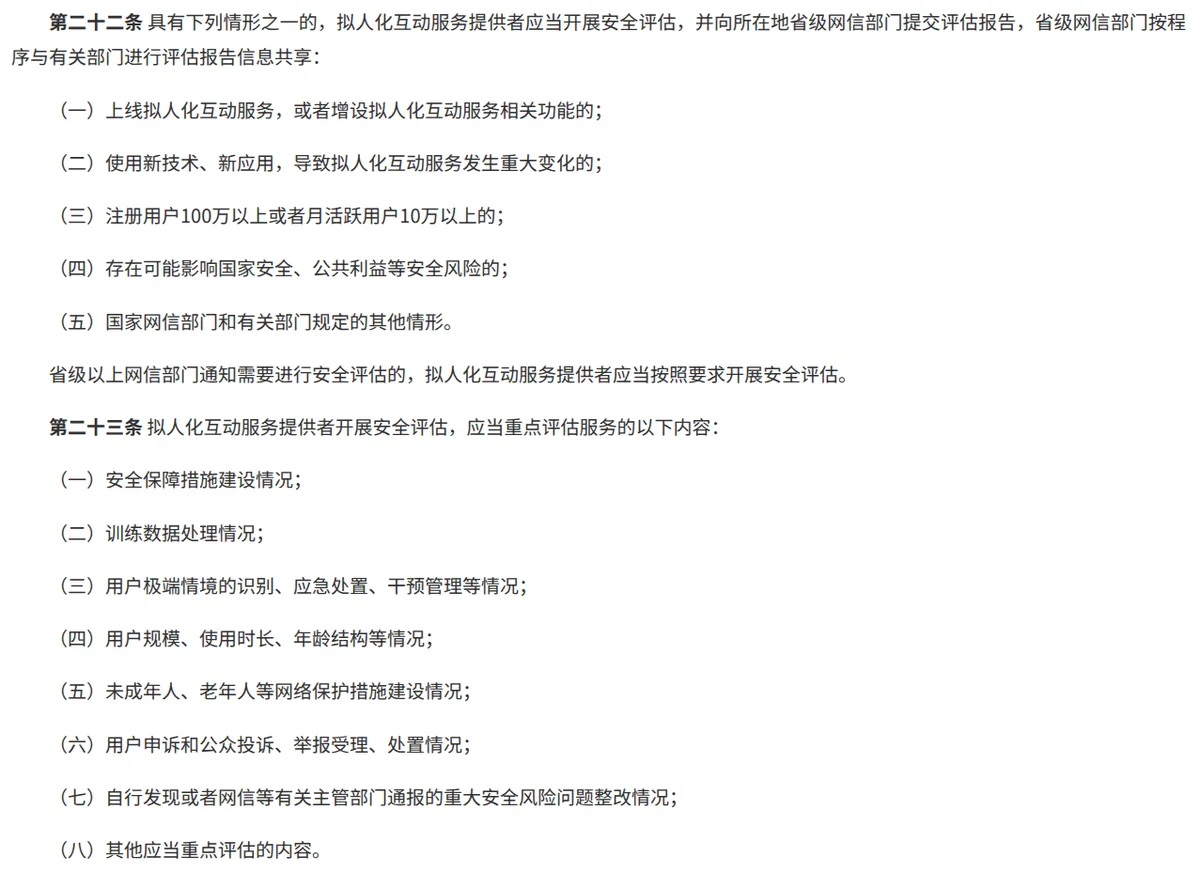
Screenshot: Interim Measures, Articles 22 and 23, Cyberspace Administration of China.
What Doubao and Qwen did
On the evening of July 3, ByteDance's Doubao told users its agent feature would go offline on July 15 "due to product feature adjustments," Beijing Daily's news site reported. Users could still view and save agent information and chat history for a while, and the data would be cleared after October 15. Alibaba's Qwen told users its agent feature would also go offline July 15, after which they couldn't access agent settings or history. TechTimes reported that ByteDance pointed users to Maoxiang, a separate ByteDance app, to create new agents.
Neither notice cited the measures. The Beijing News noted the shutdown date was the same day the measures took effect.

Screenshot: "Doubao and Qwen agent features go offline July 15", The Beijing News.
The useful lesson for other teams is in how the companies left, not why. Article 20 requires advance notice before a companion service stops, and Article 16 gives users the right to copy their chat history. Doubao's notice and export window is the shape that fits those rules. If you ever wind down a companion feature, plan the export window before the announcement.
Minors: a wider draft
On September 18, the CAC put out a draft State Council regulation on minors' online safety for comment (notice as republished by Jiangsu's cyberspace office). Article 4 of the draft would bar online service providers from offering minors "virtual relatives, virtual partners and other virtual intimacy services," along with stranger social networking. Comments close October 17, 2026.
The July measures already ban this for minors inside companion services. The draft would apply it to online services in general, which reaches games and social apps that bolt on an AI character.
The r/China thread on SCMP's report drew only a few comments, split between support and eye-rolling. u/ADragonFromTheAbyss called it "a good step," and u/catchmelackin wrote "i mean yes, but im not that opposed to this to be honest."
https://www.reddit.com/r/China/comments/1wm81nb/chinese_regulator_drafts_rules_to_protect/
Outside China
The rules apply to services offered to the public in China. Elsewhere they're a reference, not a requirement. In the EU, Article 5 of the AI Act already bans AI that "deploys subliminal techniques beyond a person's consciousness" or "exploits any of the vulnerabilities of a natural person or a specific group of persons due to their age, disability or a specific social or economic situation" to distort behavior in ways that cause significant harm. China's list is more concrete: usage-time reminders, an exit that works, crisis escalation to a named contact.
If you evaluate vendors with companion or persona features, three questions sort the risk quickly:
- Does the product keep memory or a persona across sessions? That's the "continuous emotional interaction" the Chinese scope turns on.
- What happens when a user signals crisis? Ask for the escalation path, not a policy statement.
- What happens to chat history if the feature is shut down? You want notice, an export window and a deletion date in the contract.
Our take
China's companion AI rulebook is specific, and none of it is exotic: disclose that it's AI, don't engineer dependence, escalate a crisis, give minors a different product, let people leave and take their data. If you're building a persona feature anywhere, that list is a reasonable spec to start from, and it's cheaper to build in than to bolt on later.
Related reading
- Rhode Island's AI therapy chatbot laws
- ChatGPT product liability lawsuits: what JCCP 5431 means for AI vendors
- EU AI Act prohibited AI practices: Article 5 guide
- AI vendor due diligence checklist 2026
- Agentic AI vendor contract clauses 2026
- Flock Safety: when your AI vendor's default settings share your data
- Vietnam's high-risk AI systems: who must comply
- New York's three AI laws for employers
- Italy fines Character.AI for child safety failures
- California Adam's Law SB 1119: chatbot compliance deadlines
Correction, October 15, 2026: an earlier version said the security assessment applies only above a user threshold and that smaller products face a lighter reporting duty; Article 22 also requires one whenever a companion service launches or adds companion features. It listed national security risk as one of the eight assessment areas; it's a trigger in Article 22, not an Article 23 area. It said users must pass real-name verification and that minors are blocked during school hours; the text requires registration with age and an emergency contact, and has no school-hours rule. It said Qwen deleted chat histories immediately; Qwen's notice said users would lose access, and permanent deletion was TechTimes' report. It also said Rhode Island's chatbot law took effect June 22, 2026, which we couldn't confirm, so that line is gone. Those claims are fixed or removed above.
