Image: Unsplash.
Thirteen of the eighteen upcoming dates below fall between late October and mid-January. Every row links the official text we read and the day we read it. If we couldn't find an official source for a date, it isn't here.
Upcoming deadlines
| Date | Where | What starts or closes | Who has to act | Official source (checked) |
|---|---|---|---|---|
| Oct 26, 2026 | Colorado | Written comments on the attorney general's draft ADMT and Chatbot Safety rules close at 11:59 p.m. MST (later if the hearing runs past that day); hearing at 10:00 a.m., 1300 Broadway, Room 1D, Denver, or online | Anyone; developers and deployers of ADMT, chatbot operators | Colorado Attorney General, Oct 15, 2026 |
| Dec 2, 2026 | EU | Generators placed on the market before Aug 2, 2026 must meet Article 50(2): outputs marked as AI-generated in a machine-readable format (new Article 111(4)) | Providers of AI systems, including general-purpose ones, that generate audio, images, video or text | Regulation (EU) 2026/1744, Oct 15, 2026 |
| Dec 2, 2026 | EU | New bans apply: AI that generates intimate images of an identifiable person without explicit consent, or child sexual abuse material (Article 5(1)(ba) and (bb)) | Providers, and deployers who use a system for that purpose (Article 5(1a)) | Regulation (EU) 2026/1744, Oct 15, 2026 |
| Dec 9, 2026 | EU | New Product Liability Directive applies to products placed on the market or put into service after this date; "product" includes software | Manufacturers, including software and AI providers; free and open-source software outside a commercial activity is excluded | Directive (EU) 2024/2853, Oct 15, 2026 |
| Jan 1, 2027 | Colorado | SB 26-189 takes effect; it repeals and reenacts the 2024 Colorado AI Act (SB 24-205) | Developers of ADMT used to materially influence a consequential decision, and deployers who use it | Colorado Attorney General, Oct 15, 2026 |
| Jan 1, 2027 | Colorado | HB 26-1263, the Chatbot Safety Act: age estimation, AI disclosure, safeguards for teen users | Chatbot operators | Colorado Attorney General, Oct 15, 2026 |
| Jan 1, 2027 | California | CCPA automated decisionmaking rules: pre-use notice (§ 7220), opt-out (§ 7221), access (§ 7222); a business already using ADMT for a significant decision must comply by this date (§ 7200(b)) | Businesses under the CCPA that use ADMT for significant decisions about consumers | CPPA approved regulations text, Oct 15, 2026 |
| Jan 1, 2027 | California | SB 951 (Chapter 860): a Cal-WARN notice for a layoff caused in whole or in substantial part by AI must give the number, occupations and work location of affected workers, the job functions being automated and the type of technology, under the heading "This notice is for a technology displacement" | Employers with a covered establishment (75 or more people in the past 12 months) | SB 951 chaptered text, Oct 15, 2026 |
| Jan 1, 2027 | California | SB 690 (Chapter 976): claims under Penal Code § 638.51 over a website or app can be brought only by the Attorney General, including pending claims filed within two years before that date | Website and app operators facing pen register suits | SB 690 chaptered text, Oct 15, 2026 |
| Jan 1, 2027 | Connecticut | SB 5 (Public Act 26-15), Sec. 5: AI companions need a protocol that detects expressions of suicide, self-harm or violence, and must tell users they're talking to an AI (at least hourly for minors) | Operators of AI companions | Public Act 26-15, Oct 15, 2026 |
| Jan 1, 2027 | Illinois | SB 315, the Artificial Intelligence Safety Measures Act, takes effect | The largest AI developers | Governor's release, July 6, 2026, Oct 15, 2026 |
| Jan 1, 2027 | New York | RAISE Act (Chapter 699 of 2025, final text in Chapter 96 of 2026) takes effect: a transparency report with each new frontier model, critical safety incidents reported within 72 hours to a new office in the Department of Financial Services; large frontier developers also publish a frontier AI framework | Frontier developers (models trained with more than 10²⁶ operations); the framework duty only for those with over $500 million in annual revenue | New York State Assembly, A9449 (same as S8828), Oct 16, 2026 |
| Jan 14, 2027 | UK | Law Commission consultation on product liability closes; the proposals would bring software, AI systems and online platform design into "product" | Anyone; software and AI producers most directly | Law Commission, Oct 15, 2026 |
| Jul 1, 2027 | California | SB 1119 (Chapter 190), Adam's Law: before releasing a new or substantially modified companion chatbot, the operator must perform and document a risk assessment for child users; the ban on showing children cross-context behavioral ads starts the same day | Operators of companion chatbots available in California | SB 1119 chaptered text, Oct 16, 2026 |
| Oct 1, 2027 | Connecticut | SB 5, Secs. 8 and 9: deployers must disclose automated employment decision tools to employees and applicants; developers must give deployers what they need | Deployers and developers of tools deployed on or after this date | Public Act 26-15, Oct 15, 2026 |
| Oct 7, 2027 | Singapore | MAS Guidelines on AI risk management take effect (Sections 3 and 4; Sections 5 and 6 a year later) | Financial institutions supervised by MAS | MAS media release, Oct 15, 2026 |
| Dec 2, 2027 | EU | High-risk duties (Chapter III, Sections 1 to 3) for systems listed in Annex III, such as recruitment, education and credit scoring | Providers and deployers of Annex III systems | Regulation (EU) 2026/1744, Oct 15, 2026 |
| Aug 2, 2028 | EU | High-risk duties for AI in products covered by Annex I | Providers of AI that is a safety component of regulated products | Regulation (EU) 2026/1744, Oct 15, 2026 |
California's two bills carry no urgency clause, so they take effect on the January 1 after a 90-day period from enactment (California Constitution, art. IV, § 8(c)). Both were signed on September 30.
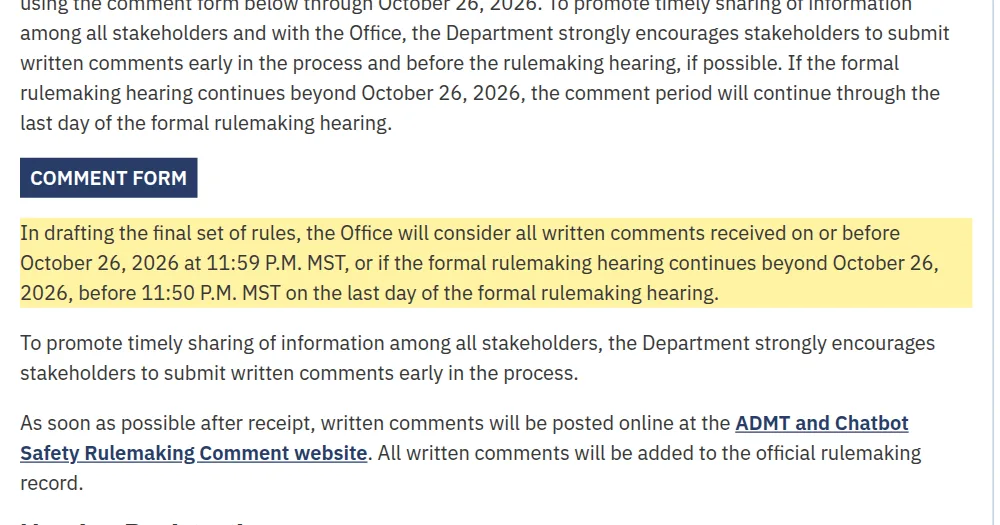
Screenshot: ADMT and Chatbot Safety rulemaking page, Colorado Attorney General, checked October 15, 2026 (highlight added).
Two rows still let you shape the rule rather than just follow it: Colorado's comments and the UK consultation, and Colorado closes first. Colorado's Department of Law released an interim draft of the rules on October 6, and comments are posted publicly. Our comment letter template has a hearing script if you want to speak.
Already in force
| Date | Where | What applies | Who it covers | Official source (checked) |
|---|---|---|---|---|
| Feb 2, 2025 | EU | AI Act Chapters I and II, including the prohibited practices in Article 5 | Providers and deployers in the EU market | Regulation (EU) 2024/1689, Art. 113, Oct 15, 2026 |
| Aug 2, 2025 | EU | Chapter V obligations for general-purpose AI models, plus governance and penalties (except Article 101) | General-purpose AI model providers | Regulation (EU) 2024/1689, Art. 113, Oct 15, 2026 |
| Jan 1, 2026 | Texas | HB 149, the Texas Responsible Artificial Intelligence Governance Act | Use of AI systems in Texas | Texas Legislature Online, Oct 15, 2026 |
| Jul 27, 2026 | EU | Digital Omnibus on AI, Regulation (EU) 2026/1744, in force (published July 24, in force on the third day) | Everyone covered by the AI Act | Regulation (EU) 2026/1744, Oct 15, 2026 |
| Aug 2, 2026 | EU | AI Act general application, including Article 50 transparency duties for systems launched from this date; Commission fines on model providers (Article 101) | Providers and deployers; general-purpose AI model providers | Regulation (EU) 2024/1689, Art. 113, Oct 15, 2026 |
| Sep 30, 2026 | California | SB 1000 (Chapter 861), an urgency statute in effect on signing: amends the AI Transparency Act and drops the user threshold from "covered provider" | Covered providers of generative AI systems | SB 1000 chaptered text, Oct 15, 2026 |
| Oct 1, 2026 | Connecticut | SB 5: key-terms notice for AI subscriptions (Sec. 1), frontier developer whistleblower protections (Sec. 2), an AEDT is no defense to a discrimination complaint (Sec. 13), provenance data from generators with over a million monthly users (Sec. 15), WARN filers say whether layoffs relate to AI (Sec. 26) | Subscription AI providers, frontier developers, employers, large generators | Public Act 26-15, Oct 15, 2026 |
| Oct 1, 2026 | Maryland | HB 895 (Chapter 154), the Protection From Predatory Pricing Act: no dynamic pricing and no pricing from consumer personal data | Food retailers and third-party delivery services | Maryland General Assembly, Oct 15, 2026 |
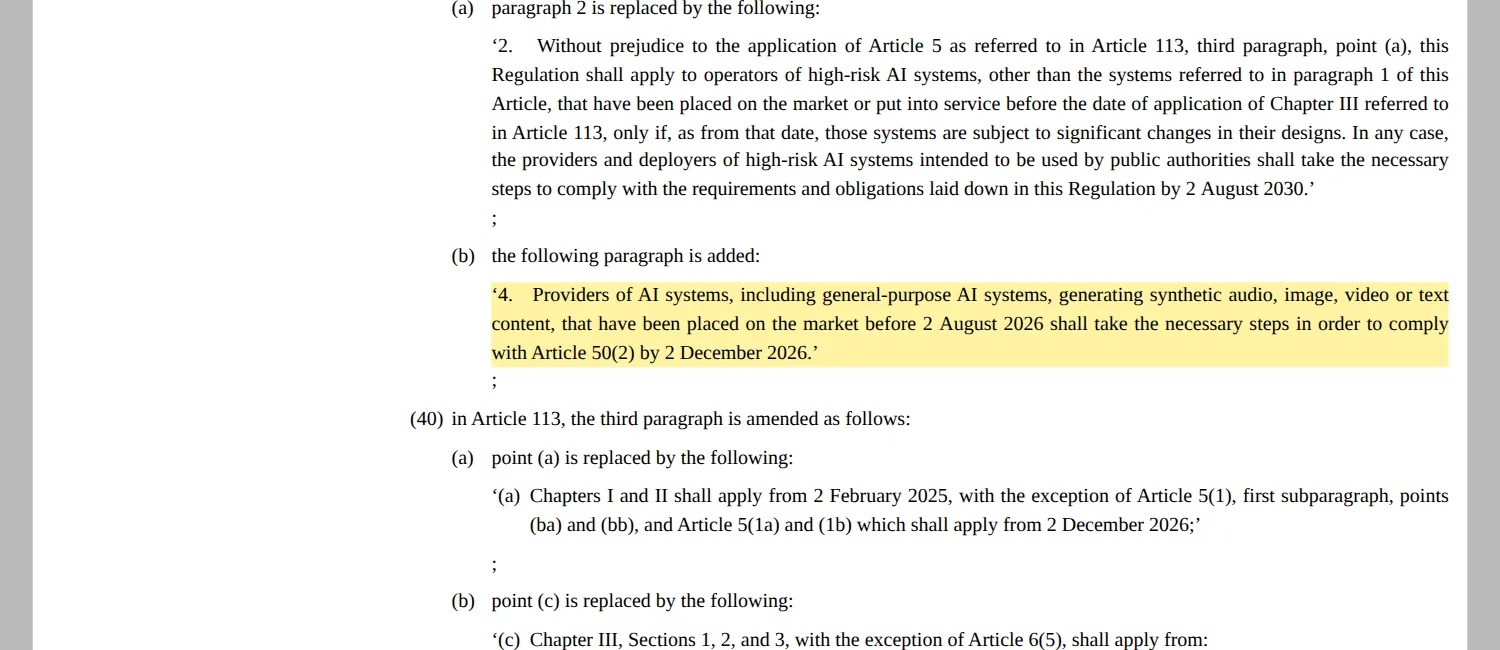
Screenshot: Regulation (EU) 2026/1744, Article 1, points (39) and (40), EUR-Lex, checked October 15, 2026 (highlight added).
Penalties we confirmed
| Law | Maximum penalty | Who enforces | Official source (checked) |
|---|---|---|---|
| EU AI Act, prohibited practices | EUR 35 million or 7% of worldwide annual turnover, whichever is higher (Article 99(3)) | Member States set the enforcement rules | Regulation (EU) 2024/1689, Oct 15, 2026 |
| EU AI Act, general-purpose AI models | 3% of worldwide annual turnover or EUR 15 million, whichever is higher (Article 101) | European Commission | Regulation (EU) 2024/1689, Oct 15, 2026 |
| California AI Transparency Act, as amended by SB 1000 | $5,000 per violation (§ 22757.4) | Attorney General, a city attorney or a county counsel | SB 1000 chaptered text, Oct 15, 2026 |
| Connecticut SB 5 | Up to $1,000 per violation of the frontier whistleblower rules; for hiring-tool violations through December 31, 2027, the AG first sends a notice with a chance to cure where a cure is possible; no private right of action | Connecticut Attorney General | Public Act 26-15, Oct 15, 2026 |
What we could not confirm: ilga.gov didn't load for us on October 15, so the Illinois row rests on the Governor's release, not the statute; we left out its duties for that reason. The Connecticut legislature's site timed out too, so we read Public Act 26-15 from the Internet Archive copy of the official PDF captured October 7, 2026. The New York Senate and Governor's sites blocked our browser on October 16, so the New York row rests on the bill text and history on the Assembly's site, which shows the amendment signed as Chapter 96 on March 27, 2026 and moving the start date to January 1, 2027. The old federal rows (an FTC rulemaking, a second Operation AI Comply) had no official source behind their dates, so they're gone.
What changed since the last review
Reviewed October 15, 2026, two days after the previous pass. New rows: the two EU AI Act dates on December 2, the Product Liability Directive on December 9, Colorado's comment deadline and its Chatbot Safety Act, the CCPA automated decisionmaking rules, SB 951, SB 690, SB 1000, Illinois SB 315, the UK consultation, the MAS guidelines and Maryland HB 895. On October 16 we added New York's RAISE Act and California's SB 1119 (Adam's Law) after reading both enacted texts.
We took out every row we couldn't trace to an official text, including the Colorado SB 205 dates, which SB 26-189 replaced before they took effect. The full list is in the correction below. There's no embedded post on this page: no single thread or official post covers the whole calendar, so the screenshots show the primary texts instead.
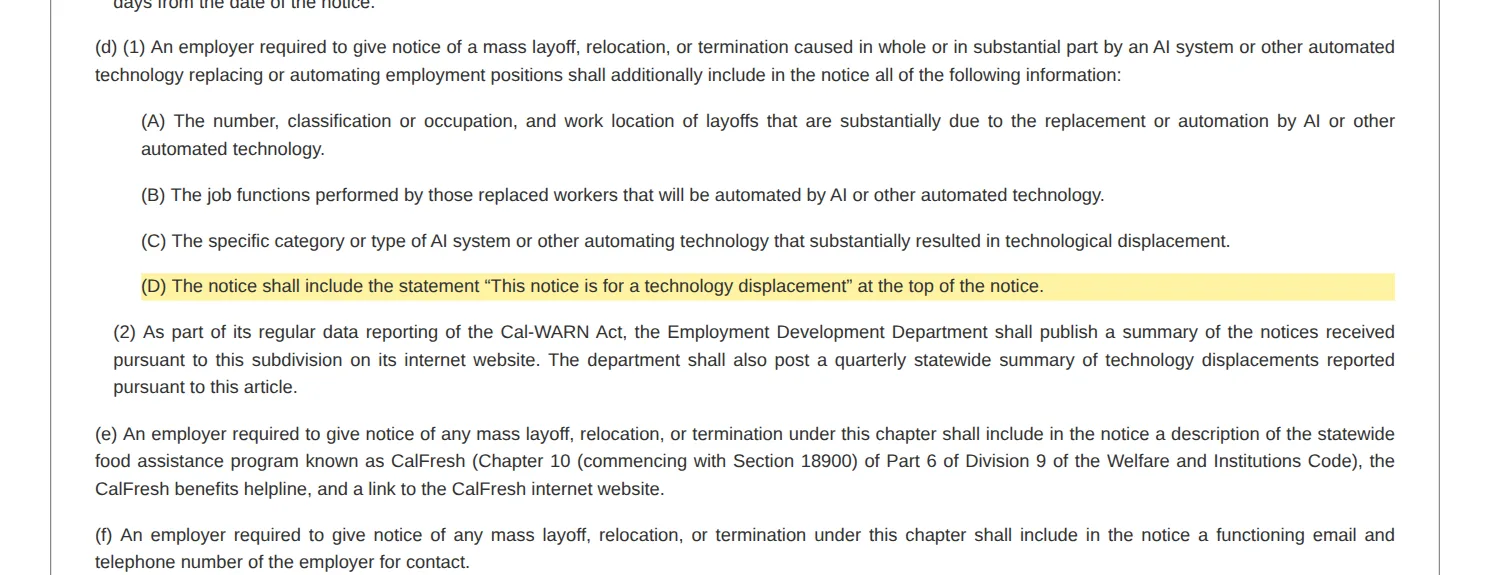
Screenshot: SB 951, Labor Code § 1401(d) as amended, California Legislative Information, checked October 15, 2026 (highlight added).
How to use this calendar
Give each row one owner and a calendar entry two weeks before the date. January 1 lands on three teams at once in California: HR (SB 951 notices), privacy (the ADMT rules) and the web team (SB 690). Check which of them you are before December.
If you ship generative features into the EU, test your output marking before December 2; a system launched after August 2, 2026 has needed it since launch. For the documents behind each row, start with the Connecticut SB 5 checklist, the California ADMT templates and the Product Liability Directive guide.
Correction (October 13, 2026): Earlier versions listed Connecticut SB 5 as requiring opt-out, annual bias audits, four-year records and AEDT notices from October 1, 2026, called it "SB 2" and "enacted 2025", and said penalties were left to rulemaking. Public Act 26-15 (approved May 27, 2026) has none of those; the notices start October 1, 2027. We also corrected the EU AI Act GPAI date (August 2, 2025) and moved the Annex I high-risk date to August 2, 2028 under Regulation (EU) 2026/1744.
Correction (October 15, 2026): We rebuilt this calendar from official sources and removed rows we couldn't confirm: Colorado SB 205 taking effect February 1, 2026 (SB 26-189 repealed and reenacted it; duties start January 1, 2027), an "Illinois AEDT annual audit" in 2025 and 2027, "CalAI amendments (SB 1047 provisions)", a second wave of the FTC's Operation AI Comply, a "Washington AI Likeness Protection Act", a "Texas AI Liability Act", a 2027 FTC AI rulemaking, Connecticut SB 4, a sector table of ongoing federal obligations, and penalty rows for Colorado SB 205, NYC Local Law 144 and FTC Section 5. Earlier versions also listed August 2, 2026 as the start of general-purpose AI model obligations (they applied from August 2, 2025), cited an unsourced "EU AI Office confirmed, May 2026" line, and described Maryland's pricing law as awaiting rulemaking; HB 895 took effect October 1, 2026.
Related Reading
- AI workforce transition plan with the Cal-WARN and New York WARN notice check
- Colorado ADMT comment letter template for the October 26 deadline
- Connecticut SB 5 employer checklist, October 2026
- California ADMT employer compliance templates
- California SB 690 and CIPA pen register suits
- California SB 947 and SB 951: worker AI protections
- California's 26 AI Bills: Newsom's September 30 deadline
- EU Product Liability Directive and AI, December 2026
- EU AI Act Article 50: watermarking and deepfake disclosure
- EU Digital Omnibus: AI Act deadline extension
- UK Law Commission consultation on product liability for AI and software
- MAS AI risk guidelines for vendors selling to Singapore financial institutions
- Illinois SB 315 frontier AI safety law and vendor risk
- Texas TRAIGA compliance checklist
- Maryland surveillance pricing law for grocery stores