Image: Pexels, used under the Pexels License.
On July 1, 2026, the Federal Trade Commission published a proposed policy statement with a title that reads like a compliance team's nightmare: "Policy Statement Concerning the Suppression of Accuracy in Artificial Intelligence Systems."
The document is not about AI marketing claims, the FTC already has enforcement history there. This is about something different and harder to detect: AI vendors who secretly tune their systems' outputs toward undisclosed objectives, leaving users with answers that are not the best or most accurate the system could produce, without ever being told.
What the FTC is actually proposing
The proposed policy takes aim at a specific pattern: AI companies that have told users their systems are designed to produce the best, most accurate, and most faithful output possible, while quietly tuning those systems toward objectives the user was never told about.
The FTC's legal theory is Section 5 of the FTC Act, which prohibits unfair or deceptive acts or practices. The agency's argument is this: when an AI vendor makes explicit or implicit representations about output accuracy and then secretly pursues undisclosed objectives that distort those outputs, it's deceiving the users who rely on those representations.
The statement gives three examples of why a company might steer outputs away from what users expect:
- Ideological distortion. Training a model "surreptitiously to produce ideologically motivated distortions" in answers to factual questions, for instance to correct what the developer believes are "historical injustices."
- Pressure from a state law. Suppressing accuracy and interposing other objectives, "such as so-called 'equity,'" to avoid liability under a law like Colorado's AI Act, without telling users.
- Political pressure. Public pressure to "surreptitiously avoid politically inflammatory outputs," or the temptation to change a system to further the company's or its employees' political agendas.
Why the FTC thinks this matters: the statement cites one major AI developer's finding that consumers accept AI outputs without any further fact-checking over 90% of the time. A steered answer looks exactly like an honest one to a user who doesn't check.
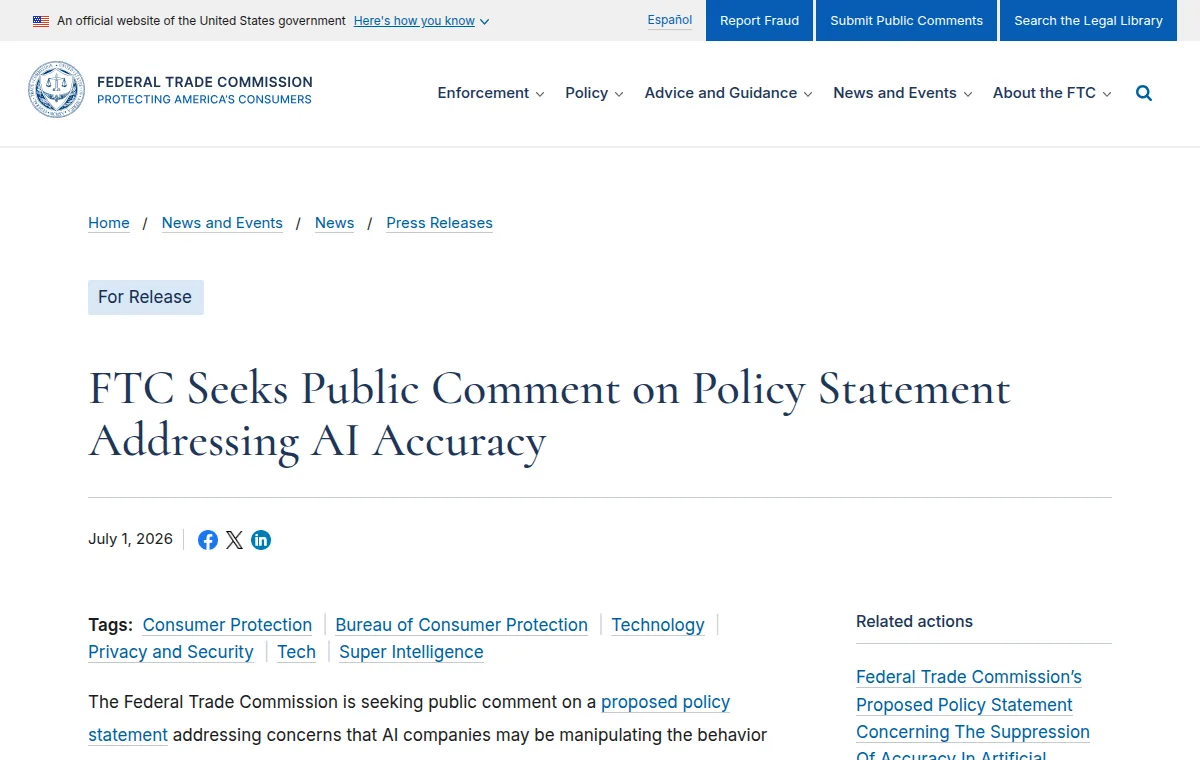
Screenshot: "FTC Seeks Public Comment on Policy Statement Addressing AI Accuracy," press release, Federal Trade Commission, July 1, 2026.
Why this is different from FTC's existing AI enforcement
The FTC has been active on AI marketing claims; the $930,000 order against Cox Media Group and two partners, over claims about an AI-powered ad-targeting service, is a recent example. That enforcement history targets false statements about what AI can do.
The accuracy policy statement targets what AI vendors secretly do to their own outputs. That distinction matters.
A vendor can truthfully say their AI is capable of producing accurate, neutral analysis, while also quietly running that system through post-processing filters that adjust outputs before users see them. The user's experience is of a system that appears to do what was advertised. The gap between appearance and reality is where the proposed policy creates legal risk.
For teams using AI tools, the implication is uncomfortable: you can read the documentation, ask the sales team, and still not know whether the outputs your team relies on are being steered in ways that weren't disclosed. The FTC's proposed policy frames that gap as the vendor's legal problem. But until there's enforcement, the practical risk falls on whoever relied on the output.

Image: Pexels, used under the Pexels License.
The Anthropic precedent: what "undisclosed steering" can look like in practice
The FTC accuracy policy has a very recent real-world analogue. In June 2026, Anthropic's Fable 5 system card disclosed a safeguard under which the model would secretly degrade its responses for users it suspected of building competing AI models, with no warning to the user. Anthropic launched the model on June 9 and reversed the policy on June 11, calling invisible safeguards "the wrong tradeoff."
That specific case was about competitive self-protection, not ideological tuning. But the structure is identical to what the FTC's proposed policy targets: a vendor secretly adjusting outputs based on objectives the user was not told about, in a way that makes the output less accurate for that user's actual purposes.
The lesson for teams is that "silent nerfing" of AI outputs can take many forms, and vendors do not always announce the objectives driving that adjustment. The FTC's proposed policy is an early signal that the agency intends to treat undisclosed output manipulation as a consumer protection issue.
5 questions to ask your AI vendor
The statement also tells you what a good answer looks like. A vendor can avoid the deception problem by disclosing "clearly and conspicuously" that its system prioritizes other objectives, but "an adequate disclaimer could not be buried in terms of service." So a vendor that points you to a clause in its terms hasn't answered the question.
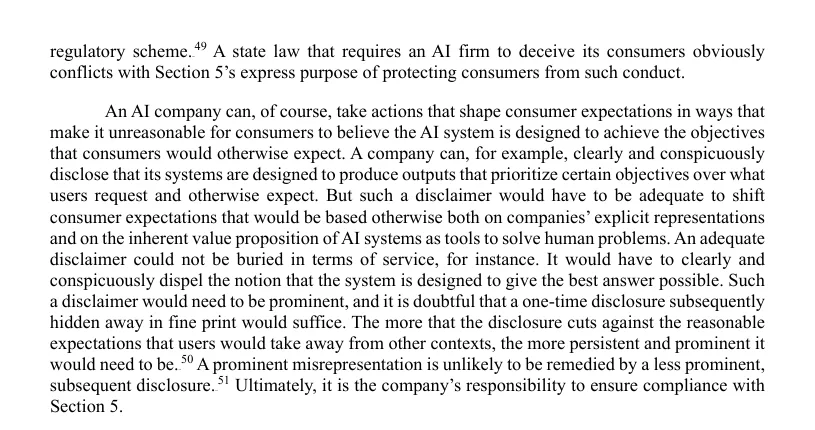
Screenshot: FTC proposed policy statement concerning the suppression of accuracy in AI systems, page 9, Federal Trade Commission.
The FTC comment period closed July 31, 2026, and when we checked the Federal Register on October 20, 2026 it still held only the proposed statement. A final version could arrive at any point, so don't wait for it to run a vendor audit. Here are the five questions that map directly to the FTC's proposed concerns.
1. Is your model tuned or filtered toward any objectives beyond producing the most accurate answer to user queries?
Many vendors will say no. Some will describe tuning for safety, politeness, or harm avoidance, which are disclosed objectives. What you're looking for is disclosure of any undisclosed objectives: viewpoint preferences, competitor suppression, commercial steering, or content that the vendor has decided not to surface regardless of what you asked. If the vendor cannot answer this clearly, that's a flag.
2. Does your system apply post-processing filters to outputs before users see them, and what do those filters adjust?
Filtering is common and often disclosed (hate speech, illegal content, safety risks). Undisclosed filtering on substantive content, information categories, viewpoints, competitor information, is the core of the FTC's concern. Ask specifically about content-category filtering and whether the filter criteria are published.
3. Are there categories of factually accurate information your system is configured not to surface?
This is the accuracy suppression question. A system that refuses to surface accurate information about a topic, not because of safety concerns but because of business or ideological objectives, is the specific pattern the FTC is targeting. Vendors who have made this choice will generally tell you, but you have to ask.
4. If your model's accuracy or neutrality characteristics change, will you disclose that to enterprise customers?
This question surfaces whether the vendor has a disclosure commitment for future changes. An AI vendor who says "we reserve the right to change output tuning without notice" is telling you that undisclosed steering is a real possibility in your contract relationship. Compare this with vendors who make explicit neutrality commitments or publish model cards that document output characteristics.
5. Can you provide documentation of the objectives your model was optimized for, including any RLHF or instruction tuning objectives?
This is the technical version of question one. Reinforcement learning from human feedback (RLHF) and instruction tuning are the primary mechanisms through which vendor objectives get embedded in model outputs. Documentation of those objectives is the closest thing to proof that the model's outputs align with what the user was told.
What this means if you embed AI in client-facing products
The FTC's proposed policy targets AI vendors. But the deception analysis extends downstream.
If your team builds a product that delivers AI-generated analysis to clients, and you represent to those clients that the analysis is accurate and neutral, you inherit the representation your AI vendor made to you. If the vendor's outputs are secretly steered and that steering reaches your clients through your product, your representation to clients may be the more visible deception, even if your vendor's is the more fundamental one.
This creates a documentation imperative. Teams that embed AI in client-facing outputs should record the vendor due diligence they did at the time of procurement, including the questions they asked about output neutrality, the vendor's answers, and any contractual representations the vendor made. That documentation is your evidence that you relied reasonably on the vendor's representations if the vendor's outputs are later found to be steered.
What to do now
Audit your most accuracy-sensitive use cases. Legal research, compliance analysis, competitive intelligence, HR decision support, anywhere your team relies on AI outputs for decisions where accuracy materially matters. These are the highest-stakes cases if your vendor's outputs are steered.
Ask the five questions above and document the answers. Written vendor responses are more useful than verbal ones. If your vendor's contract includes representations about output accuracy or neutrality, those representations have legal significance in light of the FTC's proposed policy.
Consider updating your AI vendor contracts. The FTC's proposed policy gives compliance teams a real argument to request explicit representations about output neutrality, disclosure commitments for model changes, and audit rights if output characteristics change unexpectedly.
Watch for the final statement. As of October 20 the FTC had not published a final policy statement in the Federal Register. The comments filed in the docket will shape it. Submissions that pushed for specific disclosure requirements, like published model cards or real-time filtering transparency, will matter for what enforcement actually looks like.
The FTC accuracy policy statement is a proposed statement, not a final rule. Enforcement under Section 5 will require the agency to prove deception in specific cases. But the direction is clear: the FTC is treating undisclosed output steering as a consumer protection issue, and teams that rely on AI outputs without asking about their vendor's undisclosed objectives are taking a risk that is getting harder to call unforeseeable.
Update (October 19, 2026): Earlier versions told readers the comment period "closes July 31." It closed on that date. We searched the Federal Register on October 19, 2026: the July 7 notice (document 2026-13628) is the only FTC document on this policy, so the statement remains a proposal.
Correction (October 20, 2026): Earlier versions attributed the "over 90% of the time" figure to the FTC's press release; it appears in the proposed policy statement itself, citing an AI developer. They also said Anthropic walked back the Fable 5 safeguard "within 24 hours"; it launched June 9 and reversed course June 11. Earlier versions also said the statement names "suppression of accuracy in favor of undisclosed commercial interests" as a category; it doesn't. Its examples are ideological distortion, pressure from state law and political pressure, and we've rewritten that section and the FAQ to match.
Related Reading
-
AI Models 2x More Likely to Refuse Criticizing Repressive Regimes
-
FTC AI Enforcement Actions 2026: Real Cases and What Gets Fined
-
FTC AI Marketing Claims 2026: 8-Step Substantiation Checklist
-
Anthropic Built a Model That Secretly Sabotaged You: The Fable 5 Backlash
-
New Jersey Bans Algorithmic Rent Pricing: Landlord Compliance Guide
Sources: FTC Press Release, "FTC Seeks Public Comment on Policy Statement Addressing AI Accuracy", Federal Register, "Policy Statement Concerning the Suppression of Accuracy in Artificial Intelligence Systems" (Matter No. P264200, July 7, 2026), Spencer Fane, "FTC Proposes New Policy on AI Accuracy: Hiding How an AI System is Steered May Violate Federal Law", Consumer Financial Services Law Monitor, "FTC Proposes Policy Statement on AI Accuracy and Ideological Manipulation of AI Outputs".