
Image: Pexels, used under the Pexels License.
Short answer: on business plans, almost no major AI vendor trains on your data by default. On personal and free plans, most of them can, and two defaults flipped this year without much noise. GitHub started training on Copilot Free, Pro and Pro+ interactions on April 24, 2026, and Atlassian started using Confluence and Jira content from Free and Standard organizations on August 17, 2026.
The question got sharper in June, when a top post on r/artificial asked "So now scraping data without permission is bad for AI training all of sudden?" The most upvoted reply, from u/Open_Enthusiasm8528, put the irony bluntly: "the people who had their hard work stolen weren't paid anything." Underneath the joke sits the practical question for your team: which of the tools you use right now trains on what you type into it?
https://www.reddit.com/r/artificial/comments/1ugwccs/so_now_scraping_data_without_permission_is_bad/
Why this question is harder than it looks
"Does this vendor use my data to train its model?" can mean three different things:
Training the base model. Your data improves the underlying model the product is built on. This is the highest-risk case, because your content could shape what the model produces for other customers.
Fine-tuning the product. Your usage data tunes the product layer on top of the model (tone, task behavior). Lower risk, but your data still feeds something you don't control.
Inference through a subprocessor. Your prompt goes to a third-party model provider to produce an answer, without being used for training. Most AI products work this way, and it's the least risky form of "the vendor sees your data."
Vendor statements about "not training on your data" usually mean the first two. The same vendor may still send your prompts to a subprocessor for inference, which shows up in its subprocessor list or DPA. The table below covers training, not subprocessing.

Image: Unsplash.
Training data policies by vendor and plan (checked October 2026)
| Vendor / Plan | Trains on your data? | Opt-out | Notes |
|---|---|---|---|
| ChatGPT Free, Plus, Pro | Yes, by default | Yes (Settings > Data Controls, or the privacy portal) | Feedback you submit can be used even after opting out |
| ChatGPT Business, Enterprise, Edu and API | No, by default | N/A | API organization owners can choose to share data |
| Claude Team, Enterprise and API (commercial terms) | No, by default | N/A | Feedback you submit can be used |
| Claude Free, Pro, Max | Your choice | Yes (Privacy Settings) | If you allow training, retention extends to five years |
| Gemini app (personal Google account) | Yes, with Keep Activity on | Yes (turn off Keep Activity) | Human reviewers read some chats |
| Gemini in Workspace (business, education) | No, without your permission | N/A | Not human reviewed or used for training outside your domain |
| Microsoft Copilot (consumer) | Yes, can be used | Yes, at any time | Conversations stored for 18 months by default |
| Microsoft 365 Copilot (work accounts) | No | N/A | Prompts, responses and Graph data aren't used to train foundation models |
| GitHub Copilot Free, Pro, Pro+ | Yes, by default since April 24, 2026 | Yes (Settings > Privacy) | Inputs, outputs, code snippets and context; earlier opt-outs carried over |
| GitHub Copilot Business, Enterprise | No | N/A | Not affected by the April change |
| Atlassian (Jira, Confluence, Rovo) | Free and Standard: yes by default. Premium and Enterprise: in-app data off by default | In-app data: any plan. Metadata: Enterprise only | Live since August 17, 2026; data is de-identified and aggregated |
| Notion AI | No, by default | N/A | AI providers are bound by no-training terms |
GitHub Copilot: the default that flipped in April
GitHub announced on March 25, 2026 that from April 24 it would use interaction data from Copilot Free, Pro and Pro+ to train its models unless users opt out. That covers inputs, outputs, code snippets and the surrounding context. Copilot Business and Enterprise aren't affected, and anyone who had already turned off data collection for product improvement kept that choice.
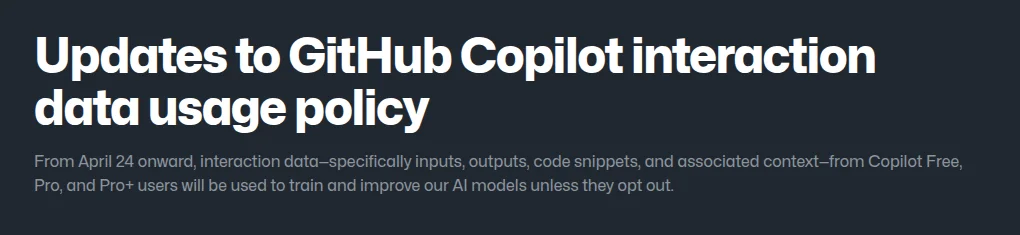
Screenshot: "Updates to GitHub Copilot interaction data usage policy", GitHub Blog, March 25, 2026.
For a small team this is the most likely leak: a developer on a personal Copilot plan working in your private repository. The fix is either a Business seat or a check that the Privacy setting is off.
Atlassian data contribution: live since August 17
Atlassian's data contribution change went into effect on August 17, 2026. It uses metadata and in-app data from Jira, Confluence, Jira Service Management and platform apps including Rovo to improve its apps and AI for all customers. In-app data means things like Confluence page titles and content, Jira work item titles, descriptions and comments, and custom emoji, status and workflow names. Atlassian says all of it is de-identified and aggregated first.
The defaults depend on your organization's highest active plan:
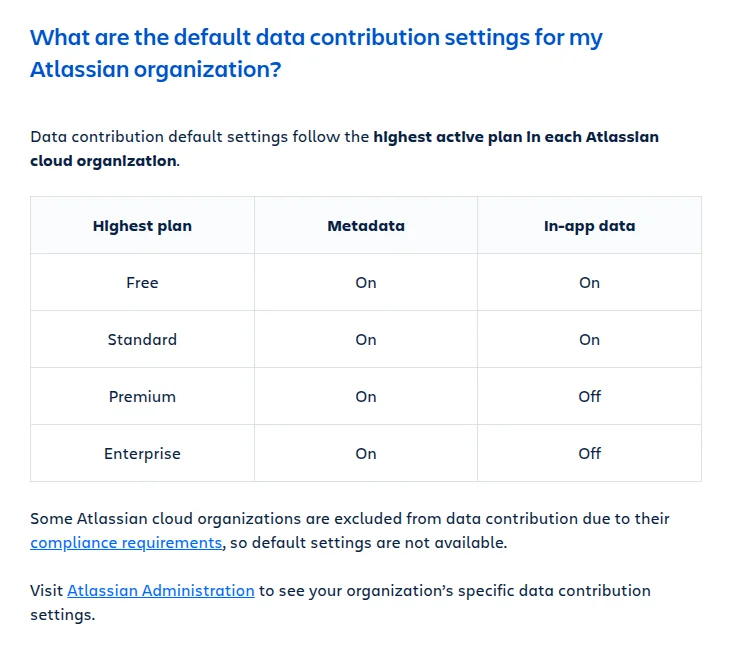
Screenshot: "What are the default data contribution settings for my Atlassian organization?", Atlassian Trust Center, captured October 20, 2026.
So a Free or Standard organization that nobody configured is contributing page and issue content now. Premium and Enterprise organizations start with in-app data off. Metadata is on for everyone, and only Enterprise can turn it off.
How to check: open Atlassian Administration (admin.atlassian.com), find the data contribution settings, and turn off in-app data contribution if you don't want it. Atlassian says you can change it at any time.
For teams with EU data: Atlassian's subprocessor list names OpenAI, Google Vertex AI and AWS Bedrock as AI service providers for products with Atlassian Intelligence or Rovo enabled, processing in the USA among other places. That's inference, separate from the contribution setting, but it belongs in your transfer assessment.
The account tier problem
The most common mistake is assuming that because you pay for business tiers of your main tools, all AI use in the company is covered. It isn't.
People use personal accounts for work all the time:
- A developer on a personal Copilot Pro plan works in a company repository (trains by default since April)
- A manager pastes meeting notes into a personal ChatGPT account (trains unless opted out)
- An analyst runs business data through the Gemini app on a personal Google account (human reviewers may read it)
The risk sits at the boundary between personal accounts and company work. An acceptable use policy that requires company-provisioned accounts for business AI use is the most direct control.
If you can't enforce that everywhere, tier it: require business accounts for anything confidential (customer information, legal documents, financial data, HR records), and allow personal accounts only for low-sensitivity tasks where training exposure is acceptable.
The self-hosted alternative
For strict data handling there's a category the table leaves out: open-weight models on your own infrastructure. Meta's Llama, Mistral's open models and DeepSeek's open-weight releases can all run on servers you control, so no vendor sees the data at all.
The tradeoff is operations: hosting, updates and security become your job. For regulated work (health data, financial records, personal data under GDPR), that control can be worth the cost. The privacy-first AI APIs guide covers commercial APIs with verifiable no-training commitments if self-hosting is too much.
How to update your AI acceptable use policy
Three provisions to add or tighten:
Personal account restriction. Employees use company-provisioned AI accounts for any task involving confidential information, customer data or regulated personal data. Define "confidential" for your context. Personal accounts are fine for learning and low-stakes experiments.
Training data disclosure at procurement. Ask every new AI vendor in writing: (a) do you train base or fine-tuned models on customer data; (b) is that the same on every plan; and (c) how do we request deletion of data already used?
Opt-out verification. For tools where training is on by default (GitHub Copilot's individual plans and Atlassian's lower tiers are the current examples), record the setting in your AI tool register and re-check it at least once a year.
The regulatory dimension
Under GDPR, training on personal data raises a purpose question. Jira comments or Confluence pages written for project work are personal data about the people who wrote them, and using them to improve an AI model is a new use.
Article 5(1)(b) requires personal data to be collected for specified purposes and "not further processed in a manner that is incompatible with those purposes." Atlassian's answer is de-identification, aggregation and an opt-out. Whether that's enough for your organization is a question for your DPO, not your Atlassian admin, so put it on their list.
The AI data privacy for small teams guide covers the GDPR analysis for common AI tool use cases, including purpose limitation.
What to ask before you sign
- At which plan tier does the vendor stop training on customer data?
- Is there a delay between processing data and using it for training? Can you delete it before then?
- Can the vendor remove your data from a model that's already trained? (Almost none offer retraining, which is worth knowing.)
- Which subprocessors receive your data for inference, and what are their training terms?
- If the vendor changes its training policy after you sign, how much notice do you get, and can you leave?
Question 5 is the GitHub and Atlassian lesson. Both changed defaults with advance notice and an opt-out, and neither change needed a contract amendment. Teams that weren't watching found out late.
Our take
Pay for business tiers where your confidential work happens, and then stop worrying about the big vendors' default policies; they're consistent. Spend the effort on the boundary instead: personal accounts, individual Copilot plans and lower-tier Atlassian organizations. That's where this year's changes landed.
Correction (October 19, 2026): Earlier versions described Atlassian's change as coming on August 17 and said Anthropic doesn't train on Claude conversations on any plan. Atlassian confirms the change went into effect on August 17, 2026. Anthropic's consumer terms let Claude Free, Pro and Max users choose whether their chats train models; commercial plans and the API are not used for training by default.
Correction (October 20, 2026): Earlier versions said Atlassian uses data from every plan unless teams opt out; Premium and Enterprise organizations start with in-app data off. They also missed GitHub's April 24 change for Copilot Free, Pro and Pro+, described consumer Microsoft Copilot's opt-out as "limited" (Microsoft says you can opt out at any time), gave Atlassian's customer count without a source, and called the page an 11-vendor comparison when it covers seven vendors.
Related Reading
- Illinois SB 315 Signed: The Toughest AI Safety Law Yet
- A California Court Coordinated a Dozen-Plus Wrongful Death Cases Against OpenAI
- AI Companies Built Empires by Scraping the Internet: The Vendor Risk Behind the Backlash
- Anthropic Built a Model That Secretly Sabotaged You: The Fable 5 Backlash
- Privacy-first AI APIs with no training on your data: 2026 guide
- AI data privacy for small teams: GDPR and CCPA compliance
- DeepSeek and Chinese AI models: GDPR data transfer risk
- GDPR AI fines 2026: enforcement cases and what small teams must know
- AI meeting transcription apps: data risks and compliance 2026
- Anthropic vs OpenAI: GDPR compliance differences 2026
- AI vendor due diligence checklist 2026
- Enterprise AI privacy pages: direct links to vendor documentation
- Russia's Project 2026 targets AI training data: 6-point vendor risk checklist
- FTC Says Your AI Vendor May Be Breaking the Law If It Secretly Steers Outputs
- Anthropic's $1.5B Copyright Settlement: Training Data Has a Price Now
- Anthropic's Project Panama: Book Destruction, FTC Risk, and You
- Meta Commercial Terms: The AI Crawl Clause and What to Do
