Image: Unsplash.
TL;DR: Gov. Mikie Sherrill signed the FAIR Act on July 20, 2026 (P.L.2026, c.43). From July 1, 2027, using or running rent-setting software that draws on competitors' nonpublic data, or a shared algorithm that facilitates parallel pricing, is a violation of the New Jersey Antitrust Act. "Nonpublic" means anything not free to the public, and mixed data counts as nonpublic. New Jersey is the fourth state, after California, New York and Connecticut.
New Jersey Gov. Mikie Sherrill signed the Forbidding the Algorithmic Inflation of Rent (FAIR) Act on July 20, 2026, at a press conference in Military Park in Newark. It was enacted as P.L.2026, c.43, and it takes effect on July 1, 2027. The Governor's office called New Jersey "just the fourth state to explicitly regulate rent setting algorithms."
"Landlords, who should be competing to provide the best price to renters, are instead colluding to drive prices up through so called 'algorithmic pricing.' That stops now," Sherrill said in the signing release.
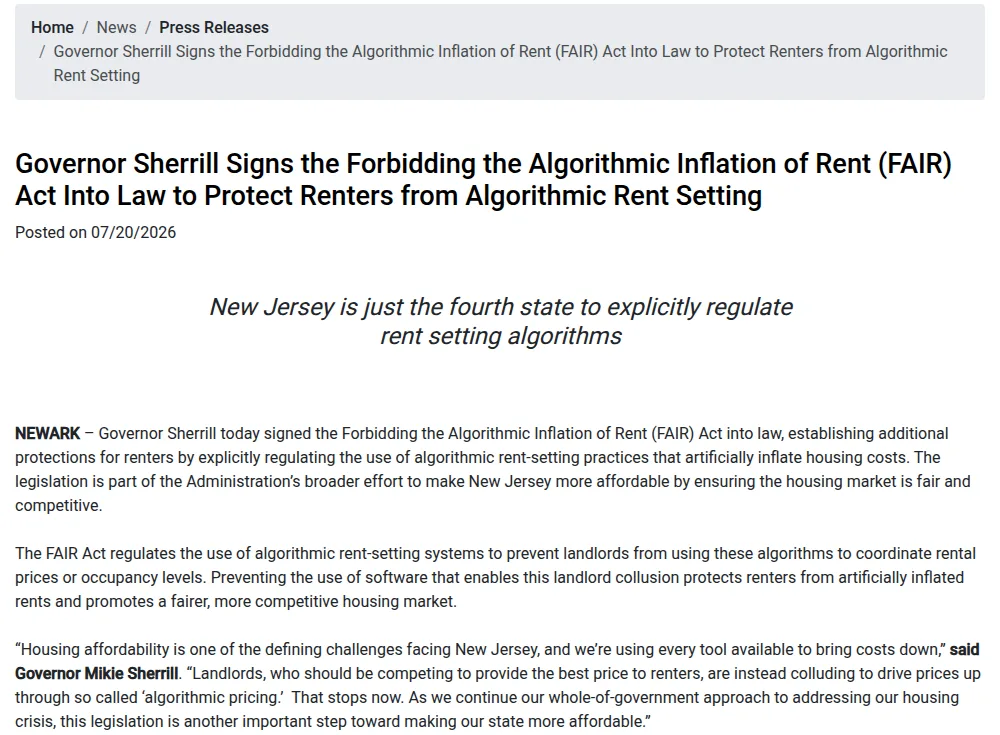
Screenshot: Governor Sherrill signs the FAIR Act, press release of July 20, 2026, Office of the Governor of New Jersey.
The bill is the Assembly Committee Substitute for A3497. Its sponsors include Senate Majority Leader M. Teresa Ruiz, Sen. Brian Stack and Assemblywomen Yvonne Lopez and Katie Brennan, with Assemblywoman Margie Donlon and Assemblyman Chigozie Onyema. The Assembly passed it on party lines; in the Senate, all Democrats and most Republicans voted for it.
What the FAIR Act prohibits
The Act makes five kinds of conduct unlawful and a violation of the New Jersey Antitrust Act. The one that reaches most landlords is the first: a rental property owner, or its agent, may not "receive, subscribe to, contract for, or otherwise exchange any form of consideration in return for the use of, the services of a coordinator." The others cover the coordinator facilitating an agreement, two or more persons engaging in parallel pricing coordination, a coordinator's agents doing so, and anyone performing a coordinating function.
A coordinator is anyone running algorithmic revenue management software or an algorithmic device that performs a "coordinating function," and that includes a landlord doing it for its own benefit. The Act lists three coordinating functions:
- Pooling. Collecting the competitively sensitive information of two or more rental property owners and running it through an algorithm, including to train one, where the output sets or recommends rents, lease terms or occupancy.
- Using someone else's data. Setting your own rents through an algorithm that processes another owner's competitively sensitive information, including an algorithm trained on it.
- Sharing the same algorithm. Setting or recommending rents for two or more owners with the same or a substantially similar algorithm that "facilitates parallel pricing coordination." This one does not depend on pooled data.
Competitively sensitive information is nonpublic information such as prices, supply levels, security deposits, ideal occupancy levels, lease termination and renewal dates, and other material lease terms.
The definition of nonpublic is where the Act is stricter than many readers expect. It means information "not available to the public at no cost," and "where the information is combined with public information, all combined information shall be deemed nonpublic information." A paid data feed is nonpublic. A model that blends public listings with one competitor's private data is fed entirely nonpublic data. DLA Piper notes that it "remains unclear" whether enforcers will treat public information from paywalled platforms differently from freely available sources.
Parallel pricing coordination can rest on a tacit agreement, which the Act defines as mutual consent shown without verbal or written communication; "mutual consent may, but need not, be demonstrated by a pattern of conduct."
What the Act does not cover
- A spreadsheet that "operates without artificial intelligence" and requires human analysis, and a database that only queries unprocessed data.
- Research, statistical analysis or testing, where the data is not used to set prices or lease terms.
- An estimated rent "made available to the public at no cost."
- A real estate brokerage listing database available on equal terms to subscribers, as long as it does not set or recommend prices or collect sensitive information to do so.
- Government affordability controls, such as rent control and housing programs.
The Act does not cap rents or require landlords to lower them.

Image: Pexels, used under the Pexels License.
Enforcement
The Act says nothing limits the application of sections 6 through 17 of the New Jersey Antitrust Act to a violation, and Day Pitney summarizes it as preserving "existing remedies under the New Jersey Antitrust Act." We did not read those sections for this update, so we make no claim here about who can sue or what the penalties are.
Three more provisions matter in practice:
- Complaint portal. The Attorney General must set up a location on the Department of Law and Public Safety website to receive complaints about violations. An existing antitrust complaint page can satisfy this.
- Rules. The Attorney General may adopt rules under the Administrative Procedure Act.
- Local ordinances. "A municipality shall be prohibited from enacting an ordinance that conflicts with this act." The text addresses new ordinances; it does not say what happens to existing local bans such as Jersey City's.
How it compares with the DOJ settlement with RealPage
The federal case is the template many readers have in mind. On November 24, 2025, the Justice Department filed a proposed settlement with RealPage. If the court approves it, RealPage must:
- stop its software using competitors' nonpublic, competitively sensitive information to set rents "in runtime operation";
- stop training on active lease data, "limiting model training to historic or backward-looking nonpublic data that has been aged for at least 12 months";
- not use models narrower than state level;
- stop market surveys that collect competitively sensitive information, and accept a court-appointed monitor.
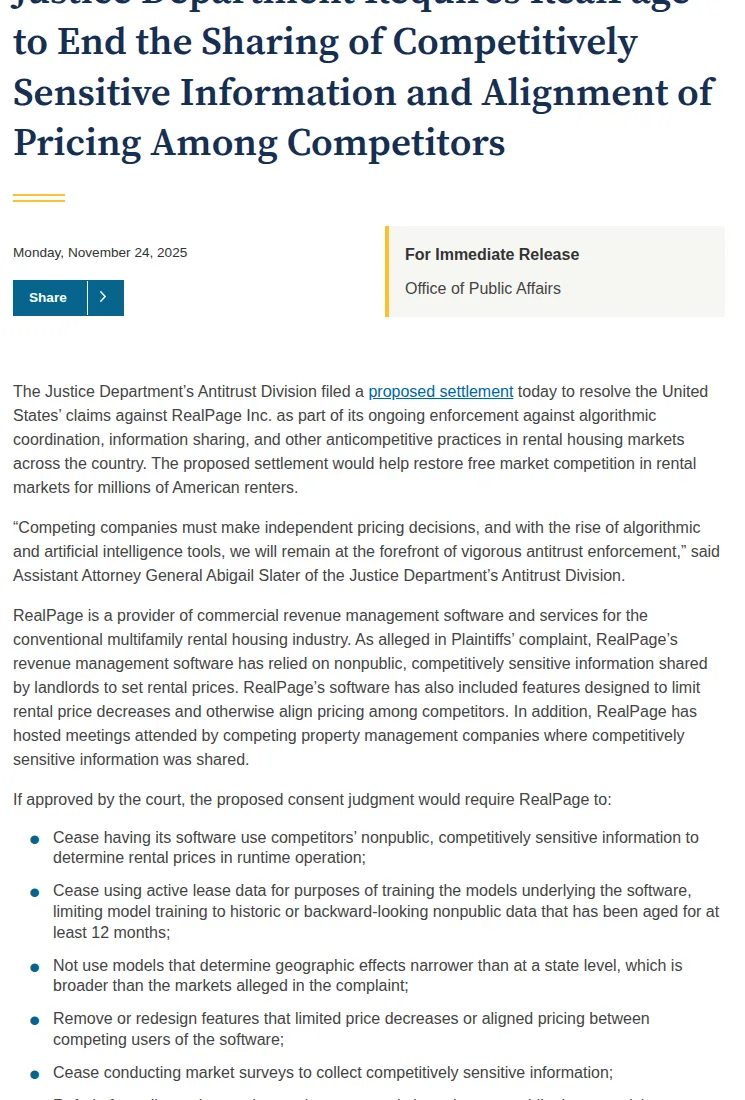
Screenshot: Justice Department Requires RealPage to End the Sharing of Competitively Sensitive Information, press release of November 24, 2025, U.S. Department of Justice.
Two differences matter. The settlement binds RealPage, while the FAIR Act applies to every landlord and vendor operating in New Jersey. And the settlement permits training on nonpublic data aged at least 12 months; we found no aging exception in the FAIR Act's text, which covers using another owner's competitively sensitive information "to train an algorithm." A vendor that is compliant with the federal decree is not automatically compliant in New Jersey. Under the Tunney Act, the federal court in the Middle District of North Carolina enters the final judgment only after a comment period and a public-interest finding.
The lawsuits behind the law
The push started in court. The DOJ sued RealPage in 2024. In October 2025, Greystar and 25 other property management companies agreed to pay more than $141 million together to settle a class action over RealPage's rent-setting software.
In New Jersey, then-Attorney General Matthew Platkin announced a suit against RealPage and 10 of the state's largest landlords on April 23, 2025. The complaint, filed partially under seal in the U.S. District Court for the District of New Jersey, alleges violations of the Sherman Act, the New Jersey Antitrust Act and the New Jersey Consumer Fraud Act. RealPage called it "devoid of merit." At the FAIR Act signing, current Attorney General Jennifer Davenport said her office is "leading the fight in court against algorithmic collusion by landlords and tech companies." The allegations have not been proven.
The other states
New Jersey joined California, New York and Connecticut. City bans came first, starting with San Francisco and Philadelphia and spreading to Jersey City, Minneapolis, San Diego and Hoboken; Jersey City passed its own in May 2025. Bills are pending in Massachusetts and Pennsylvania.
The state laws do not draw the line in the same place. DLA Piper's comparison: Connecticut's HB 8002 defines nonpublic competitor data as information "not available to the general public"; New York's S7882 "does not distinguish between public and nonpublic data, instead focusing on whether software performs a coordinating function"; California's AB 325 reaches common pricing algorithms that use competitor data whatever the source. A vendor selling into all four states cannot treat them as one rule.
The Fair Price Protection Act, three days later
On July 23, 2026, Sherrill signed a separate law, the Fair Price Protection Act. It "prohibits retailers from using personal data to set individualized prices on groceries and other necessities" but "does not ban loyalty programs or discounts." DLA Piper describes the scope as retail food stores and third-party grocery delivery platforms, with violations treated as an unlawful practice under the Consumer Fraud Act.
- Enforcement. The Attorney General may recover actual damages or $50,000 per violation, whichever is greater. WHYY reports Consumer Fraud Act fines of $10,000 for a first offense and $20,000 after that.
- Electronic shelf labels. A one-year moratorium on new electronic shelf labels while the New Jersey Innovation Authority studies them. Existing labels can stay.
- Dates. The shelf-label provisions take effect February 1, 2027, and the rest on August 1, 2027.
NJBIZ reports that New Jersey joins Maryland and Connecticut as the first states to ban personalized grocery pricing. The New Jersey Business and Industry Association warned the "unintended consequences could very well be the elimination of some loyalty programs, coupons, and other customer-specific discounts."
Compliance checklist for landlords and property managers
These steps follow from the text of the Act. They are not legal advice.
1. List every pricing tool. Revenue management software, rent recommendation features inside property management suites, and any consultant who sends you rent recommendations. A person running an algorithm on your behalf can be a coordinator too.
2. Ask each vendor three questions in writing. Does the tool use any other owner's nonpublic data, including for training? Does it recommend prices to competing owners from the same or a substantially similar model? Does it combine paid or private data with public data?
3. Check your data feeds against the "no cost" test. A paid market report is nonpublic under the Act. If a tool blends it with public listings, the whole input counts as nonpublic.
4. Do not rely on a DOJ-compliant label. The federal decree allows 12-month aged data for training. Ask the vendor to say how it complies with the New Jersey text, not the decree.
5. Keep a record of what you use. Write down the sources behind each price you set. If the Attorney General receives a complaint about your building, that record is your answer.
6. Set an internal deadline well before July 1, 2027. Switching or reconfiguring property management software takes time.
7. Watch for the Attorney General's complaint page and any rules. The Act lets the Attorney General adopt rules, which may answer the paywalled-data question.
What renters and landlords are asking
The r/newjersey thread on the signing asked the practical questions. One commenter wrote: "And how exactly are they going to enforce this?" Another asked: "If I am a landlord, am I not allowed to look on Zillow and see what similar apartments are renting for before pricing my unit?" Under the text, a free public rent estimate and an equal-terms listing database are excluded; the risk starts when a tool feeds competitors' private data into a recommendation.
A commenter who describes themselves as a small owner-operator in Bergen County put the target this way: "It's platforms where a bunch of separately-owned buildings feed their rents and occupancy into one shared system that then spits out a coordinated "recommended" price back to all of them."
https://www.reddit.com/r/newjersey/comments/1v1v8ds/new_jersey_restricts_rentsetting_algorithms_amid/
Our take
The headline is about RealPage, but the text is wider than the federal settlement in two ways that small landlords and their vendors should notice. First, the "no cost" definition makes paid data nonpublic, and mixing turns public data nonpublic. Second, the third coordinating function catches a shared algorithm that facilitates parallel pricing even without pooled data. A landlord who pays for a market-rent product should ask the vendor how it meets this text, and get the answer in writing, before July 1, 2027. The open question is how the Attorney General will read "paywalled" data; until there are rules or a case, plan for the strict reading.
How we checked this
We read 17 sources on October 10, 2026: the Governor's July 20 and July 23 releases, the enacted bill text (Assembly Committee Substitute for A3497), the DOJ's November 24, 2025 RealPage release, the New Jersey Attorney General's April 23, 2025 release, Day Pitney, DLA Piper, NJBIZ (two articles), New Jersey Globe, HousingWire, the Private Equity Stakeholder Project, Colorado Public Radio (AP), the New Jersey Monitor, WHYY and two r/newjersey threads. Every number above is in the source log for this article. We did not read sections 6 to 17 of the New Jersey Antitrust Act or the DOJ landlord settlements. We found no official video or post from the Governor's office to embed, so the embed is the Reddit thread on the signing. Last reviewed: October 10, 2026.
Corrections in this update. The earlier version listed Illinois among the four states; the other three are California, New York and Connecticut. It said models trained only on public, historical, time-aged data are outside the Act; the 12-month aging rule is in the DOJ settlement, the Act treats paid or mixed data as nonpublic, and it also covers a shared algorithm. It said the Fair Price Protection Act takes effect February 1, 2027 and gives shoppers a private right of action with treble damages; only the shelf-label provisions start February 1, the rest start August 1, 2027, and we found no source for a private right of action. It said the FAIR Act creates no private right of action and that Antitrust Act fines are uncapped; we removed both because we did not read the sections the Act applies. It named Matthew Platkin as the current Attorney General; he filed the suit in April 2025, and the current Attorney General is Jennifer Davenport. We removed an unsourced list of DOJ landlord settlements, a claim about congressional preemption attempts, and the photo caption that called the building Newark.
Related Reading
- Maryland Surveillance Pricing Law 2026: Grocery Stores Face New Personalized Pricing Rules
- Multi-state AI compliance in 2026: operating across US and EU AI laws at once
- New Jersey AI employment law 2026: employer compliance guide
- RentGrow FTC Settlement: AI Tenant Screening FCRA Checklist 2026
- FTC AI Enforcement Actions 2026: Real Cases, What Gets Fined, and Your Checklist
- US State AI Law Tracker: Which Laws Are in Force, Pending, or Repealed (July 2026)