Flock Safety sells AI-powered license plate readers to police departments; by June 2026 its network had passed 100,000 cameras across the United States, according to TechTimes. The cities that bought them wrote data policies. The records released this year show what those policies were worth when the vendor's platform had sharing settings the city did not control, and in some cases did not know were on.
TL;DR: Mountain View, California says a Flock "nationwide" search setting, enabled without the police department's permission or knowledge, let federal agencies search one city camera from August to November 2024, and a "statewide" function let unapproved California agencies into 29 of its 30 cameras. A class action says agencies outside California searched San Francisco police data more than 1.6 million times in seven months. The case is now in federal court, where the judge has questioned whether the plaintiffs have standing. For any team buying a networked AI tool, the lesson is the same: list the sharing settings, decide who may change them, and get the access logs.
What Mountain View found
On January 30, 2026, the City of Mountain View issued a statement about its Flock system. The police department had run its own audit. It found that from August to November 2024, several federal law enforcement agencies accessed the city's system for one camera "via a 'nationwide' search setting that was turned on by Flock Safety." The city's words on consent were blunt: "This setting was enabled without MVPD's permission or knowledge."
The agencies the city named include ATF offices in Kentucky and Nashville, Langley Air Force Base in Virginia, and the U.S. GSA Office of Inspector General. The city could not say what, if anything, those searches returned, because "Flock Safety did not retain records for that time period."
The same audit found a second problem. A "statewide" search function let Flock enable access for California law enforcement agencies that the department had not approved, on 29 of the city's 30 cameras. The department turned that setting off on January 5, 2026. Its statement called the episode "a system failure on Flock Safety's part" and said Flock had assured it that it no longer enables any access sharing outside California.
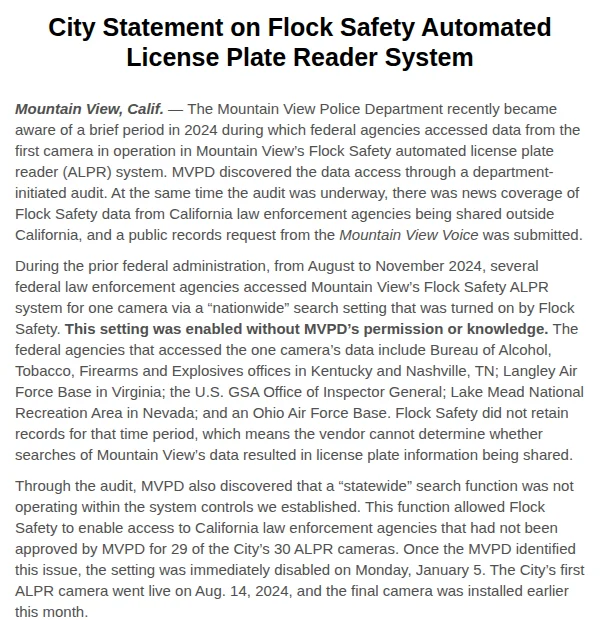 Screenshot: City Statement on Flock Safety Automated License Plate Reader System, City of Mountain View, January 30, 2026.
The Mountain View Voice, whose public records request was part of what prompted the review, counted the statewide searches. It found that more than 250 agencies searched the city's data through the statewide lookup tool without authorization, and that from December 2024 through December 2025 those agencies ran roughly 600,000 searches. Those were California agencies; the federal access the city described was the one camera in 2024. Police Chief Mike Canfield told the paper: "But why wasn't it caught sooner? I couldn't tell you." On February 2, the Voice reported, Canfield said all of the city's license plate cameras were being disabled, effective immediately.
What the lawsuit says
On February 26, 2026, Gibbs Mura and Milberg filed a class action for two drivers, Daniel Javorsky and Anthony Mayor, in San Francisco Superior Court. The complaint relies mainly on California's ALPR Privacy Act, which says a public agency "shall not sell, share, or transfer ALPR information, except to another public agency." The complaint says more than 200 California law enforcement agencies use Flock's data, and it gives three examples of out-of-state access:
- Agencies from outside California searched the San Francisco Police Department's database more than 1.6 million times between August 2024 and February 2025.
- Agencies from 48 other states searched the Los Altos database over a million times in 2024 and 2025.
- El Cajon's data is shared with over 300 out-of-state law enforcement agencies.
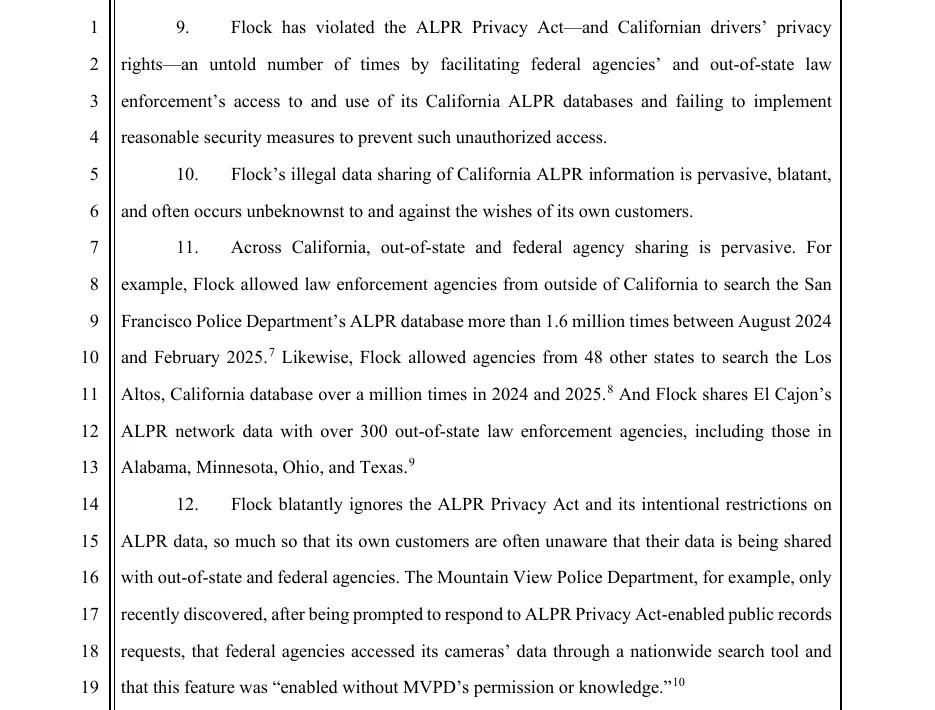 Screenshot: Javorsky v. Flock Group, Inc., class action complaint, San Francisco Superior Court, filed February 26, 2026.
Some coverage described the 1.6 million San Francisco searches as queries by ICE, CBP, the FBI and ATF. The complaint does not say that; it says agencies from outside California. The plaintiffs ask for damages of not less than $2,500 per violation, the statute's liquidated amount. They also take aim at Flock's habit of blaming customers: "But Flock cannot rely on weaponized incompetence when its obligations under California law are crystal clear," the complaint says, as quoted by Courthouse News.
The state case did not stay in state court. On the federal docket, the California cases were consolidated on May 29, 2026 before Judge Vince Chhabria as In re: Flock Group Inc. Automated License Plate Reader Litigation, No. 3:26-cv-02375 (N.D. Cal.). A consolidated amended complaint followed on July 9. Flock moved to dismiss.
On September 23, the day before the hearing, the judge issued a short order: "The Court is tentatively of the view that the plaintiffs lack Article III standing to assert Claims 1-4." He asked the parties whether, if that is right, "the case should be remanded to state court." The motion was argued on September 24, and the docket says the court will issue a written ruling. The initial case management conference is set for October 16, 2026.
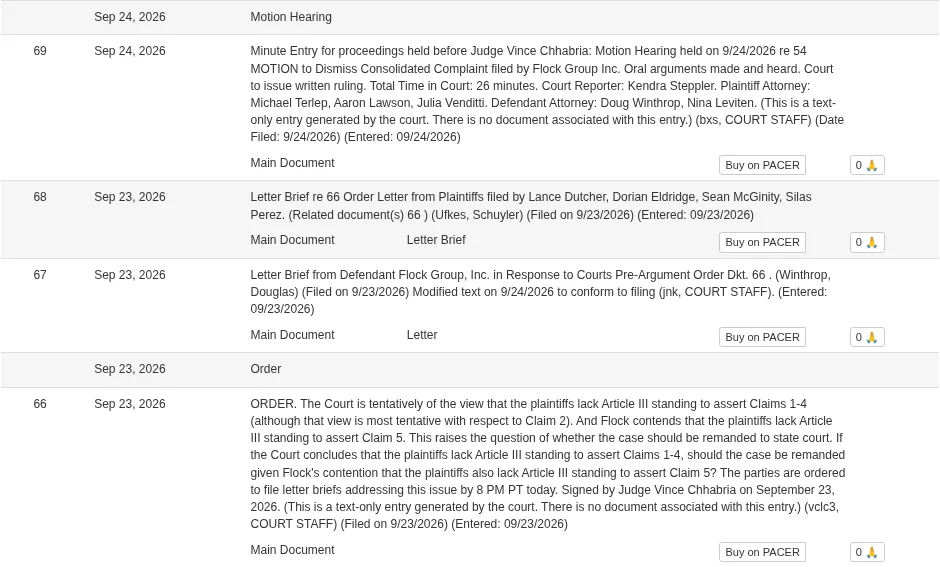 Screenshot: docket, In re Flock Group Inc. ALPR Litigation, No. 3:26-cv-02375 (N.D. Cal.), CourtListener.
So the per-violation number is a claim, not a finding. Whether drivers can sue in federal court, and whether the case goes back to state court, is the open question as of this update.
Dayton: a different failure, same lesson
Dayton, Ohio shows the other side. At the beginning of May 2026, the Dayton Police Department announced that its Flock data was being wrongfully used and accessed by outside agencies, and the city suspended its fixed-site cameras. Records released in late June show outside agencies accessed the city's camera data 7,150 times for immigration-related searches, according to the Dayton Daily News (Dayton 24/7 Now reported the figure as 7,100). U.S. Border Patrol accounted for 3,703 of them. Those searches violated city policy. The city covered all 72 of its fixed-site cameras with plastic bags, and it said it "cannot currently determine whether any of these requests resulted in returned information."
No source we read says Dayton's problem came from a Flock default. But the outcome rhymes with Mountain View: the policy said one thing and the system did another, and the city learned about it from its own logs.
TechTimes counted more than 53 municipalities in 20 states that had terminated or rejected Flock contracts by late June 2026.
What readers said
In r/dayton, readers were not surprised. One asked "why could the citizens predict this and not the government?" Another pointed out that "it was the Major who rotated in that noticed this and reported it, so there are ones that follow rules and policies." On a thread about cities covering Flock cameras with trash bags, a commenter put the privacy objection in data terms: "Not for the picture but the aggregation and then making it available and searchable without probable cause or warrant."
The governance lesson is not about cameras
Mountain View had a written policy that barred out-of-state sharing and required the chief's approval for each partner agency. The platform had lookup settings that reached past that policy. The city found out through an audit and a reporter's records request, and for the 2024 period the vendor had no logs to show what left.
That pattern is not limited to license plate readers. Most SaaS AI tools run on a shared platform the vendor configures. The questions worth checking for any of them:
- Meeting transcription and note-taking tools: who sets retention, who can see recordings across your workspace, and is model training opt-in or opt-out on your plan?
- HR and workforce analytics: is your data pooled into cross-customer benchmarks, and where in the contract or DPA is that addressed?
- Customer service AI: are your conversations used to improve shared models unless you opt out?
- Any tool with a "network," "community" or "lookup" feature: what does it let other customers see, and is it on by default?
The answers live in settings pages, DPAs and help articles, not in the sales deck. Read them.
Six questions to ask before your next AI vendor contract renewal
These questions target the failure Mountain View described: sharing settings the vendor controls, changed or enabled without the customer knowing.
1. What data sharing features exist on this platform, and which are enabled by default on our account?
Ask for a written list of every sharing, network, lookup or consortium feature and its current state on your account. If the vendor cannot produce it in writing, treat that as an answer.
2. Can the vendor change our configuration without notifying us first?
Mountain View says the nationwide setting was turned on by Flock without its knowledge. Your contract should require written notice before any change that widens who can access your data, with time to refuse.
3. Which third parties can access our data, and under what conditions?
Cover subprocessors, other customers on a shared network, law enforcement and other government bodies. Ask for the current subprocessor list and a written promise that no other third party gets access without your prior written consent.
4. Can we get the access logs, and how long are they kept?
Mountain View found the problem through its own audit, and for 2024 Flock had no records. Your contract should give you the right to pull logs of who accessed your data and when, and set how long the vendor must keep them.
5. Is our data separated from other customers' data?
Ask whether your data is logically isolated, and in what cases it is combined with other customers' data for any purpose, including benchmarks and model improvement.
6. What happens when a government agency asks for our data?
Ask for the vendor's law enforcement request policy in writing, and whether it notifies you before complying where the law allows.
What to do with the answers
For tools that handle personal data about customers, employees or the public, get the answers as contract terms, not emails. A vendor that says "we don't share data" but will not sign it has told you something.
For lower-risk tools the answers still belong in your AI tool inventory. If a regulator, auditor or customer asks what data flows exist in your stack, "we signed the standard contract" is not an answer.
Our take
The Mountain View statement is the most useful document in this story, because it is the customer's own account: a policy written with the vendor's help, a setting the customer did not turn on, a vendor with no logs for the period. Every part of that maps to a contract term a small team can ask for today: a list of sharing settings, notice before changes, and logs you can pull. The lawsuit may or may not survive the standing question, and you should not plan around a $2,500-per-violation recovery. Plan around finding out first. Dayton shows that even without a vendor default, the only reason anyone knew was that someone read the logs.
How we checked this
We read 10 sources on October 10, 2026: the City of Mountain View's January 30 statement, the Javorsky complaint (PDF), the federal docket on CourtListener, the Mountain View Voice, Courthouse News, the Dayton Daily News, Dayton 24/7 Now, TechTimes, and two r/dayton threads. Every number above is in the source log for this article. We did not read the consolidated amended complaint itself, only its docket entry, and the September 24 transcript is not public. We looked for an official post or video about the Mountain View statement or the federal case to embed and found none. Last reviewed: October 10, 2026.
Corrections in this update. The earlier version said ICE, CBP, the FBI and ATF queried San Francisco's cameras 1.6 million times; the complaint says agencies outside California, and does not name those four. It said Mountain View estimated 600,000 unauthorized federal searches by 250 agencies; that is the Mountain View Voice's count of California agencies using statewide lookup, and the federal access was one camera in 2024. It cited SB 54; the law the complaint relies on is the ALPR Privacy Act. It described an April 3 amended complaint and billions in exposure; we replaced those with what the federal docket shows. It said Dayton found 7,100 searches through a compliance audit "under Dayton's own policy with Flock"; the city's released records show 7,150, and no source ties them to a Flock default. We removed an unsourced count of how many cancellations came in the first half of 2026.
Related Reading
- AI Vendor Due Diligence Checklist 2026
- Agentic AI Vendor Contract Clauses 2026
- Vetting AI Tools: What the Fake Malware Cases Teach Us
- AI Vendor Contract Redline Template 2026
- Meta Project Cannes: What the Fake Teen Account Story Means for AI Vendor Trust
- ChatGPT Product Liability Lawsuits: What JCCP 5431 Means for AI Vendors