
 Image: Pexels, used under the Pexels License.
If you only use Midjourney, California's AI Transparency Act doesn't put a duty on you. If you build a tool that generates images, video or audio and people in California can reach it, it almost certainly does now, however small you are. A bill signed on September 30 cut the size floor out of the law, and it took effect the same day.
Midjourney stays the awkward example. The Act has been operative since August 2, and nothing Midjourney has published since says how it will meet it. Whether that's a violation is a question for the Attorney General, a city attorney or a county counsel. None of them has announced a case.
What changed on September 30
SB 1000, Senator Josh Becker's rewrite of the Act, cleared the Senate 33-1 in May, the Assembly 72-0 on August 25, and the Senate again 39-0 on August 27. Governor Newsom signed it on September 30 and it was chaptered the same day as Chapter 861. It carried an urgency clause, so there was no January wait: the new text has applied since signing.
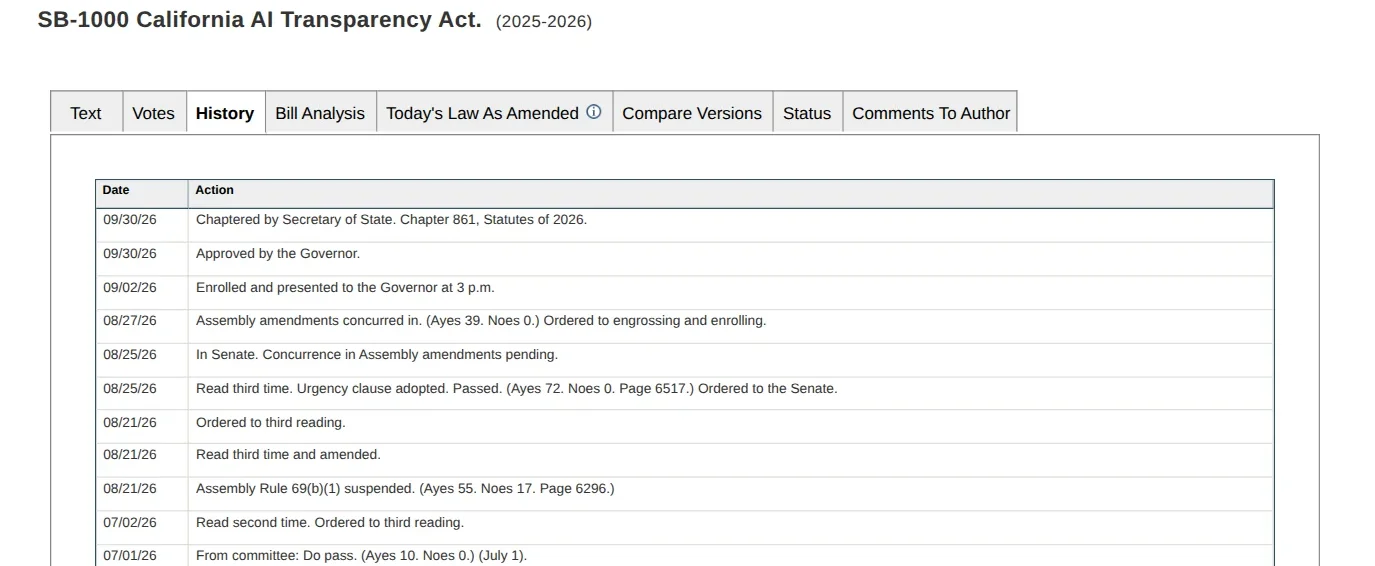 Screenshot: SB 1000 bill history, California Legislative Information, October 15, 2026.
The Act itself (Business and Professions Code sections 22757 to 22757.6) is the 2024 law, SB 942, as moved to an August 2026 start by AB 853. Here's what SB 1000 changed in it.
| Rule | Before September 30 | Since September 30, 2026 |
|---|---|---|
| Who is covered | Providers of generative AI systems with over 1,000,000 monthly visitors or users, publicly accessible in California | Any person that "creates, codes, or otherwise produces" a generative AI system publicly accessible in California |
| Visible (manifest) label | Providers had to offer users the option to add one | Deleted |
| Hidden (latent) disclosure | Provider name, system name and version number, time and date, unique identifier | Same, with "version information", plus whether the system created or altered the content; from January 1, 2029, whether it's built as assistive technology |
| Free checking tool | "AI detection tool" | "Disclosure verification tool"; a compliant third-party tool linked from your interface is enough |
| Assistive technology | Covered | Out of scope until January 1, 2029; falsely claiming the status costs $50,000 per violation |
| Suits filed before September 30 | n/a | Can't continue if the conduct is lawful under the new text |
The first row is the one that matters for most readers. Latham & Watkins expects the newly covered group to "likely now include startups, open-source model developers, enterprise-facing SaaS platforms, and other GenAI system operators" that sat under the old floor.
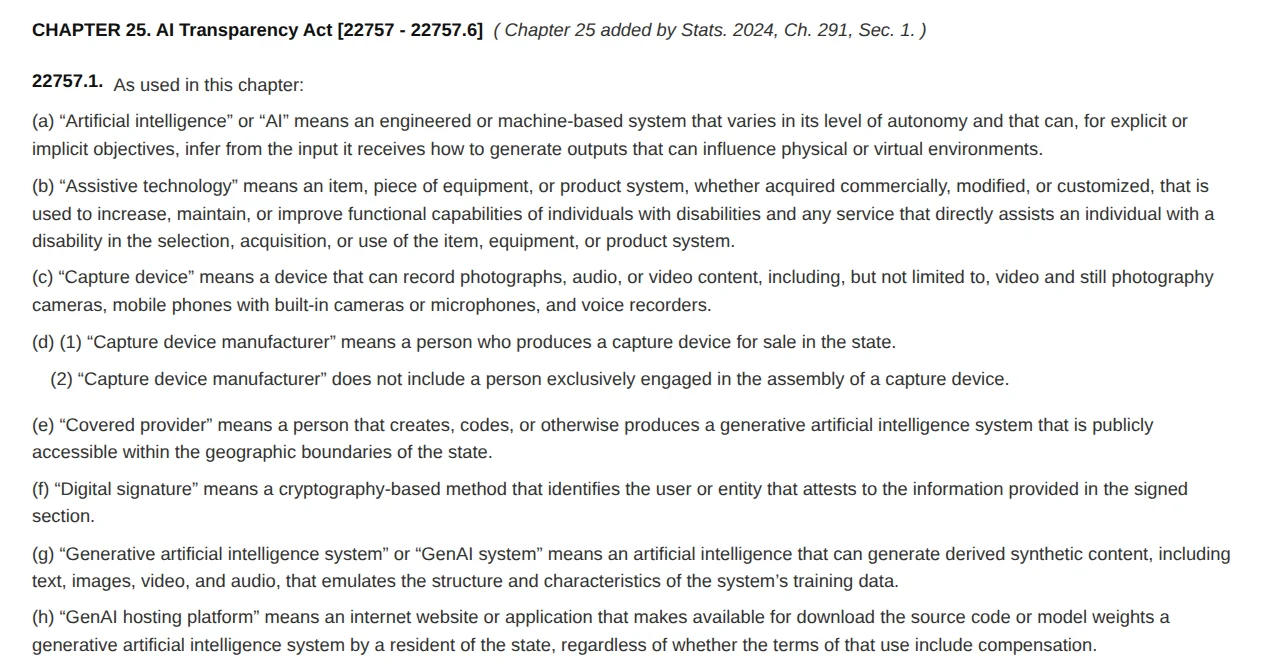 Screenshot: Business and Professions Code section 22757.1, California Legislative Information, October 15, 2026.
What a covered provider has to ship
Two things, both about image, video and audio content. Text output isn't covered.
A latent disclosure in every file your system creates or alters (section 22757.3), "to the extent it is technically feasible". Edits the statute calls minor modifications, such as cropping, resizing, brightness changes or a file format conversion, don't trigger it. The disclosure must:
- convey, directly or through a link to a permanent website: your name as provider, the system's name and version information, the time and date of creation or alteration, a unique identifier, and whether the system created or altered the content;
- be "permanent or extraordinarily difficult to remove or tamper with";
- work with your verification tool;
- be "compliant or interoperable with widely recognized industry standards".
A free disclosure verification tool (section 22757.2) that:
- tells a user whether image, video or audio content came from your system;
- accepts an upload or a URL;
- can be called through an API, without visiting your website;
- outputs the system provenance data it finds, but no personal information unless the person it concerns consented;
- is publicly accessible, with limits allowed only for security risks or malicious misuse.
You also have to collect feedback on how well the tool works. You can't make access to the generator or the tool depend on personal data beyond what compliance needs.
If you license your model to others, tell the licensee about these duties when you license it. If you learn that an identifiable licensee modified it so it no longer complies, you have 72 hours to revoke the license or notify them. The licensee then has 96 hours to fix it or stop and report back, and you report a non-response to the Attorney General.
A visible "AI-generated" stamp on its own satisfies none of this. The visible label was the part SB 1000 deleted; what's left is the hidden disclosure and the tool.
Where Midjourney stands
On October 15 we searched the saved text of Midjourney's updates page, every post from March 2024 to October 9, 2026, for "C2PA", "Content Credentials", "provenance", "watermark", "metadata", "California" and "transparency". There wasn't a single hit. The newest posts are about testing a "Thinking Mode" on its alpha site. On the day the Act went live, Tech Times reported that Midjourney "ships no C2PA content credentials and no known pixel watermark".
We tried to check a file ourselves. Midjourney's image CDN answered 403 to every request we made for original-size images from its public Explore page, both from a script and from a headless browser. The thumbnails it does serve are re-encoded, so they can't show whether an original carries a disclosure. We couldn't test a Midjourney file.
For contrast, here's what two other providers publish about their own outputs. OpenAI says images from ChatGPT, Codex and its API carry both C2PA Content Credentials and a SynthID watermark, and it offers openai.com/verify plus a Content Provenance API for checking files. Adobe applies Content Credentials automatically to assets whose pixels are 100% Firefly-generated, and its Inspect tool reads them. We didn't test either vendor; this is what they publish.
Who can enforce it, and for how much
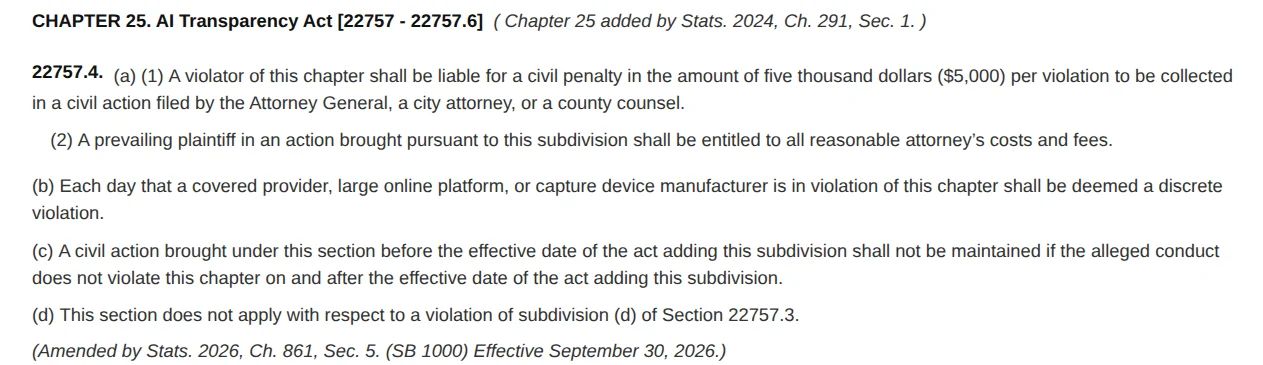 Screenshot: Business and Professions Code section 22757.4, California Legislative Information, October 15, 2026.
Section 22757.4 sets the penalty per violation, collected in a civil action by the Attorney General, a city attorney or a county counsel. Each day a provider is out of compliance counts as a separate violation, and a winning plaintiff recovers reasonable attorney's costs and fees. Those three public offices are the only plaintiffs the section names, so a consumer can't sue under the Act.
We read the Attorney General's press releases from June 16 to October 14. The only AI item is a call for Congress to act on catastrophic AI risk; nothing under the Transparency Act, against Midjourney or anyone else.
What to do now
- You build or resell a generator of images, video or audio that Californians can use: assume you're covered. Embed the hidden disclosure (C2PA Content Credentials are the obvious way to be "interoperable with widely recognized industry standards", though the statute names no standard), stand up a verification tool or link a compliant third-party one from your interface, and write down where you decided something wasn't technically feasible and why.
- You license a model to others: add the notice to your license terms and decide who handles the 72-hour clock.
- You use Midjourney for marketing or product images: the Act asks nothing of you. If a client or platform wants files that carry provenance data, Midjourney's public record doesn't give you that today, while OpenAI and Adobe say their files do.
- You run a large platform (over 2 million monthly users): you have separate duties to detect provenance data and let users inspect it. That's a different checklist from this one.
Our take
The old version of this post called Midjourney the obvious first enforcement target. Two months on, the bigger story is the one SB 1000 told quietly: a two-person startup with an image feature now has the same duty as Midjourney. We'd spend this quarter on the disclosure pipeline before worrying about who gets sued first. The "technically feasible" wording is a thin shield when OpenAI and Adobe already say they ship it.
What we could not confirm: whether Midjourney files carry any provenance data today (we couldn't download one), and whether Midjourney has a compliance plan it hasn't published.
Correction, October 15, 2026: an earlier version said the Act covers only providers with more than one million monthly users; SB 1000 deleted that threshold on September 30, 2026. It also said a C2PA credential or a visible watermark alone satisfies the law (the law requires a latent disclosure plus a free verification tool), that the law puts disclosure duties on deployers in political ads and news (it has none), that Los Angeles, San Francisco and San Diego city attorneys had signaled or staffed up AI enforcement, and that most Midjourney users are in California. We found no source for those last two claims and removed them.
Related Reading
- Newsom's Sept 30 AI signings: who must act
- California's 26 AI Bills: Newsom's September 30 deadline
- California SB 942 AI Transparency Act: Compliance Guide for August 2026
- EU AI Act Article 50 Watermarking and Deepfake Disclosure 2026
- OpenAI's EU text watermark: what to do
- Generative AI Copyright Ownership 2026
- Minnesota Nudify App Ban Is Live After xAI Loses First Round
- Pennsylvania SB 806 AI Ad Disclosure: Text, $3,000 Fine, Checklist
