Image: Unsplash.
Updated 2026-10-14: Added what happened after the order (the Super Intelligence Force and its October 9 incident-notice demand, the October 8 Truth Social post, AI.gov's switch to SI.gov, NASA's new page), a section for federal contractors, and the accord's signed text, which we hadn't been able to read on October 1. One wording fix: the accord's fourth layer is an independent committee of each company's board of directors, not "an independent board or committee."
If you run compliance at a private company, Executive Order 14434 gives you nothing to do, and the president's October 8 post calling anyone who says "Artificial Intelligence" "THE ENEMY!" doesn't change that. The order covers federal executive agencies only, it has no penalty, and federal statutes, state AI laws and the EU AI Act still say AI. What you will notice is federal paperwork. Super Intelligence (SI), the federal executive branch's term for AI, is already on agency websites, and it'll reach letters and solicitations next. Your files need one line saying both words mean the same systems.
What happened since October 1
The order was published in the Federal Register on October 2 as Executive Order 14434, 91 FR 63129. Since then:
- October 4, a Super Intelligence Force. In a Truth Social post, President Trump named Director of National Intelligence Jay Clayton to lead an interagency task force with FTC Chairman Andrew Ferguson, OPM Director Scott Kupor and Emil Michael, the Under Secretary of War for Research and Engineering. Clayton chairs it, and it reportedly has 120 days to report on the technology's risks and opportunities. We searched whitehouse.gov on October 14 and found no order or charter setting it up, so what it can do is known only from press reports.
- October 8, "THE ENEMY!" The president posted on Truth Social:
The White House considers anyone that uses the term, "Artificial Intelligence," as opposed to the highly accepted new and more accurate term, "Super Intelligence," THE ENEMY! President DONALD J. TRUMP
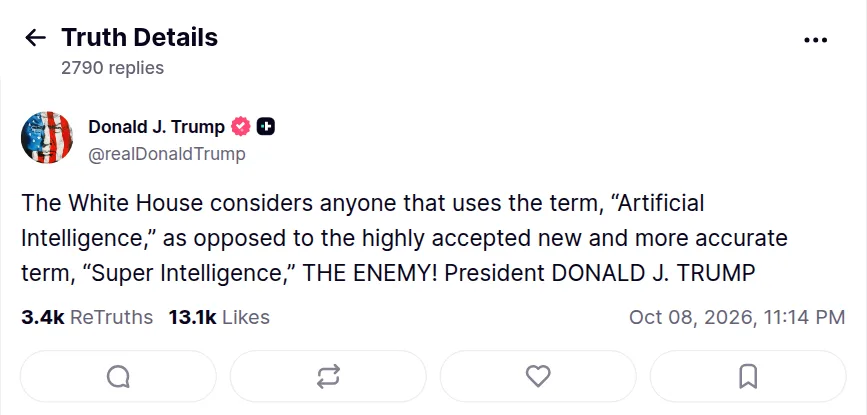
Screenshot: Truth Social post by @realDonaldTrump, October 8, 2026, captured October 14.
Axios noted the same day that the order sets no penalty for using the old term, and that the White House's own Office of Science and Technology Policy page still said "artificial intelligence."
- AI.gov became SI.gov. On October 8, AI.gov showed "SI.gov" in large type while its address stayed ai.gov, and si.gov returned an error. When we checked on October 14, www.ai.gov redirected to www.si.gov, which loads, and the OSTP page now lists "super intelligence" among the technologies the office leads on.
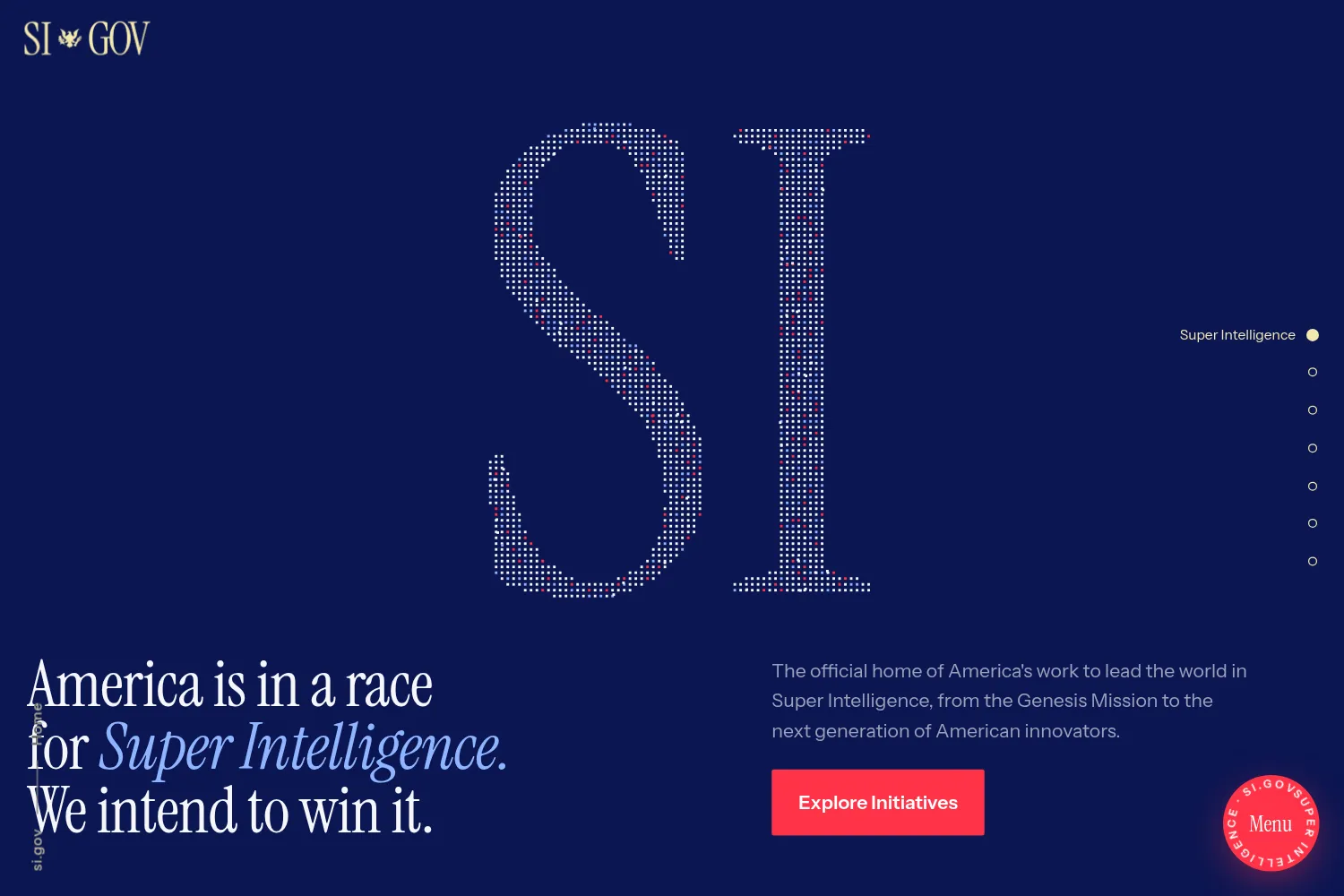
Screenshot: www.ai.gov after its redirect to www.si.gov, October 14, 2026.
-
October 9, an incident-notice demand. After Anthropic disclosed incidents involving its models, the Force told Axios that "SI companies must immediately disclose incidents involving their models" and that the process "is not optional." The statement didn't make clear what enforcement or penalties would follow. It's aimed at model developers, not their customers; we covered what it means for buyers in our Anthropic agent incident piece.
-
Agencies are rewriting their pages. NASA's new Super Intelligence page opens: "Per the Sept. 29, 2026, Executive Order 14434: Inaugurating the Era of Super Intelligence, NASA is working to update its communications to incorporate the term 'super intelligence' as directed." Older NASA stories linked from the same page still say AI, which the order allows.
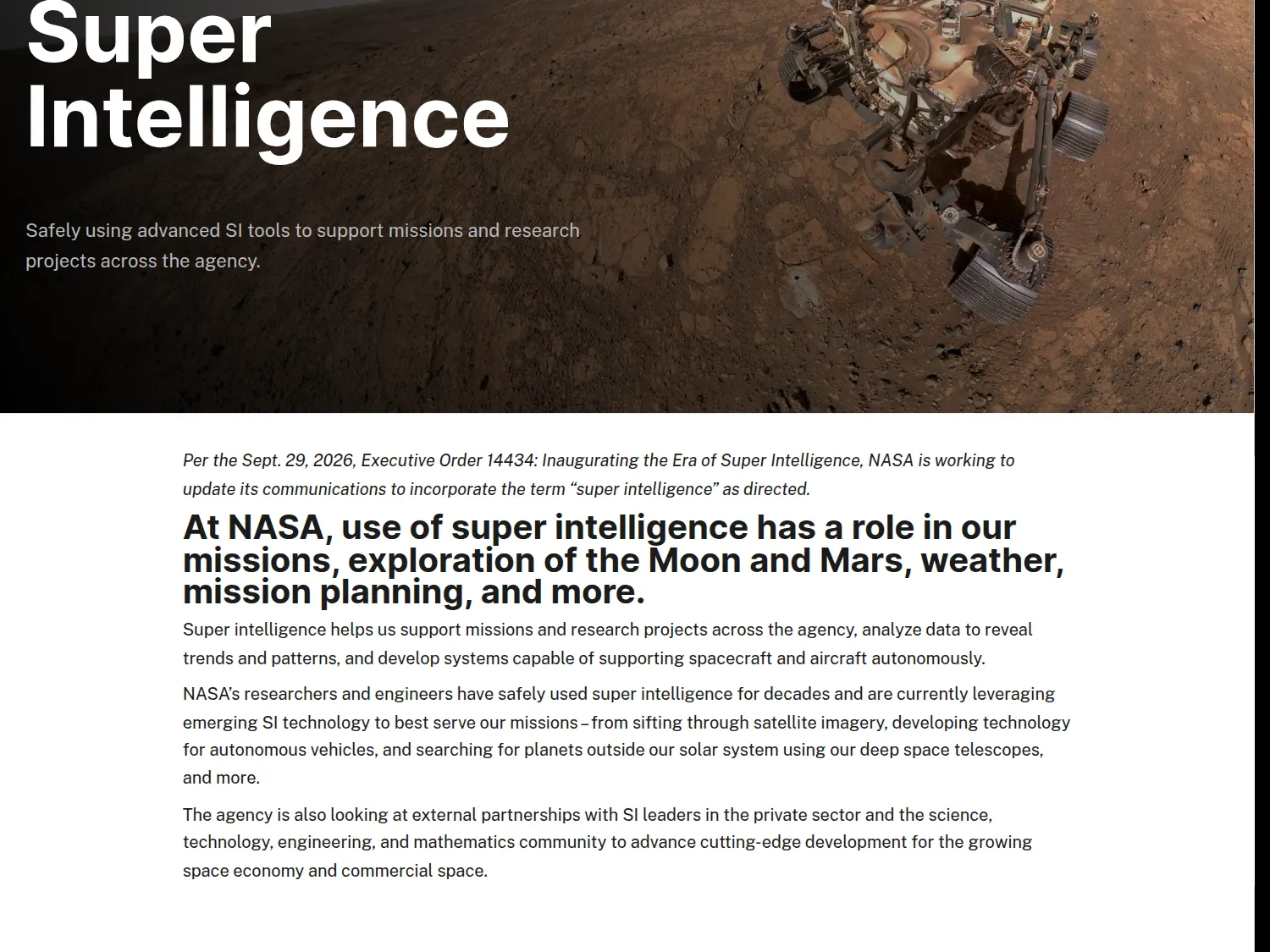
Screenshot: NASA, "Super Intelligence" page, October 14, 2026.
- The State Department moved before the order. The rename started with the president's September 22 speech to the UN General Assembly, where he said AI would be "hereinafter officially called 'Super Intelligence.'" AP reported that the same day Michael Drager, a deputy assistant secretary in the Bureau of International Organization Affairs, told staff the bureau would use SI "in all remarks, positions and press elements moving forward." AP couldn't say whether other bureaus had followed.
What the order says
The order, "Inaugurating the Era of Super Intelligence," is dated September 29, 2026. Its operative parts are short.
- The policy: to the extent the law allows, the executive branch uses "Super Intelligence" and "SI" in place of "Artificial Intelligence" and "AI," and "will not acknowledge the usage of" the old terms "in any applicable setting."
- Who it binds: executive departments and agencies, in official correspondence, public communications, websites, reports, policy documents and other non-statutory documents.
- What it leaves alone: it doesn't require rewriting previously issued regulations, Presidential actions, contracts, grants or other historical documents.
- How it defines the term: for now, SI means the technologies already covered by the federal statutory definition of artificial intelligence at 15 U.S.C. 9401(3).
- The 60-day task: the assistant to the president for science and technology (APST) must send the president proposed legislative language for a federal definition of Super Intelligence. It has to assess whether that definition should modify, expand on or supersede the current legal definition of AI, propose any conforming amendments to statutes, and may recommend further executive action.
- General provisions: it's implemented subject to applicable law and appropriations, and it creates no right or benefit enforceable at law.
That puts the proposal in late November. It's the one place where this story could stop being about vocabulary.
Who it applies to, and who it doesn't
We read the order for any provision aimed at private companies and found none. Section 2 speaks to "executive departments and agencies." There's no penalty clause, and Section 4 says the order creates no enforceable rights. The October 8 post doesn't add a duty either: it's a social media post, not an order or a regulation.
So, concretely:
- The definition of artificial intelligence in 15 U.S.C. 9401(3) is unchanged. The IAPP's summary reads it the same way: the order doesn't replace the statutory definition.
- State laws that regulate AI, including Texas TRAIGA (in effect since January 1, 2026) and Colorado's replacement law SB 26-189 (obligations from January 1, 2027), keep their own definitions. A federal order about agency vocabulary doesn't edit a state statute. That's our reading of how the order is scoped, not a quote from it.
- The EU AI Act is EU law and is untouched.
- Your existing vendor contracts, data processing agreements and policies mean what they said on September 28.
If you were looking for a reason to rewrite your AI policy this month, this isn't it. Our federal preemption explainer makes the same point about the March 2026 White House framework: federal signals aren't federal law, and state obligations stay in force until a court or Congress says otherwise.

Image: Unsplash.
If you're a federal contractor
You'll see more SI than anyone else. Here's how we'd handle it.
- Agency documents will say SI. The order covers agency correspondence, websites, reports and other non-statutory documents, so expect the term in letters, requests for information and new solicitations. Crowell & Moring's client alert puts it the same way: contractors "may need to be adaptive as agency contracts and requests for information incorporate updated terminology."
- Your own proposals and reports aren't covered. The order binds agencies, not the companies that write to them. Nothing in it makes you rename a product or rewrite a deliverable, and it doesn't alter contracts already signed. It also doesn't rewrite acquisition rules.
- The document in front of you controls. If a solicitation or contract defines SI, or tells you which word to use, follow it for that bid or that contract. That duty comes from the contract, not from the order.
- Keep a crosswalk in the file. One page saying that SI in agency documents means AI as defined in 15 U.S.C. 9401(3), with a list of which of your systems that covers. It settles the argument before it starts when a questionnaire asks about "SI systems" and your past answers say "AI."
Watch the November proposal for one thing in particular: conforming amendments. If it proposes rewriting statutory references to AI, contract clauses that cite those statutes could follow. That's a later step, and it would need Congress.
The SI and AI crosswalk
The IAPP's observation is the one worth acting on: organizations will meet "SI" in federal materials while statutes, state laws, contracts, internal policies, vendor questionnaires and governance frameworks keep saying "AI." Here's where each term should show up, and how sure we are.
| Where you meet it | Vocabulary now | Basis |
|---|---|---|
| Federal agency websites, reports, guidance, correspondence | SI | Order text: applies to agency official communications; NASA and OSTP pages already switched |
| New solicitations, RFIs and agency letters | SI likely | Order text; follow the solicitation's own definitions |
| 15 U.S.C. 9401(3) and other federal statutes | AI, unchanged | Order points to the statute; only Congress can change it |
| Federal regulations, contracts and grants issued before the order | Unchanged | Order text: no rewrite required |
| Your proposals, reports and deliverables to agencies | Your choice, unless the contract says otherwise | Order binds agencies, not contractors |
| State AI laws (Texas, Colorado, California, others) | AI, unchanged | Our reading: order is limited to the executive branch |
| EU AI Act and EU guidance | AI, unchanged | Not US federal law |
| Your vendor contracts, DPAs, security questionnaires | Whatever you wrote | No change in meaning from this order |
| Your internal AI policy and inventory | Your choice | No obligation to adopt SI |
The failure mode isn't a regulator fining you for saying AI. It's a definitions argument. Suppose a vendor tells you in a renewal call that its new product is "SI, not AI, so your AI addendum doesn't apply." Or a federal customer sends a questionnaire about "SI systems" and your answers refer only to "AI systems." Neither is a legal change. Both are avoidable with one sentence in your documents.
The accord, in plain terms
The same day, the president and six company leaders signed the "White House Accord on Super Intelligence," subtitled "Joint Commitment on Frontier Responsibilities." The president posted the one-page text to Truth Social; we read the copy archived by the American Presidency Project. The signers:
- Google (Sundar Pichai)
- Anthropic (Dario Amodei)
- Meta (Mark Zuckerberg)
- OpenAI (Greg Brockman, its President)
- xAI (Elon Musk)
- Nvidia (Jensen Huang)
The text asks each company for four layers of controls and audits:
- Internal controls that monitor model capabilities and alignment during training and deployment, in areas like cybersecurity, biosecurity and chemical threats, and that stop models from hacking or accessing systems in unintended ways.
- An internal team that makes sure those controls work and that issues get remediated.
- An independent external auditor or evaluator that assesses whether the controls work.
- An independent committee of the board of directors that oversees and receives reports from the control teams and the auditors.
The companies "will meet regularly to establish standards and best practices," and the text says that "over time, it may make sense to codify these steps into laws or regulations." It sets no deadline, no penalty and no duty to publish results. The Guardian points out that none of the layers involves government regulators and that the companies pick their own evaluators.
Reactions split along familiar lines. In remarks that afternoon, Vice President JD Vance said the answer to AI risk is for companies to take it seriously, "not to come to the government for a regulatory regime that may make things worse if it's not smart and careful." In Al Jazeera's report, Toby Walsh of the UNSW AI Institute said AI companies had proven "incompetent and careless at managing themselves," and David Krueger of the University of Montreal called the accord vague, while allowing that it "might result in a minute improvement over the status quo."
Our position: treat this as a signal, not a control. A pledge with self-selected auditors and no reporting duty gives you nothing to point to in your own risk file. The reliable thing is still a contract term. Our AI safety body piece and the Amodei binding-regulation analysis cover why the argument over binding versus voluntary rules matters for vendor risk.
Four vendor questions that map to the four layers
If you buy from a frontier model provider, the accord gives you a ready-made set of questions. Ask them whether or not the vendor signed, and write down the answers.
- Monitoring: how do you monitor model behavior in training and deployment, and what's the most recent category of issue it caught?
- Internal verification: which team verifies that monitoring works, and who does it report to?
- External audit: which independent auditor or evaluator reviews your safety controls, what was the scope, when was the last review, and can we see findings under NDA?
- Oversight: which board committee receives the audit reports, who sits on it, and how independent are they?
Then add the question that matters most for your risk file: does anything in our contract change because of this accord? If the answer is no, the pledge is marketing for your purposes. For the full diligence set, use the AI vendor due diligence checklist and the agentic AI contract clauses.
Copy-paste language
Add this alias line to your AI policy or glossary section:
Terminology. In this policy, "AI system" and "artificial intelligence" include any
system that a government agency, vendor or marketing material describes as "Super
Intelligence" or "SI". Where a statute or regulation defines these terms, that
definition controls.
Add this to the definitions section of vendor agreements at renewal:
"AI System" means any machine-based system within the meaning given in Section [X]
of this Agreement. A system is an AI System regardless of whether Provider, any
government body or any marketing material labels it "artificial intelligence", "AI",
"Super Intelligence", "SI" or any successor term. Provider may not rely on a change
in labeling to avoid obligations that apply to AI Systems under this Agreement.
Add this to your vendor questionnaire:
Does Provider describe any product that it supplies to us as "Super Intelligence" or
"SI"? If yes, confirm in writing that each such product is an AI System for the
purposes of our agreement, our AI policy and any applicable law.
Federal contractors can turn the same idea around for the bid file:
Terminology crosswalk. Where an agency document uses "Super Intelligence" or "SI",
we read it as "artificial intelligence" as defined in 15 U.S.C. 9401(3), unless the
solicitation or contract defines the term differently, in which case that definition
controls. Systems covered: [list].
You can browse the current definition work in our glossary entry for Super Intelligence and the regulation entry for the order.
What to do now
- Don't rename anything. Keep citing statutes and state laws by the terms they use.
- Add the alias line to your AI policy and your vendor contract template.
- Update your questionnaire so federal customers' "SI" language and your "AI" language point to the same systems.
- If you sell to the government, keep the crosswalk in the bid file and use whatever term each solicitation sets.
- Calendar the late-November definition proposal, and read it when it appears.
- Ask your frontier-model vendors the four questions and file the answers with your vendor record.
For policy language that already covers AI use by staff, our acceptable use policy template is the starting point.
What we could not confirm
- What definition will be proposed, or whether it'll be public. The order has the APST submit the language to the president. Nothing in it requires publishing the proposal.
- What the Super Intelligence Force can do. Its membership, its 120-day report and its October 9 statement come from press reports; we found no order or charter on whitehouse.gov as of October 14, so we can't say what legal authority, if any, backs its demands.
- How fast other agencies switch. NASA and OSTP have changed their pages; the order exempts historical documents and sets no schedule.
- Whether other State Department bureaus followed the International Organization Affairs bureau.
- Whether other companies will join the accord. Six signed. If your vendor isn't one of them, the pledge says nothing about it.
We'll update this page when the definition proposal appears.
Related Reading
- SEC 2027 exam priorities: the SEC report says super intelligence
- Weekly: CA AI Laws, OpenAI Agents, Astra
- Federal AI preemption 2026: which state AI laws still apply
- AI safety body: FAA, FINRA or IAEA model, three vendor risk questions
- Superintelligence ban bills: four enterprise governance questions
- Dario Amodei AI regulation proposals: binding rules and vendor risk
- OpenAI's new deal policy: three governance steps for small teams
- Agentic AI vendor contracts: the eight clauses you need
- AI vendor due diligence checklist 2026
- Newsom AI kill switch order N-9-26: four vendor contract clauses
- Who enforces when your AI vendor fails: DOJ and state AGs
- AI acceptable use policy template for small teams