Image: Pexels, used under the Pexels License.
TL;DR On September 30, 2026 Judge Terrence Berg granted Sirius XM judgment on the pleadings in Harper v. Sirius XM Radio, LLC and dismissed the complaint without prejudice. The plaintiff claimed iCIMS hiring software screened out Black applicants after he was rejected from 149 of about 150 roles. The court said the complaint did not show any disparity or how the tool affected him. It did not rule that AI screening is lawful. Keep an evidence file for every automated screening step you use.
An employer won an AI hiring discrimination case, and a lot of people will read that as "the lawsuits are not going to land." Read the order first. It is 20 pages, it decides only that this complaint was too thin, and it dismisses the case without prejudice. It also contains one line every HR team that runs bias tests should keep: "data collection is not the same thing as data discrimination."
This page covers what the order says, what Sirius XM and iCIMS have said, what the ruling does not decide, and a template for the one thing that helps you if a rejected candidate sues: being able to say exactly what your screening tool does.
Update after our review: we have now read the order and the complaint. Our first version followed press reports that called the ruling summary judgment and said the plaintiff had no lawyer. The order grants a motion for judgment on the pleadings, and the complaint lists a law firm as of counsel. Details below.
What happened and when
| Item | What the court record shows |
|---|---|
| Case | Harper v. Sirius XM Radio, LLC, No. 2:25-cv-12403, U.S. District Court for the Eastern District of Michigan |
| Judge | Terrence G. Berg |
| Plaintiff | Arshon Harper, suing for himself and a proposed class, with a jury demand |
| Lawyers | Harper signed the complaint himself, with a Detroit address. The complaint also lists Winston Cooks, LLC of Birmingham, Alabama as "of counsel", and the order refers to "Plaintiff's counsel" |
| Software named | Tools from third-party vendor iCIMS, including its applicant tracking system |
| Applications | About 150, from November 2023 to November 2024; the complaint pleads 149 rejections, a 99.3% rate |
| Interview | One 30-minute interview for an IT Desktop Support role in November or December 2023, then a rejection |
| EEOC | Charge filed November 22, 2024; the EEOC declined to proceed and issued a right-to-sue letter on May 6, 2025 |
| Suit filed | August 4, 2025 |
| Claims | Race discrimination under Title VII and Section 1981, on disparate treatment and disparate impact theories |
| Ruling | September 30, 2026: Sirius XM's motion for judgment on the pleadings (ECF No. 14) granted; complaint dismissed without prejudice; judgment entered the same day (ECF No. 20) |
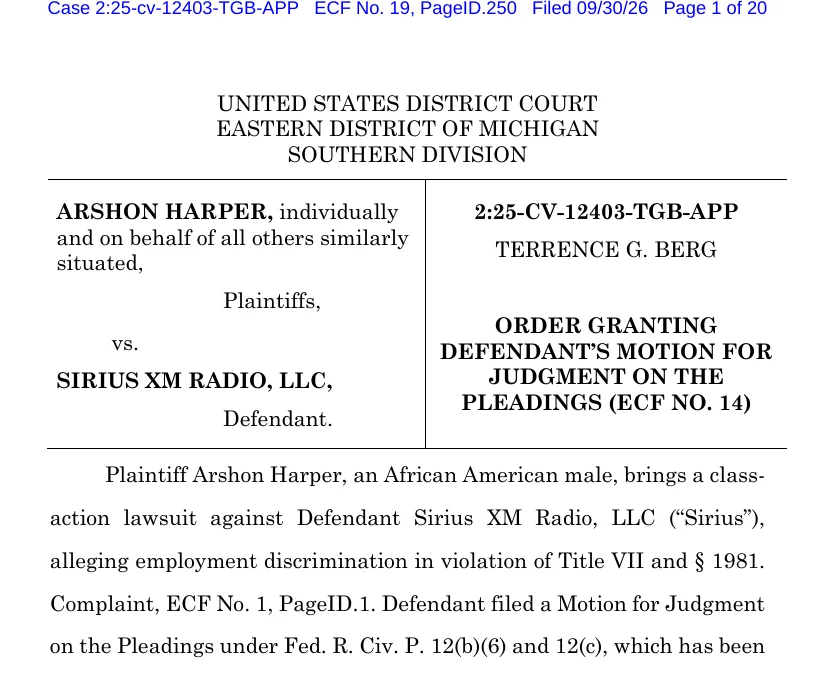 Screenshot: Order granting motion for judgment on the pleadings, ECF No. 19, U.S. District Court for the Eastern District of Michigan.
The complaint said the iCIMS tools judged applicants on "data points that act as proxies for race, such as educational institutions, employment history, and zip codes." Harper also said he applied from several email addresses to avoid "suspected algorithmic penalties for repeat applications," and he was asked about those addresses in his one interview. He asked the court for class certification, damages and "a permanent injunction prohibiting continued discrimination and requiring reforms to ensure equitable hiring." Fisher Phillips described that request at filing as an order to stop or significantly change Sirius XM's use of the screening tool.
On the lawyer question. Fisher Phillips and Metz Lewis both described Harper as proceeding pro se, and so did the first version of this page. The court record is less clear. Harper signed the complaint himself, but page 12 lists two lawyers at Winston Cooks, LLC as of counsel, and the order says Sirius XM told Harper about its position "through Plaintiff's counsel." The docket lists attorney appearances, but the copy we can read does not say who filed them, so we do not say whether a lawyer formally appeared for Harper.
What the court said
The motion was brought under Federal Rules of Civil Procedure 12(b)(6) and 12(c). That matters: the court took Harper's factual allegations as true and asked only whether they were enough to state a claim. It did not weigh evidence.
Disparate treatment. To claim intentional discrimination, Harper had to plead facts pointing to intent. The court found none: "Plaintiff does not indicate any comparator class," meaning no similarly situated non-Black applicants who were treated better. It also noted that "the term "disparate treatment" does not appear once in the Response."
Disparate impact. This was the AI theory, and it failed on the same gap. In the court's words, "Plaintiff pleads disparate impact without showing that any disparity exists." The complaint did not say "how or whether the AI/ML collected data about him that was racial in nature or how it impacted his hiring decision," and it pointed to no other applicants.
The class claims. Because the individual claims failed, "the Court will not address Plaintiff's class claims."
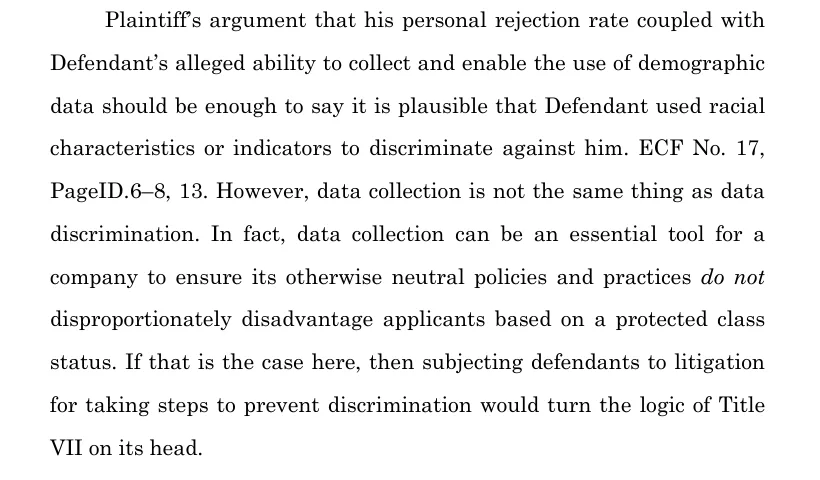 Screenshot: Harper v. Sirius XM Radio, LLC order, page 19, U.S. District Court for the Eastern District of Michigan.
The line worth keeping. Harper argued that Sirius XM's ability to collect demographic data, plus his own rejection rate, made discrimination plausible. The court disagreed: "data collection is not the same thing as data discrimination." It added that "data collection can be an essential tool for a company to ensure its otherwise neutral policies and practices do not disproportionately disadvantage applicants." For employers that keep demographic data to run adverse impact checks, that is a useful statement from a federal judge, even though it is one district court's reasoning and not binding elsewhere.
What Sirius XM and iCIMS say
Sirius XM says it does not use AI in hiring. The order records Sirius XM's position that "it has never used any type of AI/ML during the hiring process." The court did not decide whether that is true. It excluded Sirius XM's EEOC position statement from the record and "declines to exercise its discretion to convert the motion to one for summary judgment." So the case ended on what the complaint failed to say, not on Sirius XM's denial. Sirius XM did not respond to HR Dive's request for comment.
iCIMS points to its customers. After HR Dive published, an iCIMS spokesperson said the company "develops AI under a responsible AI program with governance and safeguards designed to help mitigate potential bias," and that "Our customers decide whether and how to use AI features, and their hiring teams make the hiring decisions." That second sentence is the vendor telling you where the accountability sits.
 Image: Pexels, used under the Pexels License.
What this does not decide
It is not a ruling that AI screening is lawful. One district court, one complaint, decided on the pleadings. The order never says the software is unbiased or that anyone tested it.
It is not final in the usual sense. The dismissal is without prejudice. The order does not say what Harper may do next, and we could not confirm whether he will appeal or file again.
It does not touch the city and state rules that name automated tools. New York City's Local Law 144, for example, bars using an automated employment decision tool unless it has had "a bias audit within one year of the use of the tool" and the audit information is public, with notice to candidates. A federal ruling on a Title VII complaint does not change that. Our guides cover these rules: NYC Local Law 144, multi-state bias audit requirements and California ADMT templates.
It does not end the Workday case. HR Dive notes that the Workday lawsuit involves alleged violations of the Age Discrimination in Employment Act, that "Workday couldn't beat the state discrimination claims," and that the case is still ongoing. Our Workday screening checklist covers what that case asks of employers.
It does not mean federal pressure is coming back. HR Dive places the case against a federal retreat on disparate impact: an April 2025 executive order telling agencies, including the EEOC, to stop enforcing disparate impact liability, and a June 2026 Justice Department view that the EEOC's disparate impact guidelines are unconstitutional. We covered the agency side in FTC drops disparate-impact claims and in our EEOC checklist. Private plaintiffs and state laws carry more of the load, which is why your own records matter.
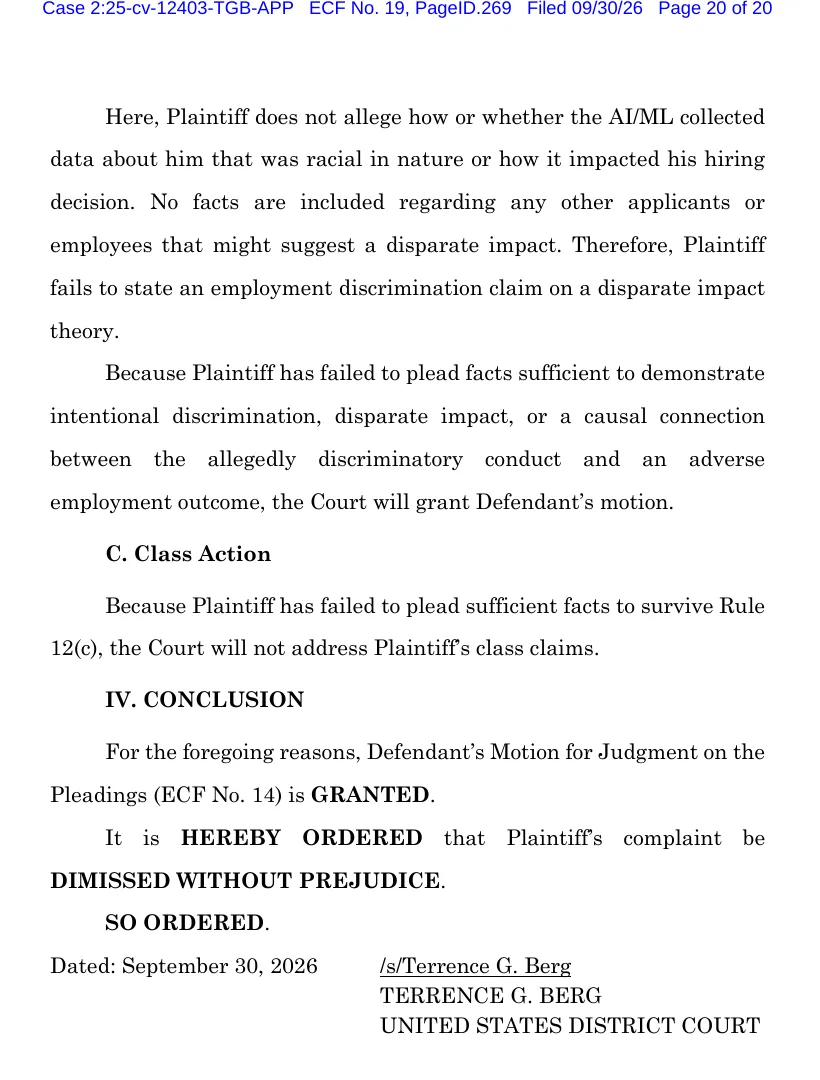 Screenshot: Harper v. Sirius XM Radio, LLC order, page 20, U.S. District Court for the Eastern District of Michigan.
Why this still matters if you are small
The most useful detail in the case is not the outcome. It is the confusion about what the software did. Harper believed repeat applications were penalized, so he applied from extra email addresses. Sirius XM says it used no AI at all. The court never had to decide who was right, because the complaint fell short first. A better-pleaded complaint, with numbers on other applicants, would put that question in front of a judge.
If a rejected applicant sues you, the first question is what the tool actually does. "We use an applicant tracking system" is not an answer. "It ranks resumes against the job description, it does not reject anyone automatically, a recruiter reviews the top-ranked candidates, and it treats repeat applications the same as first ones" is an answer, and you can only give it if you wrote it down before the lawsuit.
Template: AI screening evidence file
Fill one in per tool and per role family. Date it, keep old versions, and re-check it when the vendor ships a major change. This is our suggested structure, not a court or agency form.
AI SCREENING EVIDENCE FILE
Tool and version: [e.g. applicant tracking system name, module, date last updated]
Owner at our company: [name and role]
Roles covered: [job families]
Date written / last reviewed: [date] / [date]

1. WHAT IT DOES
   Inputs it reads: [resume, application form, assessment, video, other]
   Output it produces: [score / rank / yes-no flag / none]
   Can it reject a candidate with no human step?  [yes / no]
   If yes: which stage and which rule: [description]

2. HUMAN REVIEW
   Who reviews candidates the tool ranks low: [role]
   Share of low-ranked candidates a human actually opens: [percent, how measured]

3. REPEAT AND DUPLICATE APPLICATIONS
   How the tool treats a second application or a second email: [description]
   Is that treatment disclosed to candidates?  [yes / no]

4. BIAS TESTING
   Last test date: [date]    Done by: [internal / vendor / third party]
   Groups tested: [race, sex, age, disability, other]
   Result and any change we made: [summary]

5. NOTICE AND ACCOMMODATION
   What candidates are told about automated screening: [text and where shown]
   How a candidate asks for an alternative or an accommodation: [route]

6. RECORDS
   What we keep, where, and for how long: [description]
   Who can pull a candidate's score history on request: [role]

7. VENDOR
   Contract clause on audit access and incident notice: [clause reference]
   Open questions we have asked the vendor: [list and dates]
Section 3 is the one most teams skip. It is also the detail that shaped the plaintiff's own behavior in Harper: he used several email addresses because he suspected repeat applications were penalized.
Five questions for your applicant tracking vendor
- Does the product rank, score or reject, and which of those is on by default?
- How does it treat a second application from the same person or a second email address?
- What bias testing exists, who did it, and can we see the summary?
- Can we export a candidate's score and the inputs behind it?
- What changes when you update the model, and how will you tell us?
If the vendor cannot answer the first two in writing, treat that as a finding. For a broader process, our small-team AI hiring compliance guide walks through the steps in order.
Our take
This order is a pleading lesson, not an AI verdict. Harper's complaint rested on his own 149 rejections and on what the software could do, and the court said that is not enough without any comparison to other applicants. That bar is real, but it is not high for a plaintiff who has data on other candidates, and discovery is where that data usually comes from.
Two things in the order help employers who do the work. The court said collecting demographic data is not discrimination and can be how a company checks its own process. And Sirius XM's denial that it used AI did not win the motion; the court kept it out of the record. A written description of your tool, kept before any dispute, does more for you than a denial written after one.
The iCIMS statement says the same thing from the vendor side: customers decide how the AI features are used. If your vendor says that, your evidence file is the document that shows what you decided.
What we could not verify
- We could not see who filed the attorney appearances on the docket (CourtListener's feed lists them without names), so we do not say whether Winston Cooks, LLC formally appeared for Harper.
- We could not confirm whether Harper will appeal or file an amended complaint after the dismissal without prejudice. The CourtListener docket feed showed nothing after the September 30 judgment when we checked on October 22, but it only holds filings someone has uploaded.
- Sirius XM's statement that it never used AI in hiring comes from its own argument as recorded in the order. The court did not test it.
- We found no Reddit or forum thread about this case and no post or video from the court or the parties, so this page has no community quote and no embed.
How we checked this
We read the full 20-page order (ECF No. 19, September 30, 2026) and the 18-page complaint (ECF No. 1, August 4, 2025) from the CourtListener RECAP archive, HR Dive's October 5 report and its October 6 update with the iCIMS statement, the Fisher Phillips and Metz Lewis summaries, and New York City's Local Law 144 page. That is 7 sources, 2 of them court documents. Every fact on this page has a row with a verbatim quote in our source log. This review corrected two errors in our first version: the ruling was judgment on the pleadings, not summary judgment, and the record does not support saying the plaintiff had no lawyer. On October 22, 2026 we downloaded the order and complaint again, re-matched every quote, re-read the complaint's relief request (now quoted directly), and checked the docket feed for later filings. Last reviewed: October 22, 2026.