Image: Pexels, used under the Pexels License.
If you sell software with AI in it to a Singapore bank or insurer, you don't have to guess what their due diligence will look like from 2027. MAS wrote it down. Paragraph 5.11 of the new Guidelines on Artificial Intelligence Risk Management lists eight things an institution weighs before it onboards third-party AI, and almost every one of them turns into a question for the vendor.
We read the full Guidelines PDF, not just the press release. The release is accurate, but the vendor-facing detail (contract clauses, testing on the bank's own data, the line about self-attestations) only appears in the text itself.
What MAS published on 7 October
The Monetary Authority of Singapore issued the Guidelines on 7 October 2026. They apply to all financial institutions and all forms of AI technology, and each institution scales its approach to how much AI it uses and how much damage a failure could do.
| Topic | What MAS says |
|---|---|
| Who is covered | All financial institutions, all forms of AI |
| Takes effect | 7 October 2027 |
| Sections 3 and 4 (oversight, AI identification, inventory, risk materiality) | From 7 October 2027 |
| Sections 5 and 6 (life cycle controls, including third-party AI, and capability) | By 7 October 2028 |
| Third-party AI | The institution stays accountable for AI in its services, including AI built, run or supplied by others |
| Low-impact use | Basic policies can be enough where a failure wouldn't have a material impact |
One date note: The Straits Times wrote that the second phase starts "From Oct 8, 2028". The MAS release and the Guidelines both say Sections 5 and 6 apply by 7 October 2028, and so does CNA's report. We use MAS's date.
The road here was short. MAS opened its consultation on 13 November 2025, closed it on 31 January 2026, and published its response with the final text. Respondents asked, among other things, how to handle embedded AI, and MAS says it refined the text to answer that. It also plans to consult again in 2027 on extra guidance for agentic AI.
Two things in the release will save smaller institutions from overbuilding. They don't need a dedicated AI committee if existing governance gives adequate oversight. And basic policies can cover AI whose poor performance or unavailability wouldn't materially hurt the institution or its customers; The Straits Times lists drafting emails, summarising internal meeting notes and designing marketing materials as the kind of use MAS meant.
Your SaaS counts, even if you never called it AI
This part is easy to miss. Paragraph 4.2 says an institution's AI identification process should at least cover AI in services from material third-party providers. Footnote 21 spells out the example: software-as-a-service that "may not be explicitly sold as AI, but contains AI features".
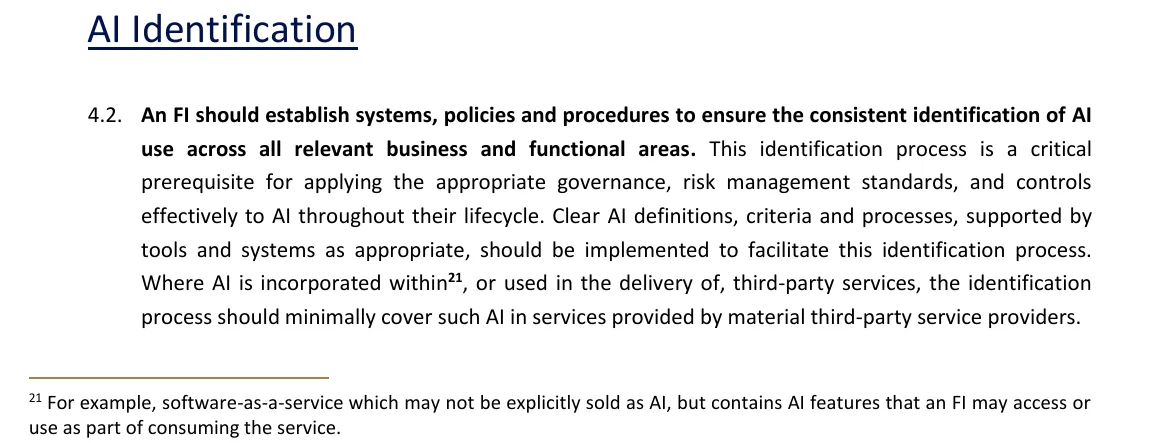 Screenshot: Guidelines on Artificial Intelligence Risk Management, MAS, paragraph 4.2.
Section 4 is in the first wave, so this lands in October 2027. If your CRM, ticketing tool or document platform has a summarise button, expect a bank customer to ask in 2027 whether your product contains AI, what it does, and how to switch it off. Paragraph 4.7 lists the attributes their inventory may record: purpose and description, approved scope of use, model type, data used, dependencies, lifecycle status and an assigned risk materiality rating. You can pre-fill most of those for them.
The vendor checklist hiding in paragraph 5.11
Paragraph 5.10 sets up the rule. The institution's onboarding and deployment controls for third-party AI should match the risk of the use case. Its contracts should give it visibility over the introduction of AI and later changes. It should test third-party AI in its own use cases, including with its own data, and run compensatory testing where the vendor's disclosures leave gaps. Then it documents how it tested the AI and decided it was fit for use.
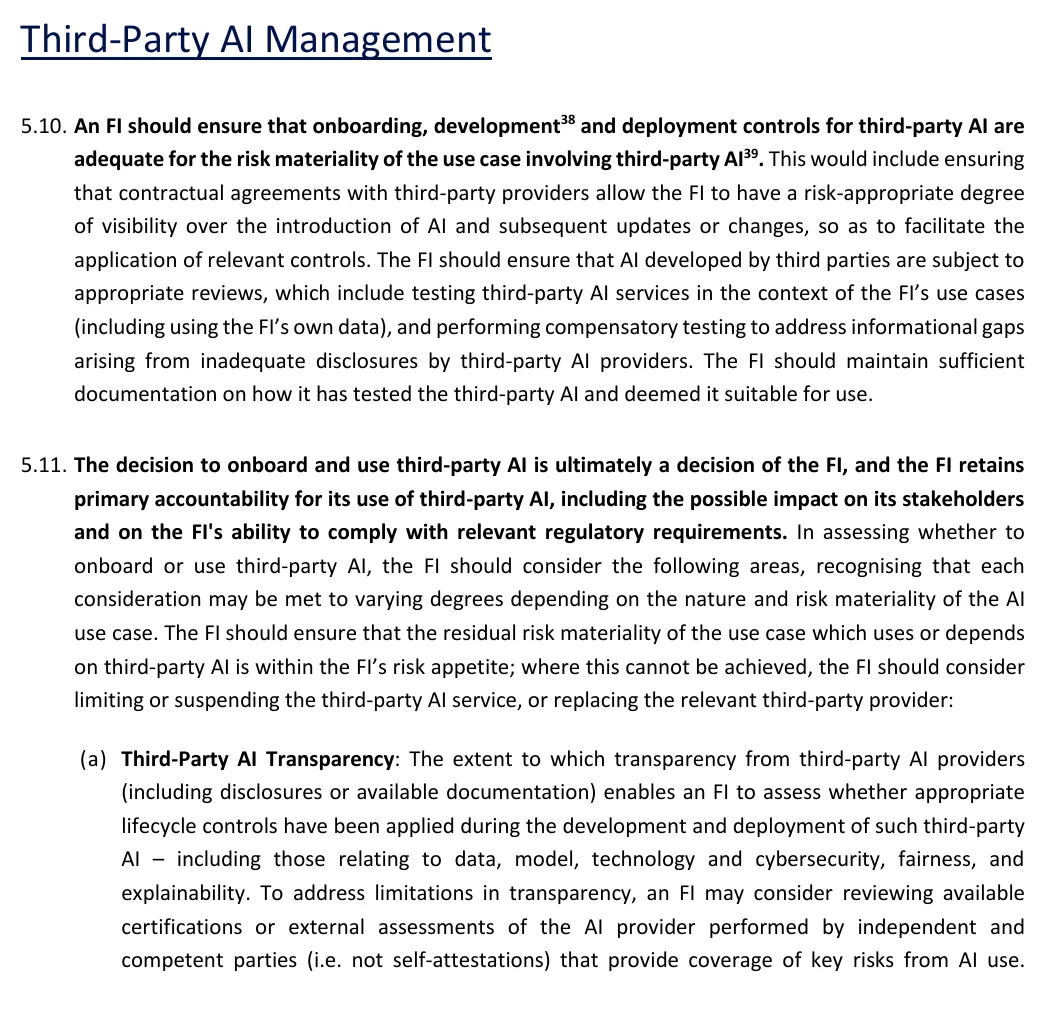 Screenshot: Guidelines on Artificial Intelligence Risk Management, MAS, paragraphs 5.10 and 5.11.
Paragraph 5.11 then lists eight considerations, (a) to (h). Here's how we'd read each one from the supplier's side:
| 5.11 | What the institution weighs | What we'd have ready |
|---|---|---|
| (a) Transparency | Whether your disclosures show appropriate controls on data, model, security, fairness and explainability. If not, certifications or external assessments by independent parties, "not self-attestations" | Control documentation per feature, plus one independent assessment whose scope covers AI risk |
| (b) Supply chain | Whether key models, datasets and dependencies had supply chain checks, including model provenance and training data integrity | A list of upstream models and providers, versions, and what you know about each one's provenance |
| (c) Concentration | Over-reliance on key AI providers, direct or indirect | Name your foundation model providers; say whether you can switch |
| (d) Change management | Whether the institution gets notice of updates or changes after deployment and can assess their impact | A written change notice process with a defined notice period |
| (e) Contingency | Plans for failures, unexpected behaviour or a vendor dropping support, especially for high-risk use | A documented way to disable the AI feature without breaking the product |
| (f) Legal agreements | Performance guarantees, data protection, right to audit, notice when AI is introduced or updated, or the institution's agreement before AI is added | Contract language you can live with before a bank's lawyers draft it for you |
| (g) Capabilities | Whether the institution's own procurement and user staff understand the AI | Short, plain-English feature guides for their staff |
| (h) Complexity | More detailed assessment for complex services; the footnote's example is AI agents | Extra test evidence for any agentic feature |
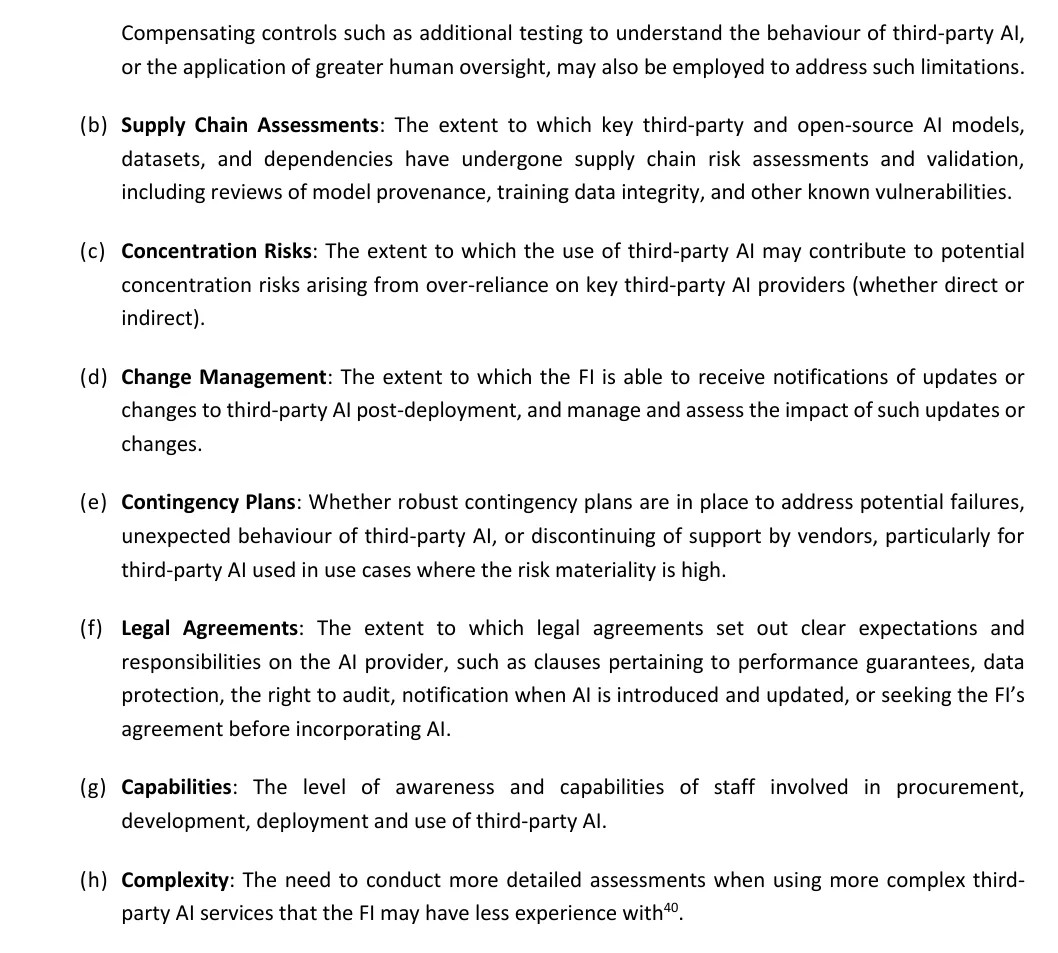 Screenshot: Guidelines on Artificial Intelligence Risk Management, MAS, paragraph 5.11.
Footnote 39 adds that MAS's existing outsourcing and third-party expectations apply to third-party AI too. If you already answer outsourcing questionnaires for Singapore banks, this is an AI annex to that file, not a new process.
What we'd prepare this quarter
Section 5 doesn't bind banks until 2028, but procurement cycles are long and contracts signed in 2027 will still be running then. Here's the evidence request we'd send to our own product, engineering and security owners:
 Image: Pexels, used under the Pexels License.
AI features and scope (for the 2027 inventory questions)
- Which features use AI, including AI inside upstream services we resell or embed?
- For each: purpose, intended use, data used, model type, dependencies, status (beta, GA, deprecated).
- Can a customer switch each feature off, per tenant?
Evidence (for 5.11(a), (b), (h))
- What testing have we done, on what scenarios, and which product version does it cover?
- Which upstream models and providers do we rely on, and what do we know about their provenance?
- Which independent assessment or certification covers AI risk? If none, which scoped assessment could we commission?
Changes and failure (for 5.11(d), (e))
- Which changes can alter a feature's behaviour, and how much notice can we give?
- What happens to the customer if an upstream model is withdrawn?
Contract (for 5.11(f))
- Will we accept audit rights, notice before new AI features, and a customer opt-in before AI is added to their tenant?
Use the buyer's own questionnaire when they send one. This list just means you aren't writing the answers under a deadline. For the structure of the full pack, our AI vendor due diligence checklist and contract redline template cover the generic parts.
Our take
We'd start with the contract, not the model card. Paragraph 5.11(f) names "seeking the FI's agreement before incorporating AI" as something a legal agreement may cover. A SaaS vendor that ships an AI feature to every tenant on the same day is exactly the case MAS is describing, and a bank that negotiates an opt-in clause in 2027 will hold you to it in 2028. Build tenant-level AI switches now; it's cheaper than retrofitting them per customer.
The other line we'd act on is "not self-attestations" in 5.11(a). A small vendor can't hand a bank its model weights, and MAS doesn't expect that: it points to certifications and external assessments by independent, competent parties. If a meaningful share of your revenue comes from Singapore financial institutions using your AI in anything customer-facing or credit-related, we'd budget for one scoped external assessment before 2028. If your AI only drafts emails for bank staff, skip it. MAS says basic policies can be enough for low-impact use, and your customer will likely treat you that way too.
How we checked this: we read the full Guidelines PDF and the MAS release and consultation page on October 13, 2026, and compared the dates with The Straits Times and CNA (5 sources, listed in our source log). We searched Reddit (r/singapore, r/fintech, r/compliance and two others, last 10 days) and found no discussion thread to quote, and no official video or post to embed. We haven't read the separate response-to-feedback paper. Last reviewed: October 13, 2026.