Image: Pexels, used under the Pexels License.
On July 22, 2026, Michael Kratsios, director of the White House Office of Science and Technology Policy, named a specific Chinese AI company as having copied a specific American model. The company was Moonshot AI. The model was Anthropic's Fable 5. The technique was distillation: training one model to imitate the outputs of a more capable one. Within hours, Treasury Secretary Scott Bessent put sanctions and Entity List designations on the table.
Three months later the accusation has hardened and the penalty hasn't arrived. On September 8 the NSA, FBI and CISA put the Moonshot claim into a formal advisory. As of our October 20 check, Moonshot isn't on Treasury's sanctions list or Commerce's Entity List. If you use a Chinese model anywhere in your stack, that gap is the time to prepare.
What Kratsios said on July 22
Kratsios wrote on X that Moonshot had "developed a sophisticated internal platform to conduct large scale distillation against U.S. models, allowing them to quickly switch between multiple methods of access to avoid detection." The target, he said, was Fable. Fable had only been publicly available since July 1, and Moonshot unveiled Kimi K3 on July 16 as the largest open-weight model on the market.
https://x.com/mkratsios47/status/2079933645888880708
He made a second allegation: that Moonshot had acquired Nvidia "GB300-equipped servers and has accessed GB300s in Thailand, likely to train its AI models." GB300 servers belong to Nvidia's Blackwell generation, which can't be sold to Chinese companies, so the claim raises an export-control question on top of the IP one. He didn't say how the government knew. Moonshot didn't answer CyberScoop's request for comment.
The sanctions threat from Treasury
Bessent's response came hours later: "Open source is not open season on American IP. When [Chinese] firms conduct covert, industrial-scale distillation attacks that cross the line into IP theft, sanctions and entity list designations will be on the table." He didn't announce action against Moonshot.
The two tools work differently, and the difference matters to a buyer:
- OFAC designation. The company goes on the Specially Designated Nationals list. Per OFAC, SDNs' "assets are blocked, and U.S. persons are generally prohibited from dealing with them." Paying for an API or a subscription is dealing with them.
- BIS Entity List. Commerce adds license requirements for exporting items subject to US export rules to the listed company. It hits what flows to the vendor, so it bites on the vendor's access to US chips, cloud and software more than on your purchase from it.
Either one would put Moonshot's US commercial relationships at risk. Only OFAC would make your own payments a problem overnight.
The timeline problem, and what the advisory added
Researchers objected right away. Braden Hancock, a researcher at the Laude Institute, told TechCrunch: "Fable's only been publicly available since July 1st. You can't distill that much data, train a model, and release it in two weeks."
The September 8 advisory answers part of that. It describes a longer campaign, not a two-week sprint. The joint Cybersecurity Advisory says Moonshot "has conducted a widespread distillation campaign against U.S. frontier AI companies since at least mid-2025," and lists Claude Opus, Sonnet and GPT models alongside Fable. It still says Moonshot "extracted significant Claude Fable 5 data to train its Kimi-K3 model." It names five other companies as well: DeepSeek, Alibaba, MiniMax, StepFun and Z.AI.
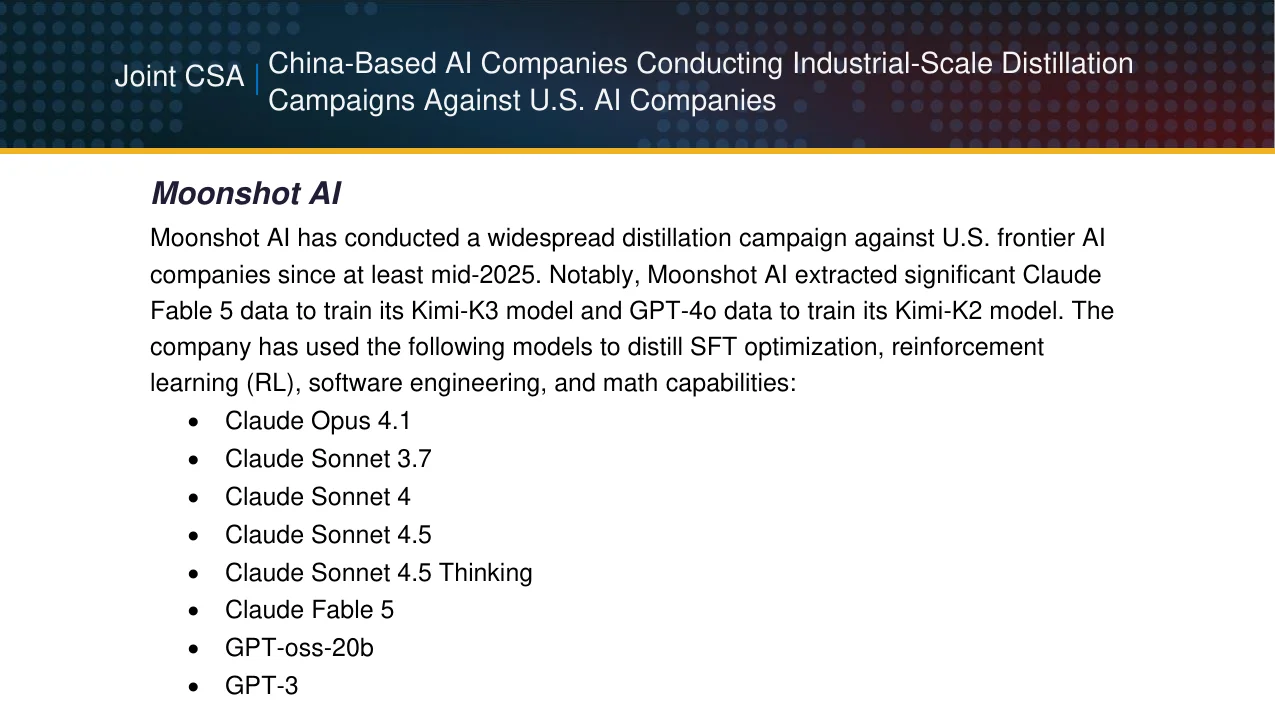
Screenshot: "China-Based Artificial Intelligence Companies Conducting Industrial-Scale Distillation Campaigns Against U.S. AI Companies", joint advisory by NSA, CISA and FBI, September 2026, page 4.
China rejected it the next day. A Ministry of Commerce spokesperson called distillation "a neutral technical method used by model companies worldwide," and said that if the US used the issue to suppress Chinese AI companies, "China will resolutely take countermeasures," as the National Law Review reported. In July the foreign ministry had already said China "opposes politicizing and instrumentalizing trade and tech issues."
None of this has been tested anywhere it would have to hold up. An advisory isn't a charge, and no public technical evidence ties K3's weights to Fable outputs. Distillation leaves no watermark that survives training, which is part of why the response so far has been accusation and threat rather than formal action.
Image: Pexels, used under the Pexels License.
Why this matters for AI vendor supply chains
Naming companies changes the risk on Chinese models. Before July, the warnings were general. Now a White House official and three agencies have named Moonshot, and the advisory adds five more labs, DeepSeek among them, which it says ran campaigns since at least 2024 to train its R1 and V3 models. If you use any of those companies' models, directly or through a platform, you're relying on a vendor the US government has publicly accused.
The closest precedent is hardware. Commerce put Huawei on the Entity List in May 2019, and every buyer with Huawei inside its network had to work out what it could keep. A designation of a Chinese AI vendor would start the same exercise. Swapping a model API is easier to start and harder to finish than it looks, because prompts, evaluations and fine-tunes are tuned to one model.
What enterprise teams should do before a designation happens
These steps don't depend on what happens to Moonshot. They apply to any vendor under active US scrutiny.
Map your actual dependencies. Not just products you use directly, but SDKs, APIs reached through routers or intermediaries, and open-weight models running inside your own tooling. K3 is open-weight, so your engineers may be running it as a base model with no contract with Moonshot at all.
Document what you use and why. If a vendor is designated, legal, audit or a customer may ask what reliance you had, when it began and what due diligence you did. A record showing you asked about model provenance, and got a specific answer, is worth having. A record showing you asked nothing isn't.
Review vendor contracts for sanctions and regulatory change clauses. Many AI contracts are silent on what happens if the vendor is designated. New contracts should say who bears termination costs and how your data comes back if OFAC or BIS acts against the vendor.
Identify fallback vendors now. Decide what you'd switch to and test it on your real prompts. Don't assume a US model matches the cost or performance you have today; find out, and tell legal and procurement before a crisis.
Watch OFAC and BIS on a schedule. Both publish designations in the Federal Register and on their own sites, and OFAC's list page shows when it was last updated. Match your vendor list against both.
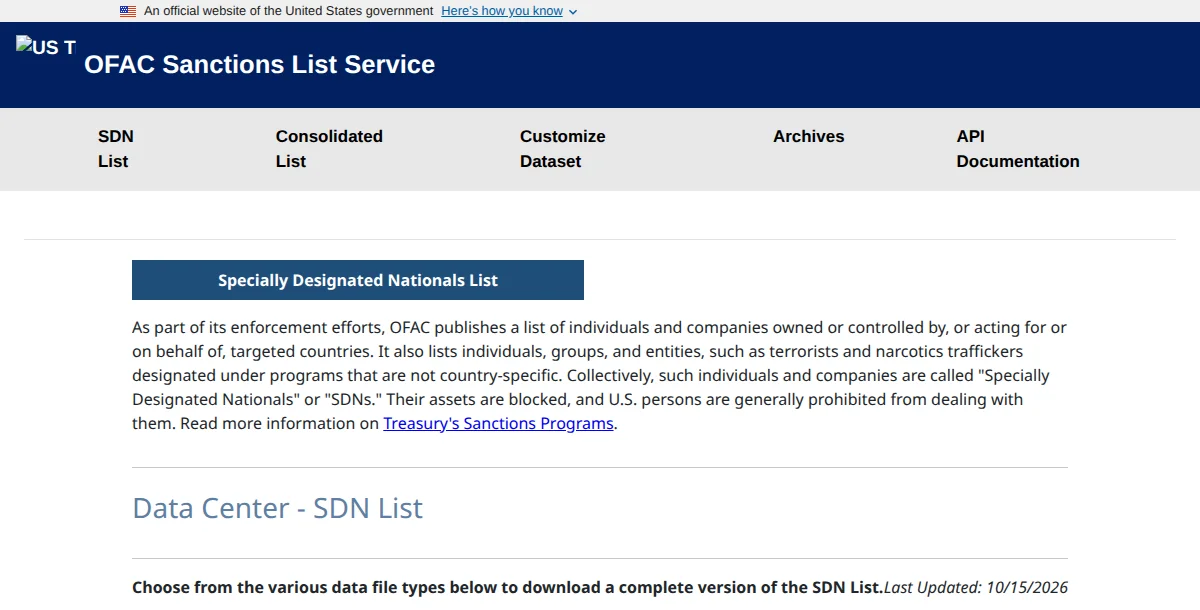
Screenshot: Specially Designated Nationals List page, OFAC Sanctions List Service, US Treasury, captured October 20, 2026.
Our take
This has moved from a social media post to an official advisory, and the next step, if it comes, is a listing with no warning period. The work above costs a few days now and a few weeks if you start after a designation. We'd do it for any Chinese-origin model in production, not just Kimi.
It also runs the other way. In June, a US government directive took Anthropic's Fable and Mythos models offline until access came back on July 1. US policy can cut off a vendor from either side, so the dependency map and fallback plan are the same exercise whichever vendor you're worried about.
Correction and update (October 20, 2026): We've rewritten this article with the September 8 NSA, FBI and CISA advisory and China's response, and corrected two details: Kimi K3 was unveiled on July 16, not "July 15-17", and the earlier claim that its weights came out on July 27 had no source and is removed. Moonshot is not on OFAC's SDN list or the BIS Entity List (both downloaded October 20), and a Federal Register search for "Moonshot" since July 1 returns no BIS rule.
Related Reading
- MiraclePlus Sanctions: What US AI Teams Need to Check
- DHS orders DeepSeek out of civilian agencies: the contractor checks
- Treasury's first outbound investment fine: $200K against Amidi for a China AI deal
- Anthropic Export Ban: What Vendor Dependency Looks Like When It Breaks
- AI Vendor Due Diligence Checklist 2026
- AI Supply Chain Security Checklist 2026
- DeepSeek and Chinese AI Models: GDPR Compliance Guide
- FTC AI Enforcement Actions 2026: Real Cases and What Gets Fined
- OpenAI, Google, Anthropic Hold 84% of AI Agents. France Noticed.
- Meta Skipped the EU AI Code: What Llama Deployers Must Do Now