Image: Pexels, used under the Pexels License.
The McDonald's case matters to small teams for a reason that has nothing to do with burgers. The legal question is what happens when many independent businesses take pricing recommendations from the same system fed with each other's data. That describes a lot of software a small company can buy: rent pricing for landlords, fare tools for travel sellers, marketplace pricing assistants, and "optimal price" features inside point-of-sale systems.
Correction, October 15, 2026: an earlier version said the lawsuit was filed on October 5 and that we couldn't find the plaintiff, case number or statutes. The complaint was filed on Friday, October 2, and reported on October 5. We have since read it: the details are in the table below. We also attributed McDonald's "AI does not set the price of a Big Mac" line to a People report; it comes from McDonald's own October 1 statement.
What was filed, and when
Reuters published an investigation on September 29, 2026 into how McDonald's uses machine learning to recommend menu prices. McDonald's answered on October 1 with a statement on its corporate site. The next day a DeKalb, Illinois customer filed a proposed class action in Chicago, and Reuters reported it on October 5. The complaint cites the Reuters article by name, so the two are worth reading together.
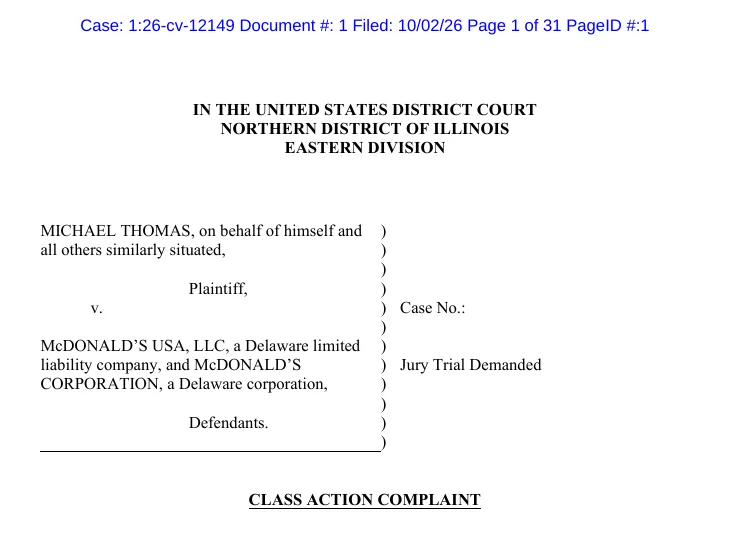
Screenshot: Class Action Complaint, Thomas v. McDonald's USA, LLC, N.D. Ill. (via CourtListener).
| Item | What the complaint says |
|---|---|
| Case | Thomas v. McDonald's USA, LLC, No. 1:26-cv-12149 |
| Court | U.S. District Court, Northern District of Illinois, Eastern Division |
| Filed | October 2, 2026 (reported by Reuters on October 5) |
| Plaintiff | Michael Thomas, a DeKalb, Illinois resident, for himself and a proposed class |
| Defendants | McDonald's USA, LLC and McDonald's Corporation |
| Claims | Section 1 of the Sherman Act (two counts: price fixing and exchange of competitively sensitive information), the Illinois Antitrust Act, and the Illinois Consumer Fraud and Deceptive Business Practices Act |
| Relief sought | Class status, treble damages, an injunction, attorneys' fees, jury trial |
| Core allegation | Since at least 2019, McDonald's and its franchisees agreed to share nonpublic pricing data and set prices with algorithms trained on it |
The complaint leans hard on structure: it says about 95 percent of the roughly 14,000 U.S. restaurants are independently owned, so the franchisees are supposed to set prices on their own. "Independent businesses must set their prices independently," it says.
What the September 29 investigation described
The investigation is the factual backbone, and McDonald's disputes its framing. Reuters reviewed screenshots of the pricing engine taken in August and interviewed nine sources:
- The engine uses machine learning to analyze data from millions of daily transactions across nearly 14,000 U.S. restaurants and generates what the company calls "the optimal price" for each item at each location.
- One input is an estimate of what each store's customers will pay. A franchisee screen reads "Your restaurant is showing MEDIUM SENSITIVITY to Price," based partly on "customer willingness to pay in your area."
- The platform also shows public menu prices from nearby competitors, including Wendy's and Burger King, which told Reuters they don't use AI in pricing decisions.
- Reuters found a Big Mac at $5.69 in one company-run Fresno store and $6.89 at another company-run store about two miles away, a 21% premium. It couldn't confirm the engine caused the gap.
- Five store owners told Reuters the company pressured them to use the tools. Since January, McDonald's has required franchisees to be "constructively engaging with McDonald's approved Pricing Consultant and Tools," per an internal communication Reuters reviewed.
- CEO Chris Kempczinski told investors in August that "pricing non-compliance in certain cases is part of those conversations" in franchisee business reviews.
- The portal's own terms warn that owners "may be competitors of each other" and must comply with antitrust law, while saying they are "always free to determine the final price."
McDonald's told Reuters the portal is "a tool, not a mandate," and called the reporting "speculative and uninformed." Its October 1 statement goes further: "AI does not set the price of a Big Mac or any other menu item," it doesn't change prices, and franchisees "independently set menu prices at their restaurants." After the suit was filed, the company told the AP it was "filled with inaccuracies" and that it would defend itself vigorously.
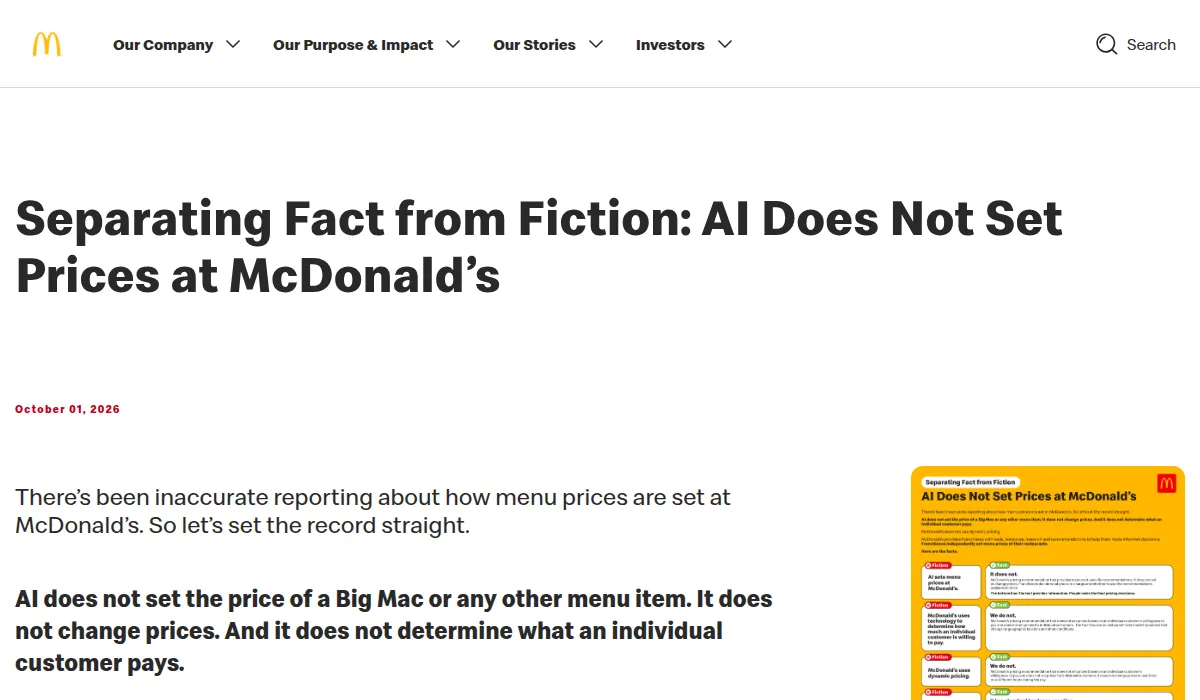
Screenshot: "Separating Fact from Fiction: AI Does Not Set Prices at McDonald's", McDonald's Corporation, October 1, 2026.
Why experts disagree
Reuters quotes two views. William Kovacic, a former FTC commissioner who directs the competition law center at George Washington University, called the portal's antitrust language "an acknowledgment there's a potential problem" given recent scrutiny of pricing algorithms by the FTC and other regulators. Other experts said the legal risk is low because the "competitors" are franchisees, and courts in recent decades have given brands wide latitude to control franchisee pricing.
On r/McDonalds, the thread about the suit split the same way. One commenter asked "competition between locations? Do people just not go to their closest one from their house", which is roughly the defense's distinct-markets point. Another pushed back that "Franchisors have been recommending pricing for franchisees for decades."
Both views can hold at once. A filing proves nothing. For a small buyer of pricing software the useful point is narrower: the same facts that make a franchise case contested (shared data, strong nudges, independent owners) show up whenever one vendor prices for competitors.
Video: Steve Lehto on YouTube, "Class Action Lawsuit Claims McDonalds Uses AI Pricing".

Image: Pexels, used under the Pexels License.
What this means for a business that buys a pricing tool
One lawsuit doesn't set a standard. These are the questions that turn a vague worry into something you can check, and they map onto what the complaint attacks.
Where the data comes from. Does the tool use your competitors' nonpublic data, such as their transaction history, to price for you, or yours to price for them? That's the heart of the complaint's second count.
Who the vendor also serves. If the same vendor serves your direct competitors, a shared engine can look like a shared decision.
Recommendation or default. Is the price a suggestion you can override, or does the system apply it unless you act? Is there any penalty for overriding?
What gets logged. Does the vendor or a parent company track how often you deviate from its recommendation? Reuters reports McDonald's records franchisees' deviations in detail.
What the contract says. Does it address antitrust compliance, data pooling and your right to set your own price?
For the regulatory side, our roundup of FTC AI enforcement actions covers the federal posture on AI claims, and our Maryland algorithmic pricing guide covers one state's rule on pricing tools. The vendor contract red flags list is the right place to add the clause below.
Copy this: pricing tool antitrust review
PRICING TOOL REVIEW (draft, have counsel review before you rely on it)

Vendor / tool: [name]               Reviewed on: [date]       Owner: [role]

1. Inputs
   [ ] Uses only our own data and public data
   [ ] Uses pooled data from other customers  -> which, and are any of them
       our direct competitors?  [answer]

2. Who else uses it
   [ ] Vendor will tell us if it serves competitors in our market
   [ ] Not answered  -> escalate

3. How prices are applied
   [ ] Recommendation we can override with no consequence
   [ ] Default applied unless we act
   [ ] Any tracking or reporting of our overrides?  [answer]

4. Contract
   [ ] Antitrust compliance language reviewed by counsel
   [ ] We keep the right to set our own prices
   [ ] Vendor warrants it will not share our nonpublic data with others

5. Our record
   [ ] We keep a log of the price we chose and why when it differs from
       the recommendation
Item 5 is the cheap one. If your prices are ever questioned, a short note on why you departed from a recommendation shows an independent decision.
Contract language to ask for
Customer sets its own prices. The Services provide recommendations only and
Customer may accept, modify or reject any recommendation without penalty.
Provider will not use Customer's nonpublic data to generate recommendations for
any other customer, and will not disclose to Customer the nonpublic data of any
other customer. Provider will disclose on request whether it provides pricing
recommendations to businesses that compete with Customer in the same market.
Not every vendor will sign this as written. We'd still send it: a vendor that won't answer the last sentence has told you who else it prices for.
What we could not confirm
- The court docket after the complaint: Justia's docket page refused automated access, so we can't say whether McDonald's has answered or moved to dismiss.
- Every allegation is unproven, and the investigation's account of the pricing engine comes from screenshots and sources McDonald's disputes.