Image: Unsplash, used under the Unsplash License.
China has now put model curbs on paper, but they don't reach what's already public. On October 16, 2026, the Ministry of Commerce (MOFCOM) and the Ministry of Science and Technology published Announcement No. 48 of 2026, a draft that adds 40 technologies to the catalogue of technologies prohibited or restricted from export, 23 of them in AI. Until the revised catalogue takes effect, a Chinese exporter must register on MOFCOM's platform before transferring or licensing any listed technology abroad. The announcement says technology already in the public domain through open source or published papers is outside its scope. The "September decision window" this article once described never had an official date behind it.
The other change is in the licences. New Chinese open-weight models now ship with licence conditions for big commercial hosts, and Beijing has told Washington it will retaliate if the US moves against Chinese labs over distillation. Access to models you've already downloaded is unchanged. Access to the next releases is the open question.
What happened, dated
- July 7, 2026. Reuters reported meetings "led by China's Ministry of Commerce" with Alibaba, ByteDance and Z.ai about limiting overseas access to the most advanced models, closed and open. Its sources said any curbs might cover only future models, and that it was unclear "when or even if they would come into force."
- July 21. The Financial Times, as carried by The Business Times, reported the limits could go into the next revision of China's catalogue of technologies prohibited or restricted from export, with regulators still weighing industry feedback before a final call.
- August 28. Z.ai released the GLM-5.3 weights under a new custom licence, replacing the MIT licence that covered GLM-5.2.
- September 15. A MOFCOM spokesperson rejected the US government's September 8 advisory on model distillation, said China's open-source models are available to global companies including US ones, and warned that "China will resolutely take countermeasures" if the US acts against Chinese AI companies on that basis.
- September 23 to 25. Xi Jinping's state visit to Washington ended with eight published deliverables. The AI item sets up a China-U.S. AI Dialogue, with the next exchange in November 2026, plus a bilateral channel for AI incidents. None of the eight mentions export controls on models. The Associated Press put it plainly: "The summit produced no major breakthroughs."
- October 9. MOFCOM's latest 2026 announcement, No. 46, covers sugar and wool quotas. Still nothing on AI models as of our October 14 check.
- October 16. MOFCOM and the Ministry of Science and Technology published Announcement No. 48 of 2026: a draft revision of the export technology catalogue covering 40 technologies in AI, biomedicine and solar, open for comment until November 15, with pre-export registration in force from the same day.
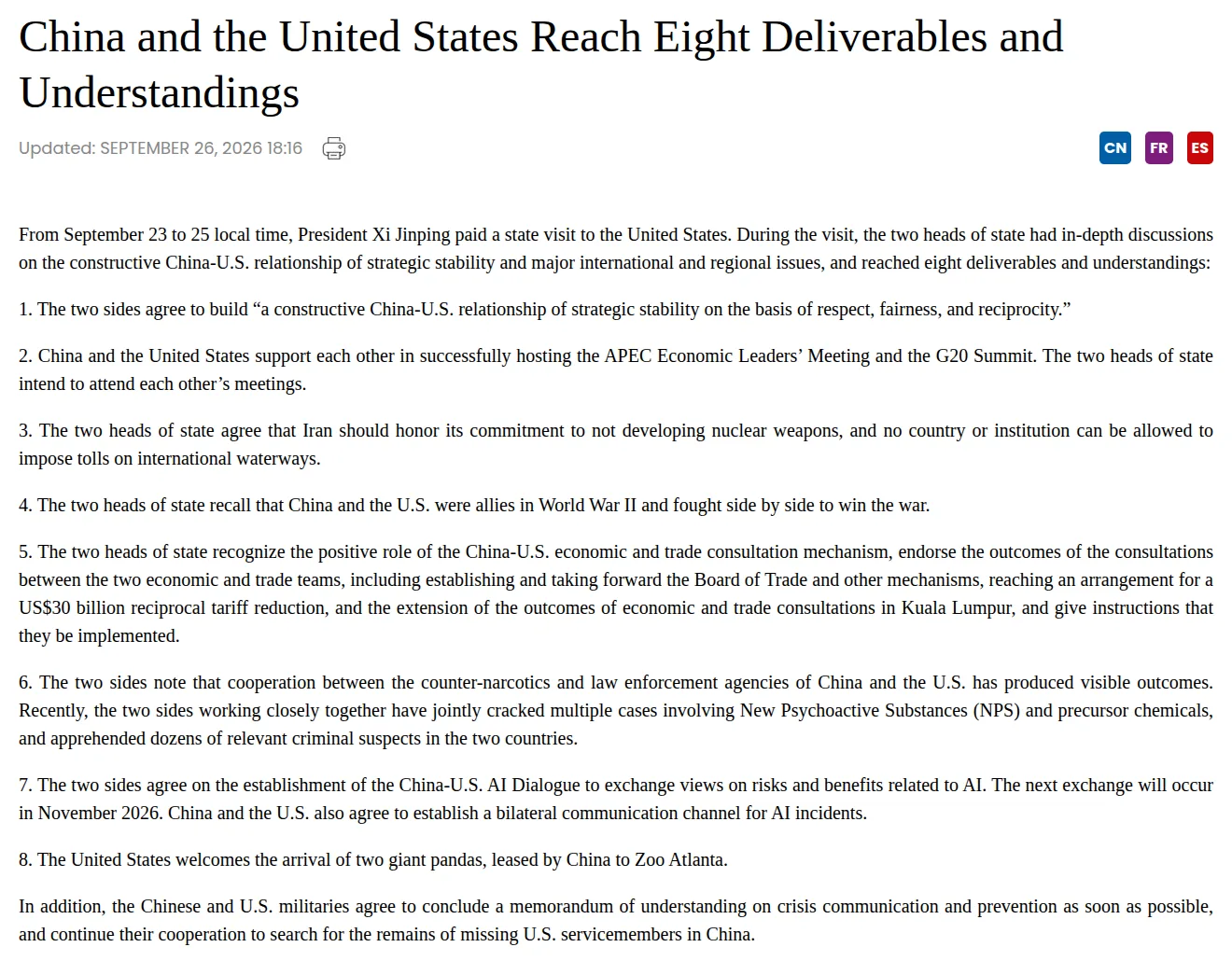
Screenshot: China and the United States Reach Eight Deliverables and Understandings, Ministry of Foreign Affairs of the PRC, September 26, 2026.
What the October 16 draft covers
We read the announcement and its Attachment 1, the draft list, on MOFCOM's site on October 24, 2026. The AI part covers large models, agents, AI chip design, computing clusters and information processing. The two model items matter most if you use Chinese models:
| Item in the draft | Tier | What it covers |
|---|---|---|
| 266501J, large model technology | Prohibited | Large models that provide services after training on China's "core data", as defined under the Data Security Law |
| 266504X, large model technology | Restricted | Models that provide services after training on China's "important data" (a share of 0.1% or less is excluded if it can't substantially lift the model's capability and safeguards are in place), and the core technology of models that meet any one of three tests: compute of at least 10^26 floating-point operations, at least 2 trillion parameters, or a global top-10 ranking in public evaluations at the time of export. Core technology includes weights, key checkpoints, source code and architecture |
| Interim registration | In force since October 16 | Before transferring ownership of listed technology abroad, licensing it for use abroad, or moving its owner or controller to a foreign entity |
| Scope limit | Applies to the AI items | Technology already in the public domain through open source or published papers is not covered |
For a team that downloads Qwen or GLM checkpoints, the carve-out is the line that matters: weights already on Hugging Face are public. The draft bites on the next frontier release. A Chinese lab whose new model passes one of the three tests would have to register before licensing the weights abroad, and once the catalogue is final the item sits on the restricted list.
What the July reports did and didn't say
Our first version got two things wrong, and both made the risk sound more settled than it was.
The three tiers (a simple filing for basic open-source tools, security reviews for more advanced ones, and a domestic-only lane for the most sensitive systems) weren't a MOFCOM draft. Reuters attributed them to "a May roundtable of Chinese legal experts," summarized in a Supreme People's Court journal. On r/LocalLLaMA the same day, u/Stannis_Loyalist read the filing idea as a relief valve rather than a new barrier: "the scholars proposed quick filings to protect developers and keep the global code pipeline wide open." That's one reader's interpretation, but it sits closer to the source than our old summary did.
Nobody reported criminal penalties for distilling Chinese models, either. The idea Reuters described was making "any leak or theft of proprietary AI technology an offence under China's stringent national security law." That's about insiders and theft, not about foreign teams fine-tuning on outputs.
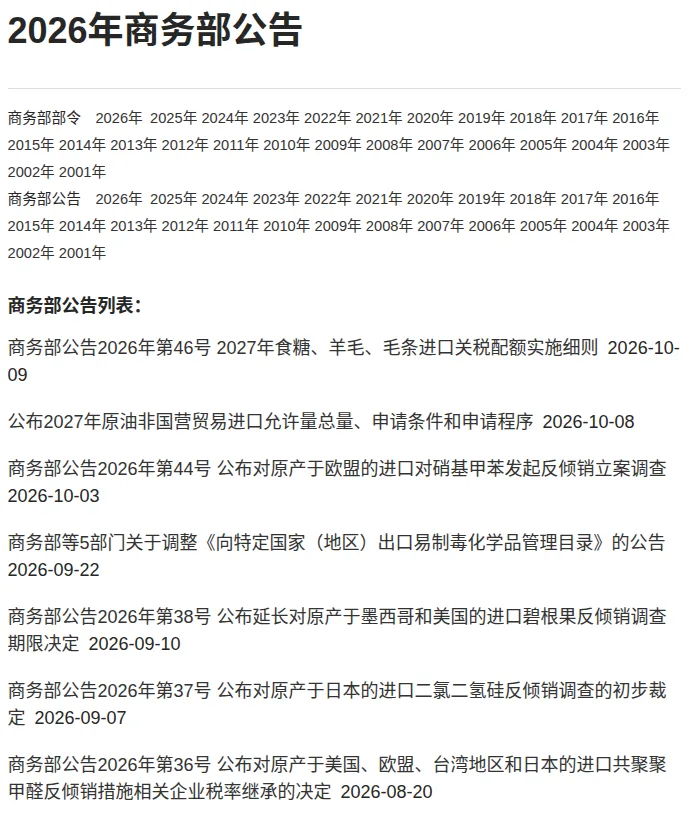
Screenshot: 2026 MOFCOM announcements list, Ministry of Commerce of the PRC, checked October 14, 2026.
Who this applies to
Teams that self-host Qwen, GLM or Kimi weights. Copies you already have are public, and the October 16 draft leaves technology already released as open source outside its scope. What the draft could change is how future frontier releases reach you.
Teams that sell hosted access to Chinese models. This is where the real gates are today, and they come from licences, not the state. The GLM-5.3 licence says that if you and your affiliates run a model-as-a-service business whose revenue exceeds 10 billion US dollars over any consecutive 12 months, you must pass Z.ai's security review before commercial use. Moonshot's Kimi K3 licence asks for a separate agreement once a hosting business passes 20 million US dollars. Most small teams sit far below both lines, but your inference provider may not.
Buyers whose vendors build on Chinese base models. Alibaba says its Qwen models drew more than 3 billion downloads in six months (Bloomberg, via Fortune, August 15), so Qwen-based fine-tunes are common inside vendor products, often without a label.
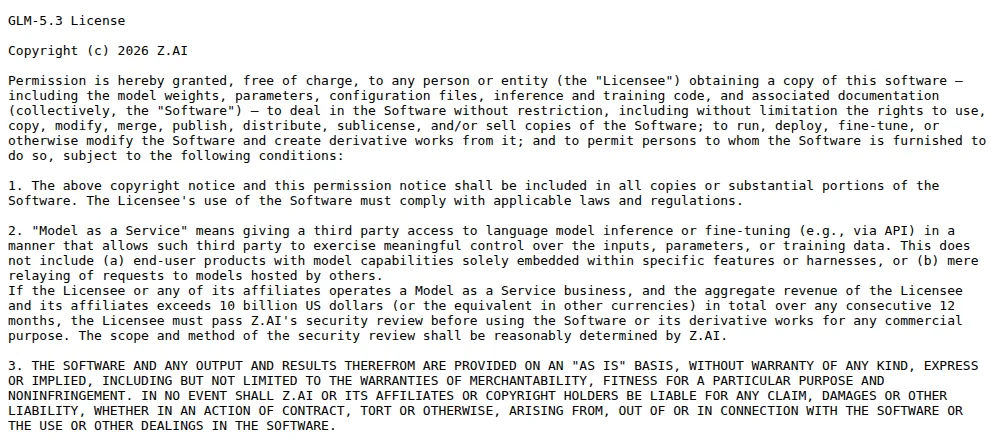
Screenshot: GLM-5.3 License, zai-org on Hugging Face, checked October 14, 2026.
What to do now
- Map the base models. Ask each AI vendor which base model every fine-tuned model came from, and list anything derived from Qwen, Doubao, GLM or Kimi. It's a supply chain question today, not a compliance one.
- Read the licence before each upgrade. GLM-5.3 and Kimi K3 show the direction. AEI's October 1 analysis expects any closure to be "soft", through terms like these, rather than an outright ban.
- Keep a tested fallback. For each workflow that depends on a Chinese model, name a non-Chinese substitute and test it once. Put model-substitution notice into vendor contracts; the agentic AI vendor contract clauses guide has wording for model-routing disclosure.
- Watch three dates. November 15, when comments on the draft catalogue close; the final catalogue, which has no date yet; and the AI Dialogue exchange in November. We'll update this page when the catalogue is final.
What we could not confirm: whether hosted or API access to a covered model counts as a technology export. The announcement's registration cases are transfers, licences and changes of control, and it says nothing about API access. We also couldn't find a date for the final catalogue. We couldn't trace the OpenRouter and Hugging Face usage-share figures in our first version to a primary source, so we took them out.
For the US side of this story, see the Trump-Xi AI summit analysis. For contract wording on model provenance, see the AI vendor due diligence checklist and the Anthropic export ban vendor dependency checklist.
Correction (October 14, 2026): An earlier version said a decision was expected in a September 2026 window, described the tiered scheme as MOFCOM's framework, and said it would add criminal penalties for distillation. No official date was ever given and no decision has been published; the tiers came from a May legal-expert roundtable; and the offence Reuters described covered leaks or theft of AI technology. We also removed usage-share figures we couldn't trace to a primary source and replaced an outdated Qwen download figure.
Update (October 24, 2026): On October 14 this page said no export rule existed. Two days later MOFCOM and the Ministry of Science and Technology published Announcement No. 48, a draft catalogue revision with interim pre-export registration. We added it to the summary, the timeline, the scope notes and the checklist, read against the announcement and its Attachment 1 on MOFCOM's site. The licence and summit rows were not re-checked in this pass.
Related Reading
- MiraclePlus Sanctions: What US AI Teams Need to Check
- DeepSeek banned from federal civilian agencies: what vendors check
- Treasury's first outbound investment fine: $200K against Amidi for a China AI deal
- Trump-Xi AI Summit Sept 24: chip loophole, distillation, 3 vendor questions
- Amodei's AI pacing plan: embedded evaluators and 3 vendor questions
- AI Safety Body: FAA, FINRA, or IAEA model, 3 vendor risk questions
- Anthropic export ban risk: vendor dependency compliance checklist
- Agentic AI vendor contract clauses: what to add in 2026
- AI vendor due diligence checklist 2026
- Board AI governance reporting: quarterly template for 2026