

AI coding tools used to be a seat price. You knew what 20 Copilot seats cost. That stopped being true for Copilot's business plans. GitHub now bills Copilot Business and Enterprise usage in pooled AI credits, and Claude Code bills by tokens unless you're on a seat plan. Spend now follows behavior, and behavior changes fast once people start running agents.
We read the current billing docs from GitHub and Anthropic on October 13, 2026 and took screenshots of the two passages that matter most. Here's what changed, and the six controls we'd put in place, in order.
What changed in how AI coding tools bill
| Tool | How it bills now | Numbers from the vendor docs |
|---|---|---|
| Copilot Business | $19 per seat a month, includes 1,900 AI credits per user, pooled | 1 AI credit = $0.01 |
| Copilot Enterprise | $39 per seat a month, includes 3,900 AI credits per user, pooled | Same credit rate |
| Claude Code | Token usage on the Console or cloud providers; seat allowance on Teams and Enterprise | About $13 per developer per active day, $150-250 per developer per month on average |
Sources: GitHub's plans page and usage-based billing for organizations, and Anthropic's Claude Code costs page.
Two details in GitHub's model matter most for budgeting. Code completions and next edit suggestions are not billed in AI credits; they stay unlimited on paid plans. Copilot Chat, Copilot CLI, the cloud agent, Spaces, Spark and third-party coding agents do draw credits. So a team that mostly uses completions will barely touch the pool, and a team that runs agents can drain it.
For scale: 20 Business seats give a shared pool of 38,000 credits, or $380 of included usage a month. Unused credits don't carry over. In an r/GithubCopilot thread about credit limits, one team lead wrote: "We have 6 developers and are sharing a pool of 11,400 now that the promo pricing has gone away." That's exactly 6 × 1,900, so the arithmetic holds in practice.
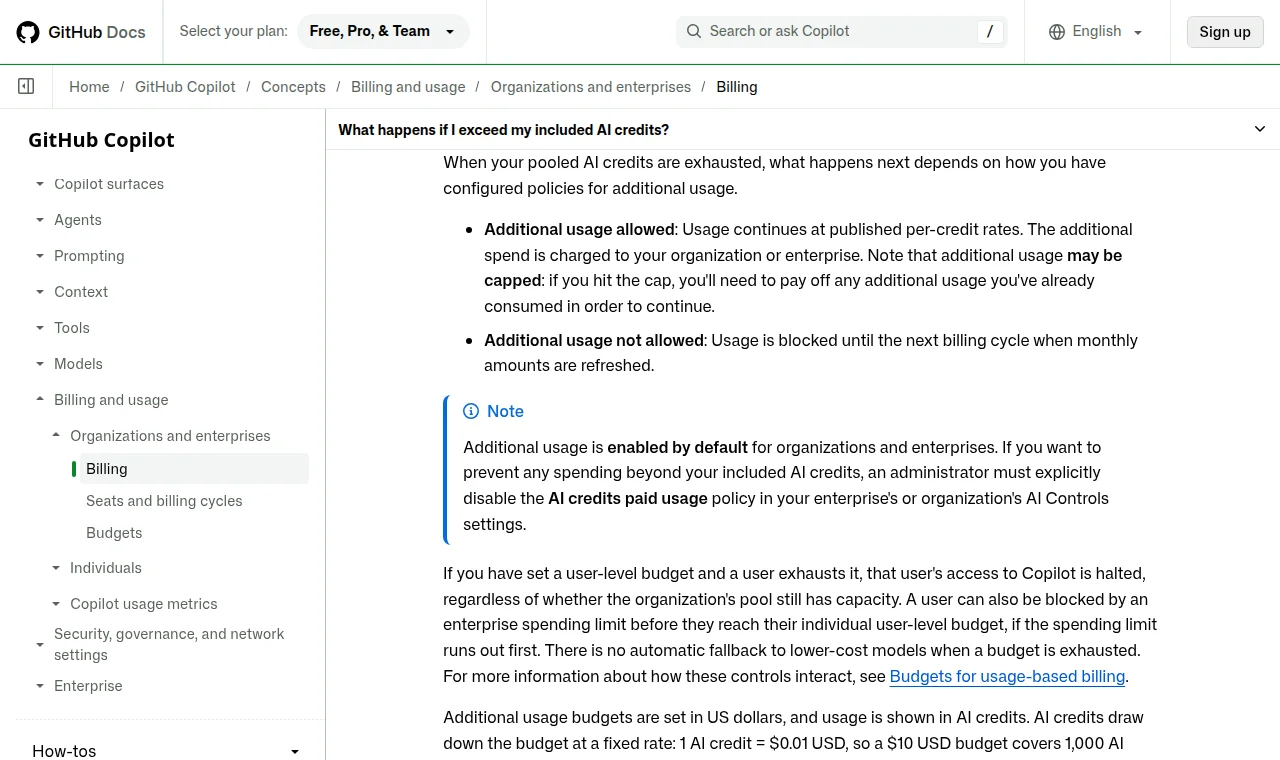 Screenshot: GitHub Docs, "Usage-based billing for organizations and enterprises", taken October 13, 2026.
The six controls, in the order we'd add them
1. Decide what happens when the pool runs out
GitHub's docs say it plainly: "Additional usage is enabled by default for organizations and enterprises." When the pooled credits run out, usage continues at the per-credit rate and lands on your bill, unless an admin disables the AI credits paid usage policy in AI Controls or caps it.
That default is the first thing we'd change. Either switch overage off (usage stops until the pool resets on the first of the month) or set an organization budget you're comfortable paying without a meeting. For Claude Code, the matching control is a workspace spend limit on the Console, or spend limits on Teams and Enterprise plans.
2. Set per-user budgets once you have data
GitHub lets admins set user-level budgets, and a $0 budget blocks a user immediately. Two things to know before you set them. A user who exhausts their budget loses Copilot access even if the pool still has credits. And "there is no automatic fallback to lower-cost models when a budget is exhausted", so a developer who hits the cap mid-task just stops.
On Anthropic's side, Teams and Enterprise admins can set limits at the organization, group or member level. We'd set budgets from a month of real usage, generous enough that normal work never hits them, and publish how to ask for more.
3. Pilot before rollout, and baseline it
Anthropic's own advice is to "start with a small pilot group and use the tracking tools below to establish a baseline before wider rollout." It's good advice for any tool. Pick three to five developers with different work, give them the tool for a month, and record usage per person alongside pull request cycle time and defects. One commenter in the same r/GithubCopilot thread described the problem this solves: "Management sometimes have no idea and won't allow higher tiers without arguments, which one can't get without anecdotal evidence."
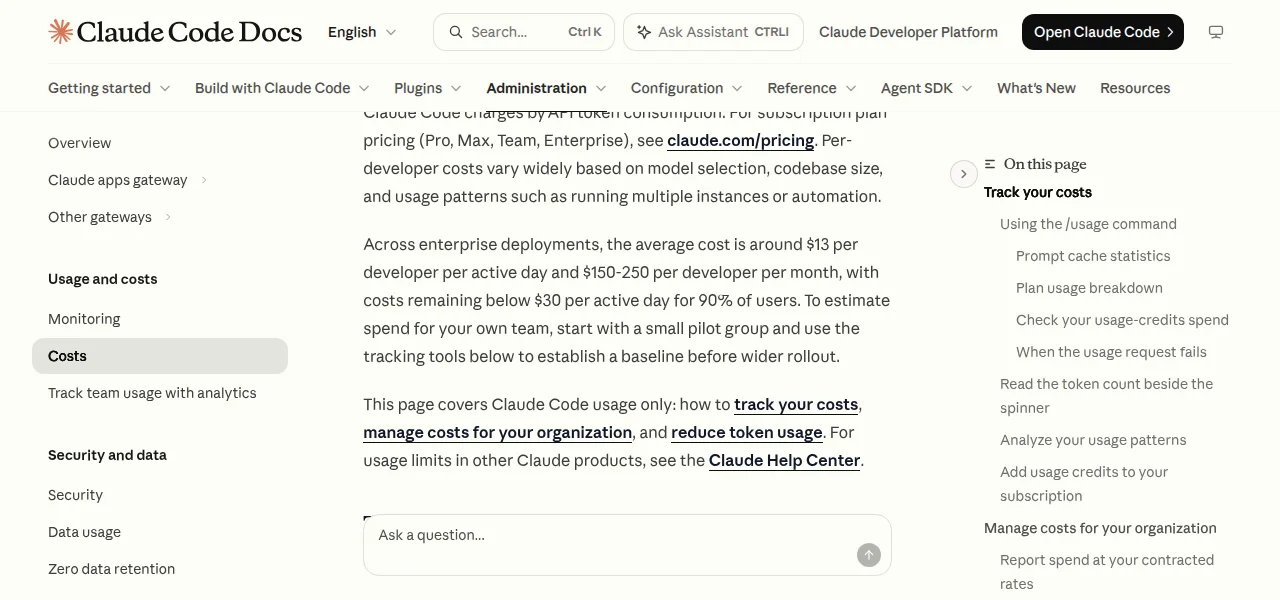 Screenshot: Claude Code Docs, "Costs", taken October 13, 2026.
4. Watch agents and automation separately
The heavy spend sits in agent sessions and anything that runs unattended: CI steps, review bots, overnight agents. Another commenter called 100k credits a month "not enough to in automated agents 24x7 but more than enough for your regular sdlc needs". Give automation its own budget or cost center so it can't eat the developers' pool, and log token use per pipeline from the first run. Our policy for unattended AI coding agents covers the rest.
5. Use prompt caching in your own integrations
If you build internal tools on a model API, caching is the cheapest saving available. Anthropic's pricing charges 25% more than base input to write a 5-minute cache entry and 10% of base input to read it. OpenAI discounts cached input by up to 95%, for prefixes of at least 1,024 tokens.
Our worked example, using Anthropic's published Claude Sonnet 4.6 rates ($3 per million input tokens, $3.75 cache write, $0.30 cache read): a tool that sends the same 40,000-token prefix 10 times within 5 minutes pays $1.20 for that prefix without caching. With caching it pays $0.15 for the first write and $0.012 for each of the nine reads, about $0.26 in total, or about 79% less. The saving disappears if the prefix changes between calls (a timestamp at the top is enough), so put stable content first.
6. Set model defaults and review monthly
Since budgets don't fall back to cheaper models, the default model matters. Write down which model is the default for chat and which tasks justify a premium one. Then hold a 15-minute monthly review: pool usage, the top users and pipelines, anyone who hit a budget, and requests for more. If you pay contracted rates for Claude, Anthropic notes that Claude Code shows costs at list price by default; an admin can set a modelPricing managed setting so developers see your real rates.

Risks that aren't on the invoice
- Shadow keys. Budgets set too tight push developers to personal API keys and consumer plans, which removes both cost visibility and data control. Generous budgets with a fast request path work better. Our shadow AI policy guide covers detection.
- Code sent to vendors. Your acceptable use policy should say which repositories and secrets may never go to an external model.
- Review standards. AI output that passes review still needs the same tests and ownership as human code. Treat it as a first draft.
- Lock-in. Deep integrations with one provider make switching expensive. Keep a thin layer between your tools and the model API, and include switching cost in your vendor due diligence.
Checklist
Spend controls
- Copilot "AI credits paid usage" policy reviewed: off, or capped by an organization budget
- Claude Console workspace spend limit or Teams/Enterprise spend limits set
- User-level budgets set from a month of data, with a request path
- Automation on its own budget or cost center
Visibility
- Usage by user and by pipeline available to an engineering lead
- Pilot baseline recorded: usage, pull request cycle time, defects
- Monthly 15-minute review on the calendar
Policy
- Approved tools and default models written down
- Data rules for code and secrets in the acceptable use policy
- Prompt caching on for internal tools that reuse large prompts
Our take
The billing change made governance simpler, not harder. A year ago you had to build your own meters. Now GitHub and Anthropic both ship budgets and spend limits; they just aren't all on by default. Overage being enabled by default on Copilot is the single setting we'd check this week, because nobody notices it until the first invoice after an agent rollout.
We'd also stop arguing about ROI in the abstract. A month-long pilot with three to five developers, a usage export and a before-and-after on cycle time gives finance a real number, and gives you the data to set budgets that don't block people mid-task.
How we checked this: on October 13, 2026 we read GitHub's Copilot plans and organization billing docs, Anthropic's Claude Code costs and prompt caching docs, and OpenAI's prompt caching guide, took the two screenshots above, and read two r/GithubCopilot threads on credit limits and budgets. The caching example is our own arithmetic from Anthropic's published rates. We removed an unverifiable Reddit anecdote and several unsourced cost figures from the earlier version. Last reviewed: October 13, 2026.
